ambient temperature problem

Thread Starter

hhsting

Joined Apr 25, 2024
395
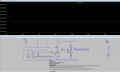
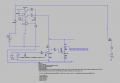
I have a 3VDC 100mA LED landscape as a load. I am using two power supplies: one 12VDC power source from the outlet V2 in simulation, and another 9VDC battery labeled B1 in simulation. The 9VDC battery would be a backup when the 12VDC power source goes off, such as in a storm when lights go out. Below is my circuit. I have a linear voltage regulator that converts 12.5VDC or 9VDC to a constant output, which feeds the LED. I also have V1 and B2, which are essentially solar panel models; they provide a voltage and current source modeled after one of the landscape lights' solar panels and act as a signal to an on/off switch for daylight/nighttime in this circuit, controlling transistors Q1 and Q2.

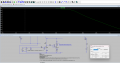
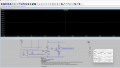
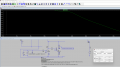
At a temperature of 38C everything is fine. I get a voltage drop between points labeled VJ and VC2 to be 3VDC from both 12.5VDC and 9VDC. However, when I change the temperature to -15 °C (winter time here), then the voltage goes well above 3VDC and the current above 100mA, causing damage to the LED. The linear voltage regulator adds 0.1VDC during cold temperatures, causing this extra 0.1VDC. What can be done to get a stable 3VDC from a temperature of 38 °C to -15C discrete components only, no ICs, controllers, etc, etc? Also attached is my solar_light_linear_regulation_4.asc.

My circuit:
1763325951017.png


at Temp of 38C outlet:

1763326129566.png

at temp of 38C battery:
1763326179516.png

At temp of -15C outlet:
1763326221197.png

At temp -15C battery:

1763326248402.png
 

Attachments

Ian0

Joined Aug 7, 2020
13,097
I would need some more details of the LED light. Is it meant to be constant-voltage driven at 3VDC, in which case it will limit its own current as necessary, or is it meant to be constant-current driven at 100mA?
 

Thread Starter

hhsting

Joined Apr 25, 2024
395
I would need some more details of the LED light. Is it meant to be constant-voltage driven at 3VDC, in which case it will limit its own current as necessary, or is it meant to be constant-current driven at 100mA?
Its the 3VD. One here:


1763329658654.png
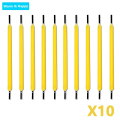
I just found this on AliExpress: $4.90 | 10pcs Edison Bulb LED Filament Lamp Parts 38mm DC3V DC12V LED Bead Incandescent Light Accessories Diode for holiday lighting DIY link;

https://a.aliexpress.com/_mOxpgrn

Here is product sec:


Product Specifications
Voltage : DC2.8-3.0V
Current : 100mA
Length=38mm
Lumen:60-70lm/W
Color : Cold White / Warm White/Red/Green/Blue
 

Ian0

Joined Aug 7, 2020
13,097
It's meant to be constant-current driven at 100mA. The forward voltage could be anywhere between 2.8V and 3.0V and will vary with temperature.
 

Thread Starter

hhsting

Joined Apr 25, 2024
395
It depends on whether your arbitrary rules classify a bandgap reference as an IC or not.
If circuit is made out of transistors, diodes, capacitors, inductor, diodes, resistors i.e discrete components then its not. If its assembled IC you purchase not knowing internal circuit then yea its IC
 

Ian0

Joined Aug 7, 2020
13,097
If circuit is made out of transistors, diodes, capacitors, inductor, diodes, resistors i.e discrete components then its not. If its assembled IC you purchase not knowing internal circuit then yea its IC
What if I do know the internal circuit. I mean, the internal circuit for a bandgap reference isn't exactly a secret.
 

Thread Starter

hhsting

Joined Apr 25, 2024
395
Hello,

You do not want constant voltage to drive the led.
You want constant current to drive the led.
The voltage will change by the temperature.

Bertus
Hi

we would get constant current if voltage is held constant post #1 circuit no? If not then how can one get constant current
 

wayneh

Joined Sep 9, 2010
18,085
If not then how can one get constant current
I'm glad you're asking because, as noted, a constant current circuit is what you need. If you could incorporate an op-amp or even a 3-pin voltage regulator, it's easy to achieve constant current.

Do you care about efficiency? Any linear circuit will waste most of the available power in dropping the voltage, essentially burning the excess as heat. A proper buck regulator could deliver your output at efficiencies over 90%.
 

Thread Starter

hhsting

Joined Apr 25, 2024
395
I'm glad you're asking because, as noted, a constant current circuit is what you need. If you could incorporate an op-amp or even a 3-pin voltage regulator, it's easy to achieve constant current.

Do you care about efficiency? Any linear circuit will waste most of the available power in dropping the voltage, essentially burning the excess as heat. A proper buck regulator could deliver your output at efficiencies over 90%.
Buck converter are not bound by temperature changes wither and they might do the same 0.1V drop as ambient temp changes.
 

Danko

Joined Nov 22, 2017
2,136
If circuit is made out of transistors, diodes, capacitors, inductor, diodes, resistors i.e discrete components then its not. If its assembled IC you purchase not knowing internal circuit then yea its IC
Transistor contains controlled charges generator and charges accelerator,
which are assembled together, and you do not know it's internal circuit.
So, according your definition, you must not use transistors!

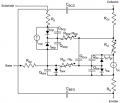
By the way, below is internal circuit of transistor:
1763342534048.png
https://web.engr.oregonstate.edu/~moon/ece323/hspice98/files/chapter_17.pdf
 

Thread Starter

hhsting

Joined Apr 25, 2024
395
Transistor contains controlled charges generator and charges accelerator,
which are assembled together, and you do not know it's internal circuit.
So, according your definition, you must not use transistors!

By the way, below is internal circuit of transistor:
View attachment 358990
https://web.engr.oregonstate.edu/~moon/ece323/hspice98/files/chapter_17.pdf
Thanks for response but Discrete component only no ICs, no microcontroller. No transistor would not be ICs. Its discrete components. I used it in my circuit in LTSpice. Anyways seems like no one is able to answer my question

1763344774867.png
 

WBahn

Joined Mar 31, 2012
32,702
Hi

we would get constant current if voltage is held constant post #1 circuit no? If not then how can one get constant current
Getting constant voltage will NOT give you constant current -- and vice-versa.

Think of your LED as a resistor whose resistance changes quite a bit with temperature. If you apply a constant 3 V across it and the change the temperature, the current will change considerably, even though the voltage is constant. Similarly, if you drive a constant 100 mA through it and change the temperature, the voltage across it will change. You can't fix both voltage and current at the same time -- you pick one, the LED determines the other for the conditions present at that moment.

It has been pointed out several times that the LED you are using appears to be intended for constant current operation, but you keep insisting on wanting to hold the voltage across it constant, so we can't tell what it is you are trying to accomplish. Do you need a circuit that adjusts the voltage so as to maintain a constant current through the LED as the temperature changes? Or do you need a circuit that imposes a constant voltage across the circuit, even though that will result in the current changing considerably as the temperature changes?

What is it that you actually NEED to accomplish? Don't talk about HOW you think you want to go about it, first clearly describe what it NEEDS to do.

This is the gist that I got from your first post:

You have an LED that nominally requires 100 mA at 3 V to operate.
You want it to turn on at night and off during the day based on the amount of ambient light.
You want it to run from a nominal 12 VDC supply but switch automatically to a 9 VDC battery backup.

There are certainly some devils lurking in the details that will need to be considered, but does this sound like a reasonable high-level description of what you need to accomplish? In other words, if someone gave you a black box with a pair of terminals for your 12 VDC input, a pair of terminals for your 9 VDC input, and a pair of terminals for your LED, and it behaved as above, would that satisfy you needs (assuming you put the box in a place where it is exposed to the ambient light)?
 

Ian0

Joined Aug 7, 2020
13,097
Hi

we would get constant current if voltage is held constant post #1 circuit no? If not then how can one get constant current
No. That's why it says Vf=2.8V to 3V for I=100mA in the data.
It means that when I=100mA, Vf could be anywhere from 2.8V to 3V.
If you fix V at 3V, and it is a devices with Vf=2.8V then you are going to get far too much current and damage it.
On the other hand, if you fix V at 2.8V and it is a devices with Vf=3V, you might not even get enough current to light it up.
GaN LEDs have a vary large variation of forward voltages.

If you had any sense, you would drive it with a constant-current LED driver IC, and you would get an efficiency of >90%. But you could just connect it to the supply with a 91Ω resistor. You would get 101mA for a 2.8V device, or 99mA for a 3V device. On a 9V supply the current would reduce to 67mA, but if you weren't watching it when it changed, you would never know. Unfortunately the efficiency would be around 30% and your resistor would take twice as much power as the LED.
 
Last edited:

WBahn

Joined Mar 31, 2012
32,702
No. That's why it says Vf=2.8V to 3V for I=100mA in the data.
It means that when I=100mA, Vf could be anywhere from 2.8V to 3V.
And... that's almost certainly just the range at one temperature, probably 25°C.

If you had any sense, you would drive it with a constant-current LED driver IC, and you would get an efficiency of >90%. But you could just connect it to the supply with a 91Ω resistor. You would get 101mA for a 2.8V device, or 99mA for a 3V device. On a 9V supply the current would reduce to 67mA, but if you weren't watching it when it changed, you would never know. Unfortunately the efficiency would be around 30% and your resistor would take twice as much power as the LED.
If that change is unacceptable, then another alternative is to use some diodes to drop the 12 V down to close to 9 V.

Let's assume that the 12 V supply might be between 11.5 V and 12.5 V. A 1N4001 diode has a typical Vf of about 750 mV at 100 mA, so four series diodes drops about 3 V Now put a 5th on series and then put one in series with the 9 V source and connect their cathodes together and you have a nominally 8.25 V source. If the LED drops 3 V and you have a transistor switch that drops another 0.25 V when saturated, you then have to drop the remaining 5 V across the resistor, so a 51 Ω resistor should do nicely. A little bit of calculation and/simulation using decent device models can confirm whether or not this is the right number of series voltage-dropping diodes to use to ensure that the 12 V supply blocks out the 9 V supply if it happens to be on the low side while keeping the LED current from rising too much if the 12 V source is on the high side. The min-max range of the diode forward voltages over temperature shouldn't be too hard to estimate, even by hand.
 

Danko

Joined Nov 22, 2017
2,136
At a temperature of 38C everything is fine. I get a voltage drop between points labeled VJ and VC2 to be 3VDC from both 12.5VDC and 9VDC. However, when I change the temperature to -15 °C (winter time here), then the voltage goes well above 3VDC and the current above 100mA, causing damage to the LED.
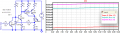
Humans do it so:
1763385274888.png
 

Attachments

Last edited:
Top