AM vs SSB vs DSB-SC vs FM in practical sense

Thread Starter

J-Pi VsV

Joined Jul 2, 2024
6
Not a native English speaker here.
I'm trying to develop some kind of self-guidance in the RF amateur area and so far without much success. I know I'm not as smart as I would want to be but that's not an excuse not to learn RF.

I feel like I'm constantly hitting the wall right from the very start and cannot get over even the simple terms in RF and see where to go next. I'm stuck.
I got literally a hundred of RF books of all kinds, ranging from the simplest "Here is an RF circuit, just solder it" up to highly sophisticated MW engineering science which is of course of no use for me. ARRL books of all kinds, etc., you name it.
Joe Carr's books seem to be very beginner friendly while Wes Hayward's ones are more advanced but I still cannot get a single book that would offer me some kind of a comprehensive guidance on how to develop one's RF knowledge in a consistent, from the ground up manner.

For instance, I more or less can understand the basic science behind all major types of the analog modulation (AM, SSB, DSB-SC and FM; well, even PM to make the angle type complete) but what I cannot really see in the books, expressed in a clear and unambiguous manner is what types of modulation are used where.
For instance, in the HAM Radio circles what modulation types are used and when/where?

I would like to get a single beginner friendly book that would guide me along through such fundamental questions but I can't find it so I am rushing around from one book to another trying to see a clear picture and I go round in circles without any success.

I know enough about digital electronics and that's really a piece of cake compared to RF even at the simple level of understanding.
Once again - I see there is a big gap in between those "Do it QRP projects" books and even modestly advanced material such as for instance the "Solid State Radio Engineering" by H.Krauss et.al (forget about Pozar etc.) and that gap is in the "comprehensive consistent practical guidance" if you will.
 

Papabravo

Joined Feb 24, 2006
22,058
As a little side project, you should investigate a bit of trigonometry. This should be within the capability of a high school senior, and it is the following:

What is the product of two sine waves of different frequencies with the same phase and amplitude. In other words:

\( \text{What is: }\;\;\;\;sin(\omega_1t)sin(\omega_2t)\\\text{with }\omega_1>>\omega_2 \)

If you are unable to derive this result you can look it up in a table of identities. It will give you insight!
 
Last edited:

ronsimpson

Joined Oct 7, 2019
4,646
At the university I had to lecture to the broadcast students on AM verses FM. They had read the book, and none understood it.
I used a code key and a light bulb to send Morse Code. The light was on or off.
Then I moved to using a red/blue light bulb. The light was red or blue, always on.
Unfortunately, most did not get it.
Using an oscilloscope only confused them.
Now they read the news to you, and they still don't get it. (the news and AM/FM)
Actually, they are probably retired by now and think they understand everything.
 

crutschow

Joined Mar 14, 2008
38,316
what types of modulation are used where.
Here's a short summary of what I know about commonly used commercial modulation techniques:

Standard AM and the SSB variants are all types of amplitude modulation.
Their main limitation is that they are sensitive to signal amplitude (no surprise their) so impulse interference is readily heard, such a EMP from lightening, IC ignition circuits, switching power supplies, or light dimmers.
Standard AM is used because it is very simple to amplitude modulate the RF carrier.
SSB is used to minimize bandwidth so is commonly used by HAM operators, even though the modulation circuit is somewhat complex, but can be difficult to demodulate without distortion, since the carrier frequency has to be exactly regenerated in the receiver for proper demodulation.
DSB-SC is easier to modulate than SSB, but requires double the BW of SSB and has no significant advantage otherwise that I am aware of.

FM is only sensitive to modulation changes in the carrier frequency and thus quite insensitive to amplitude noise in the carrier, so is used for high-fidelity broadcast of music, but requires a much larger bandwidth (commercially about a factor of five to ten higher) than AM to achieve this.

There are many forms of digital modulation used, such as simple ones for garage door control, and complex ones for things like remote drone control.
I have little knowledge of those.

Complex digital modulation schemes, such as used for HDTV signals, are the best way known to transmit HD digital television information in a low RF bandwidth with minimal data error,
Examples are 8 Vestigial Sideband modulation (8VSB) used in the US, and OFDM (orthogonal frequency division multiplexing) modulation used in some other countries.
How they work is beyond a simple explanation by me.
 

DickCappels

Joined Aug 21, 2008
10,661
You can find out a lot about which modes are used in various radio services by getting a copy of the radio regulations for the country in which you are interested.

As for Ham radio, some countries allow experimental modes -some that might not even have proper names yet!
 

Chris Watts

Joined Mar 5, 2020
23
For amateur radio analogue voice communication it depends on the frequency band and if the user is trying to achieve the best range.
For the HF bands, 1.8MHz to 30MHz, SSB is the dominant mode with a few using AM for local chat. For VHF and UHF, and even microwave, SSB is still used to get maximum range. narrow band FM is more popular though, particularly for local chat. Digital voice is becoming popular using PSK modulation schemes.
A lot of amateur activity now uses pre-formatted text messages designed to work with very low signal to noise ratios. These are mostly based on multi level FSK at very low data rates with lots of FEC (forward error correction).
There is still Morse code activity particularly on the HF bands.
 

MisterBill2

Joined Jan 23, 2018
27,173
@JP VSV: certainly there is a lot to learn and then a whole lot more to build understanding. But it all builds on itself as you learn.
One thing to understand about all of the different modulation methods is that each kind has some applications for which it is the best, or just the easiest, method. And just like tools, each works best for some different application.
I am a licensed HAM operator and we do use different forms of modulation for different applications. A great deal of VHF communication is done with narrow bandwidth FM because transmitters for VHF FM are easier to keep operating properly. Those folks using the HF portion, 1 MHZ to 30MHZ tend to use single side-band transmission because it uses a minimum bandwidth and those frequencies can allow communication over very great distances. SSB IS a form of Amplitude Modulation that provides for much more efficient use of available bandwidth. The various digital modes are used because many of them can use much less bandwidth for very reliable communications using much less power.
 

MrChips

Joined Oct 2, 2009
34,628
We are accustomed to viewing electrical signals in the time domain. Sometimes it is very useful to study signals in the frequency domain. Both exist together. You cannot have one without the other. They complement each other.
An understanding of frequency spectrum will help.

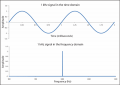
Let us begin with CW or continuous wave.

1720304452718.png

There is such a thing as negative frequency. For the purpose of this discussion, I will shown only positive frequencies.
The picture above shows a sine wave at 1 kHz. We could just as well show the same diagram for a 1 MHz RF wave.

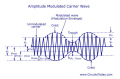
Next comes AM or amplitude modulation.
As the name implies, we modulate the amplitude of the sine wave. Let us examine the mathematics when we multiply one sine wave with another.

1720305627703.png

Our carrier wave is y = A sin(ωt) or A sin(2πft)
where ω = 2πfc
fc = carrier frequency in Hz

Now we replace the amplitude with the modulation signal A cos(xt)
The AM wave becomes,
y = A cos(xt) sin(2πft) = A/2 [ sin(2πft - xt) + sin(2πft + xt) ]

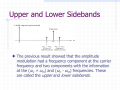
What we witness in the mathematics is that the single RF signal becomes two signals, having the sum and difference frequencies. In real audio transmission, the modulation signal is an audio signal at many different frequencies, for example 100-5000 Hz for voice. Thus the AM signal is spread over two ranges of frequencies called the lower sideband and upper sideband.

1720305655852.png

The lower sideband is a mirror image of the upper sideband. They both contain the same information. In fact, all the information is contained in either sideband. There is no AF information in the carrier signal.

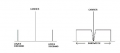
The frequency space required to transmit the AM signal must be wide enough to transmit both the LSB (lower sideband) and the USB (upper sideband). This is called the frequency bandwidth.

1720307047216.png

(Note that the bandwidth required to transmit CW is very small compared to any other modulation scheme. Once you modulate the carrier, even in keyed morse code transmission, the bandwidth of the signal will become larger. You would need a bandwidth of 10 kHz in order to transmit a carrier modulated with 0-5 kHz audio.)

The transmitter is able to conserve both transmitter power and bandwidth by transmitting only one sideband and not the other sideband or carrier. This is called single sideband transmission or SSB.

At the radio frequency receiver, the receivef SSB signal will unintelligible. The radio has to insert the carrier frequency in order to recover the original AF signal. This is done with a BFO or beat frequency oscillator.

(Similarly, the received CW signal from a morse code transmission is not audible. The BFO is used to create an AF signal.)

Now let's see if you can figure out what DSB-SC means.
 

MisterBill2

Joined Jan 23, 2018
27,173
After examining the filter method of generating SSB, I have been wondering if FM SSB is possible, and I have been trying to think of a way to receive it. So far nobody has seemed interested in further analysis. Presently it seems to me that it would require a PLL detector scheme, as a regular frequency discriminator would not work, I don't think.
 
If the modulation index is small for NBFM it starts to look like AM with the carrier phase shifted 90 deg. Removing the carrier and one sideband you end up back with SSB that can be demodulated in the normal way. As soon as the modulation index is increased though I can see you have something very difficult to recover.
 

MisterBill2

Joined Jan 23, 2018
27,173
If the modulation index is small for NBFM it starts to look like AM with the carrier phase shifted 90 deg. Removing the carrier and one sideband you end up back with SSB that can be demodulated in the normal way. As soon as the modulation index is increased though I can see you have something very difficult to recover.
That is very interesting indeed. So now the question is "how small" for the modulation index?" and, much more important would be the issue of any need for linear amplification on the transmit side. That is because linear POWER amplifiers are a lot less efficient than the typical class "C" power amps. So there would be a very big benefit if it actually worked.
So far I have not gone thru the detailed math, just speculation on the "What if" side of the concept.
 
It all depends on how big a no-ideality you can put up with. My guess would be that for M < 0.05 you would not see the difference. At this level the carrier is by far the biggest signal so the signal approximates to constant envelope so you can use a non-linear PA. Of course as nearly all the power is in the carrier this is a very inefficient way of conveying information, even with an efficient PA. If you filter out the carrier then the signal is no longer constant envelope and so you need a linear PA.
 

MisterBill2

Joined Jan 23, 2018
27,173
Present amateur radio FM uses a modulation index of around one. So evidently my concept was only suitable to briefly discuss.
BUT if the carrier were to remain and the frequency only deviate in one direction, then the bandwidth would be reduced. The serious challenge would be to convert the signal back into useful audio at the receiver end. So it seems that a PLL frequency detector could work very well while a ratio detector may not hear anything at all. So now there is something to consider, and possibly even do some math work on.
 
Last edited:

MisterBill2

Joined Jan 23, 2018
27,173
The great benefit of some of the digital schemes is that some of them can work well with the information signal below the noise floor. THAT is totally fascinating as I see it. On top of demanding much less transmit power, it is certainly hard to intercept a signal that one can not see or hear, or even detect. Privacy at last??
 
The digital modes working below the noise floor use spread spectrum. To receive these you need to know what the spreading scheme is. The choices are frequency hopping or direct sequence. Then you need to know the spreading sequence and timing. The information transfer rate is low compared to the bandwidth being used.
 

Ramussons

Joined May 3, 2013
1,567
Not a native English speaker here.
I'm trying to develop some kind of self-guidance in the RF amateur area and so far without much success. I know I'm not as smart as I would want to be but that's not an excuse not to learn RF.

I feel like I'm constantly hitting the wall right from the very start and cannot get over even the simple terms in RF and see where to go next. I'm stuck.
I got literally a hundred of RF books of all kinds, ranging from the simplest "Here is an RF circuit, just solder it" up to highly sophisticated MW engineering science which is of course of no use for me. ARRL books of all kinds, etc., you name it.
Joe Carr's books seem to be very beginner friendly while Wes Hayward's ones are more advanced but I still cannot get a single book that would offer me some kind of a comprehensive guidance on how to develop one's RF knowledge in a consistent, from the ground up manner.

For instance, I more or less can understand the basic science behind all major types of the analog modulation (AM, SSB, DSB-SC and FM; well, even PM to make the angle type complete) but what I cannot really see in the books, expressed in a clear and unambiguous manner is what types of modulation are used where.
For instance, in the HAM Radio circles what modulation types are used and when/where?

I would like to get a single beginner friendly book that would guide me along through such fundamental questions but I can't find it so I am rushing around from one book to another trying to see a clear picture and I go round in circles without any success.

I know enough about digital electronics and that's really a piece of cake compared to RF even at the simple level of understanding.
Once again - I see there is a big gap in between those "Do it QRP projects" books and even modestly advanced material such as for instance the "Solid State Radio Engineering" by H.Krauss et.al (forget about Pozar etc.) and that gap is in the "comprehensive consistent practical guidance" if you will.
For instance, in the HAM Radio circles what modulation types are used and when/where?
Post #4 gives a good answer.
 
Top