Beginner Conversation on Practical Measurments, Ohms Law and Reactance

Thread Starter

YukonMan

Joined Mar 29, 2025
8
Good Afternoon, New to this site and New to this forum and New to the world of electronics.
In teaching myself and studying myself, I have been doing small experiments with capacitive reactance, resistance and ohms law, in efforts to understand the practical results, and math formulas compared to real world results. Some things I have found is different multimeters showing different results, never can I get the same results practically as the math. I feel comfortable enough to say that nothing in the real world would ever be perfect and there would always be some tolerance off error. But my hope is to find some kind words by folks with experience on why and how professionals deal with said errors or allowances if you will. As well in the mean time Im hoping to find a great place to post questions about my silly little 'Science' experiments- not to have someone solve my problems but to help teach me how to solve my own and what I maybe missing thats causing me to get poor results.
If anyone has any suggestions where I could jump in to post some of my questions, pictures of my experiments and get some great kind feedback im all ears!
Currently my questions are as briefly mentioned are regarding capacitive reactance, resistance and determining current from said circuit. There is NO project, no test to try and get marks on, just a older person trying to learn what I should have 45 years ago so I ddint have to drive a truck.
Thanks for your time, and again I pre apologize if im posting in the incorrect place, Im very new to the page
 

Thread Starter

YukonMan

Joined Mar 29, 2025
8
This is the place, for sure.
Great thank you, Again , just new, have been doing a lot of reading, on this site as well- I surely understand I have lots to read study and learn, but as i saw on AAC sometimes experiments are fun. Hopefully I dont break any rules and just have some friendly dialogue
 

nsaspook

Joined Aug 27, 2009
16,274
Great thank you, Again , just new, have been doing a lot of reading, on this site as well- I surely understand I have lots to read study and learn, but as i saw on AAC sometimes experiments are fun. Hopefully I dont break any rules and just have some friendly dialogue
Experiments are fun but they are usually done to confirm if a theory is valid (a valid theory at least makes correct predictions of you can should measure) or not. To have a valid theory you first need to understand the existing science, technology, methods and terminology. Without that you can't design a proper experiment to validate a theory or to gain knowledge and insight from the experiment. What you really need now are boring lessons to test what you know and to gain knowledge and insight from.
 

Thread Starter

YukonMan

Joined Mar 29, 2025
8
That or describe the conditions clearly.
Thank you for being Kind.
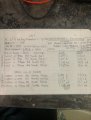
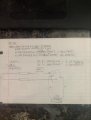
Here is my testing results from this morning. I hope they are legible enough to see what I am trying to figure out.
I am using two multimeters to compare results at the same time trying to just practically do the math for Ohms law and Kirchoffs to see if all the currents and voltages add up.
An original reply to this thread sent me some great links for reading and I will definitely follow thru with them and the 'boring' exercise's as he said
In the meantime during this experiment one thing i have notices is the Fluke 87v as opposed to the klein mm440 have substantial differences in the mA result. I checked all the fuses in both to be sure that wasn't an issue, I assume the older klein maybe faulty.
I have tried to insert them into different positions in the circuit- just to see what the result would be, but as far as perspective on my notes that maybe hard to see what i have done. I hope it is not.
I also notices that no matter how i math it i seem to get a voltage shortfall so to speak. I haven't learned enough yet to determine why... but i will. .
Im going to assume it has to do with the rectification but I dont even want to pretend i have any kind of knowledge as to why.
One thing that would be great to get an answer to is the differences in the mA and voltage readings, in practical use do the experts consider that 'negligible' or what can I do as a student, to try and get more accuracy.
I wonder about these things as in all the online courses, videos and reading I have done, everything when they do the math the usually come out accurate being off even by a few numbers makes me question whether I am grasping that concept as a beginner.
Thanks for the chat look forward to your input.


multi1.jpegmuliti2.jpg
 

MisterBill2

Joined Jan 23, 2018
27,330
Welcome to AAC, where there are hundreds of total years of experience lurking everywhere, as well as a couple of clueless dudes.
One reality to be aware of is that the published (Meaning they freely admit that it is true) tolerance on NEW common resistors is plus or minus 10%. And probably never closer that 5% off. In addition, the accuracy of the expensive AND GOOD meters means those measurements may be off by 1%, and for those $20 meters , they are probably always off by at least 5%.
And your math may be exactly correct, but the real world seldom is.
 

MaxHeadRoom

Joined Jul 18, 2013
30,598
Currently my questions are as briefly mentioned are regarding capacitive reactance, resistance and determining current from said circuit. There is NO project, no test to try and get marks on, just a older person trying to learn what I should have 45 years ago so I ddint have to drive a truck.
Another thing to realize is that when putting together even simple circuits at home making some typical experiments , the instruments you are using are often made for simple basic measurements, when delving in to even these it can help to see pic of what is going on, IOW, a small 'scope' can be an advantage here , there are some cheap versions avialable to the DIY'er
e.g. A couple as an example double beam portable

1743294921950.png
1743295110381.png
 

WBahn

Joined Mar 31, 2012
32,768
Thank you for being Kind.
Here is my testing results from this morning. I hope they are legible enough to see what I am trying to figure out.
I am using two multimeters to compare results at the same time trying to just practically do the math for Ohms law and Kirchoffs to see if all the currents and voltages add up.
An original reply to this thread sent me some great links for reading and I will definitely follow thru with them and the 'boring' exercise's as he said
In the meantime during this experiment one thing i have notices is the Fluke 87v as opposed to the klein mm440 have substantial differences in the mA result. I checked all the fuses in both to be sure that wasn't an issue, I assume the older klein maybe faulty.
I have tried to insert them into different positions in the circuit- just to see what the result would be, but as far as perspective on my notes that maybe hard to see what i have done. I hope it is not.
I also notices that no matter how i math it i seem to get a voltage shortfall so to speak. I haven't learned enough yet to determine why... but i will. .
Im going to assume it has to do with the rectification but I dont even want to pretend i have any kind of knowledge as to why.
One thing that would be great to get an answer to is the differences in the mA and voltage readings, in practical use do the experts consider that 'negligible' or what can I do as a student, to try and get more accuracy.
I wonder about these things as in all the online courses, videos and reading I have done, everything when they do the math the usually come out accurate being off even by a few numbers makes me question whether I am grasping that concept as a beginner.
Thanks for the chat look forward to your input.


View attachment 345636View attachment 345637
When you want to discuss why the results of your experiments don't seem to agree with what you expect to see, it is extremely valuable for you to provide enough information so that someone else can replicate your work. You schematic has two boxes in it that are just boxes. What are they? Resistors? Fuses? What?

What is the voltage and frequency of your power source?

You do some calculations involving a capacitor, but where is this capacitor?

Don't make people guess.

I can't find any information on a Klein MM440. Lot's of stuff about the MM400. Are you sure you typed the model number correctly?

You also need to tell us how you made the measurements in more detail. Specifically, what where the settings on the meters? There is a huge difference between AC and DC ranges. Also, which range it is on gives us an idea of the meter's tolerance.

One thing to note is that the signal in your load resistor is non-sinusoidal. This can have significant affects on the displayed results, particularly if the meter being used is not true-RMS sensing. As near as I can tell, the MM400 is not true-RMS, though the MM-420 is. Have no idea about the MM440.

Also, the Klein MM400's AC ranges are spec'ed for signals between 50 Hz and 60 Hz. But your rectifier output has its fundamental frequency at twice your input frequency, with significant harmonics above that.

Most handheld DMMs are going to have accuracies in the 1% to 2% range, plus a few (usually three to five) least significant digits.

Similarly, your components are going to have a tolerance, which may be 1% for resistors but more likely 5% or even higher, depending on the type and how old they are (at one point, resistors typically had 20% tolerances, but manufacturing quality control had gotten a lot better). Capacitors still tend to have pretty large tolerances, with 10% and 20% being pretty common.

Another thing to be aware of is that any time you make a measurement, you affect the circuit being measured. Often, the effect is negligible, but sometimes it isn't. Modern digital voltmeters usually have relatively high input resistance (10 MΩ or more is typical), so these effects can usually be ignored unless your circuit involves resistances greater than about 1 MΩ, although even resistances down in the 100 kΩ range will be disturbed enough to be noticeable with typical meters. Current measurements, on the other hand, can often affect circuit behavior, even with pretty mundane circuits, to the point where it really needs to be taken into account.

A couple of simple tests to get a handle for the differences between your two meters is to record what they read when BOTH are reading the voltage across the same two points. You don't know what the actual voltage is when the meters are not in place, but you know that, when they are, they are measuring the same voltage at the same time. Similarly, record what they read when BOTH are put in series to read the current in a branch. Again, you may not know what the correct value should be, but at least you know that both meters are measuring the same current at the same time.
 

sparky 1

Joined Nov 3, 2018
1,218
When the leads of the Fluke 87 are shorted together there should be a button named REL
that should zero out the meter first. The manual will show the accuracy.

With AC accuracy is derated as the frequency increases which is normal.
For capacitive and inductive reactance, the capacitor function will give you a capacitor value.
The frequency measurement another value. Knowing those values and using the right equation
you can solve most problems. Unlike DC using a frequency generator helps in finding an unknown.
An adjustable astable 555 timer and the frequency counter will work.

Oscillators that use simple RC timing frequency less than 60Hz and Voltage less than 400mV AC
have the highest resolution when doing analysis using a multimeter.
 
Last edited:

dl324

Joined Mar 30, 2015
18,282
Im going to assume it has to do with the rectification but I dont even want to pretend i have any kind of knowledge as to why.
The first thing you need to do is stop doing experiments with line voltage. Use a transformer.

A schematic for the first experiment would be helpful.

Is it using a bridge rectifier? The voltage at the rectifier seems low in any case.

How is the resistor wired with respect to the capacitor?
 

MrChips

Joined Oct 2, 2009
34,701
Welcome to the world of science and electronics. I have some advice for you.

1) Science is about measurements, discoveries and formulating theories. In all scientific fields, there are fundamental laws discovered and trusted over the centuries. When you conduct an experiment yourself, you will encounter discrepancies in your measurements and results. You conclude that either the law is flawed or doesn't apply in this situation. Or it could be that your measuring methodology is flawed.

If the law is flawed you must be onto something new that millions of other scientists before you missed. Instead, I suggest that you put faith in the law first. Instead, you need to examine your measurement method.

Firstly, recognize that all components and measuring tools have tolerances. What is the expected deviation of the measurement? Is it 10, 5, 1, 0.1 percent? No two testmeters are the same. Know the expected error in each instrument. Know when a 10% deviation is acceptable and when a 0.1% deviation is not. Learn that two or three significant figures is plenty good enough for typical circuit measurements, in other words, even 5% is acceptable in most cases. If my 1.5 V battery reads 1.6 V, I am not going lose sleep over it.

Secondly, understand the observer effect. One cannot take a measurement without disturbing what one is measuring. Every voltmeter and ammeter has resistance. When you use a meter to take a reading you are disturbing the circuit and hence will observe a reading that differs from the true value. The trick here is to know when the reading can be trusted.

How are you connecting the meter to the component or circuit? Are your fingers in contact with the testmeter probes? Know that your body is a conductor and can affect the measurement.

A good carpenter doesn't blame his/her tools. Know when to expect a deviation from expected results.

2) You are asking a question about Ohm's Law and reactance. Note that resistance and reactance have the same units, ohm. However, resistance and reactance are not the same thing. You cannot measure reactance with an ohmmeter, for example. The theory behind resistor circuits and circuits with reactance are very different. Learn one at a time. Stick with DC circuits first. AC circuits come with their own world of idiosyncrasies.

On your learning journey, delve into resistance and reactance separately. Get a solid knowledge and experience working with Ohm's Law first. Learn when voltmeters and ammeters can be trusted and when they are no longer valid. Learn under what conditions Ohm's Law does not apply.

3) The language of electronics is the circuit schematics. Show your circuit in a drawing. Label all the components so that the reader can follow your experiment.

4) Don't be ashamed or afraid to present your experiments and results here on AAC. There are many members here with a lifetime of knowledge and experience who are willing to guide you in this wonderful and rewarding world of electronics.
 

Thread Starter

YukonMan

Joined Mar 29, 2025
8
Welcome to the world of science and electronics. I have some advice for you.

1) Science is about measurements, discoveries and formulating theories. In all scientific fields, there are fundamental laws discovered and trusted over the centuries. When you conduct an experiment yourself, you will encounter discrepancies in your measurements and results. You conclude that either the law is flawed or doesn't apply in this situation. Or it could be that your measuring methodology is flawed.

If the law is flawed you must be onto something new that millions of other scientists before you missed. Instead, I suggest that you put faith in the law first. Instead, you need to examine your measurement method.

Firstly, recognize that all components and measuring tools have tolerances. What is the expected deviation of the measurement? Is it 10, 5, 1, 0.1 percent? No two testmeters are the same. Know the expected error in each instrument. Know when a 10% deviation is acceptable and when a 0.1% deviation is not. Learn that two or three significant figures is plenty good enough for typical circuit measurements, in other words, even 5% is acceptable in most cases. If my 1.5 V battery reads 1.6 V, I am not going lose sleep over it.

Secondly, understand the observer effect. One cannot take a measurement without disturbing what one is measuring. Every voltmeter and ammeter has resistance. When you use a meter to take a reading you are disturbing the circuit and hence will observe a reading that differs from the true value. The trick here is to know when the reading can be trusted.

How are you connecting the meter to the component or circuit? Are your fingers in contact with the testmeter probes? Know that your body is a conductor and can affect the measurement.

A good carpenter doesn't blame his/her tools. Know when to expect a deviation from expected results.

2) You are asking a question about Ohm's Law and reactance. Note that resistance and reactance have the same units, ohm. However, resistance and reactance are not the same thing. You cannot measure reactance with an ohmmeter, for example. The theory behind resistor circuits and circuits with reactance are very different. Learn one at a time. Stick with DC circuits first. AC circuits come with their own world of idiosyncrasies.

On your learning journey, delve into resistance and reactance separately. Get a solid knowledge and experience working with Ohm's Law first. Learn when voltmeters and ammeters can be trusted and when they are no longer valid. Learn under what conditions Ohm's Law does not apply.

3) The language of electronics is the circuit schematics. Show your circuit in a drawing. Label all the components so that the reader can follow your experiment.

4) Don't be ashamed or afraid to present your experiments and results here on AAC. There are many members here with a lifetime of knowledge and experience who are willing to guide you in this wonderful and rewarding world of electronics.
Great! In 24 hours I have received lots of replies and all seem to have great advice and points. My favourite is to read and study more but with that I must add, that is what I intend doing and appreciate the great links. Another poster corrected something and yes my klein meter is a mm400 not 440, My eyes were a little blurry at the time of writing, its the old diabetes kicking in. No excuse but a mistake.
My methods of learning involve reading lots, picking and sorting thru videos of online courses, setting myself at the basics and then looking forward at more complicated things but then reverting back to the basics, going thru the chapters if that makes any sense at all.
The reasons I chose this particular setup to experiment with is it seems to be a small portion of some pretty common circuitry I see in a lot of devices and I had a few parts from some old stoves and such I could tinker with.
Another mistake I made is 'perspective' if you will, my notes I could understand although I have been familiarizing myself with diagrams as i study, My notes I posted yesterday were my bench studys, I should not expect anyone to be able to read my point of reference.
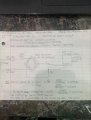
Today to add to the conversation Id like to post a better diagram of what I did- disregarding my previous multimeter tests and pose a couple of questions- again not to GET ANSWERS for a test or to build something, but to help me get a practical view into a loop on my bench to help me be more aware as i am reading and going thru the math and studys.
1. Any advice on how to do a safe semi reliable test between the two multimeters and the current specifically mA settings to confirm if my Klein meter is faulty. Klein mm400 and fluke 87V Approx age 4 years.
2. I have included my diagram of my setup I am experimenting with and some measurements taken with the fluke along with my calculations. I think it would be interesting to see what results someone who clearly understands this comes up with and or tells me why the result would be bogus. or what is missing to come up with an accurate result I specifically did not put a capacitor in as i wanted to see results as odd as those may be.
3. Again emphasising I have a lot of reading to do, does anyone feel I am even remotely on the right track with my calculations and how I am determining my results. I do have a lot more reading and studying to do but even to have a tidbit of that correct would be a good start.
Want to wish all who replied a great day, and thanks for all the kind advice. Gonna go back to chapter 1 today but am definitely going to leave my experiment open and beat that horse to death in the meantime.
 

Attachments

nsaspook

Joined Aug 27, 2009
16,274
I would trust the Fluke 87V and use it as my standard. I once ran the calibration dept. for a large technical company with ten's of fluke 87V of various ages and models. In the ten years of yearly calibrations I never saw one come back from ISO level calibration, out of calibration. The most common problem was weak or dead batteries. No experience with the Klein meter.

https://www.techtownforum.com/knowl...ultimeters-which-one-better-meets-your-needs/

As was said before, you can't just add resistance and reactive for a total impedance.

Resistance = R
Inductive reactance = jXL
Capacitive reactance = −jXC
Impedance = Z

Z =R+j(XL−XC)Z=R+j(XL−XC) , which is a complex quantity.

1743359257405.png
 

MrChips

Joined Oct 2, 2009
34,701
Reading is good, but like learning most things, practice beats reading every time. You cannot learn to swim, ride a bike, play a musical instrument, cook, speak a foreign language, etc., etc., by just reading. You learn by doing. Don't be afraid to make mistakes. Look at every mistake you make as an opportunity to learn and get better at whatever you are trying to master.

Stop doing what you are doing right now with AC circuits. It just might kill you.

If you want to compare two multimeters, your first step is to get the specifications of each meter.
Get some batteries and work with DC circuits for starters. Measure the no-load voltage of the battery using the two multimeters set to measure DC voltage.

Take one step at a time.

If you have some 1MΩ and 10MΩ resistors on hand, we can do some real world experiments.
 

Thread Starter

YukonMan

Joined Mar 29, 2025
8
I would trust the Fluke 87V and use it as my standard. I once ran the calibration dept. for a large technical company with ten's of fluke 87V of various ages and models. In the ten years of yearly calibrations I never saw one come back from ISO level calibration, out of calibration. The most common problem was weak or dead batteries. No experience with the Klein meter.

https://www.techtownforum.com/knowl...ultimeters-which-one-better-meets-your-needs/

As was said before, you can't just add resistance and reactive for a total impedance.

Resistance = R
Inductive reactance = jXL
Capacitive reactance = −jXC
Impedance = Z

Z =R+j(XL−XC)Z=R+j(XL−XC) , which is a complex quantity.

View attachment 345677
this helps....alot. Lots to ponder here.

without diving too deep into it and some quick math, would this put my (res/reactance) at around 4081ish ohms giving me my 27 ma im reading on my fluke. Fun stuff
 
Top