AM radio

Thread Starter

Mellisa_K

Joined Apr 2, 2017
391
Did the video answer these questions for you? I didn’t watch it, so I am not sure what it covers.

This lecture by Walter Levin might clear up other questions and give some insight. It’s worth a watch if you would like to go deeper:

Yes thankyou it did answer all the questions. I noted the video you recommended and I will look at that as well, thankyou once again.
 

Thread Starter

Mellisa_K

Joined Apr 2, 2017
391
Take your portable out to where your car is, if your car is picking up 972 well and the portable isn't, get a better portable.

Is there a shop in town that sells radios? If so, tell them your problems and ask them what works well in the area. See if they will let you try out their recommendation.

BTW, when we talk about alignment we mean simply putting the radio on the table and rotating it from NS to EW, all the way around. You should find one direction where your signal disappears (probably when the long axis of your radio 'points' towards the transmitter), so turn it 90 degrees from where the signal disappears.
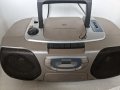
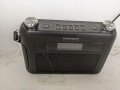
re my three radios. I took pics of each as follows. The first one is a good brand and it has best reception but still not good enough. the second one has terrible reception. the third is pathetic
 

Attachments

Thread Starter

Mellisa_K

Joined Apr 2, 2017
391
re my three radios. I took pics of each as follows. The first one is a good brand and it has best reception but still not good enough. the second one has terrible reception. the third is pathetic
Take your portable out to where your car is, if your car is picking up 972 well and the portable isn't, get a better portable.

Is there a shop in town that sells radios? If so, tell them your problems and ask them what works well in the area. See if they will let you try out their recommendation.

BTW, when we talk about alignment we mean simply putting the radio on the table and rotating it from NS to EW, all the way around. You should find one direction where your signal disappears (probably when the long axis of your radio 'points' towards the transmitter), so turn it 90 degrees from where the signal disappears.
"Take your portable out to where your car is, if your car is picking up 972 well and the portable isn't, get a better portable. "
I did and its still lousy. so the radio is not up to it. However, i will try suggestions regarding antenna loops and mr chips amplifier before i buy another one coz i am poor
 

Thread Starter

Mellisa_K

Joined Apr 2, 2017
391
"Take your portable out to where your car is, if your car is picking up 972 well and the portable isn't, get a better portable. "
I did and its still lousy. so the radio is not up to it. However, i will try suggestions regarding antenna loops and mr chips amplifier before i buy another one coz i am poor
My comment about the car radio and my question was about the technology the car radio manufacturers employ to get the radio to not be sensitive to directional tuning. I said that the car radio operates well, picking up the 972 am frequency well while the car is travelling and stationary. Because the car is continually changing direction and therefore alignment with the broadcasting antenna, there must be something in the technology that overcomes the limitations of "normal" radios. Briefly, what do you suppose that is?
 

sparky 1

Joined Nov 3, 2018
1,218
If you want to improve reception for just one frequency there are many ways to improve performance. The first is antenna and ground, second preamplier with narrow band high Q tank and filters if necessary. You can simply re-broadcast that locally and that station will always be strong on your favorite radio.
 
Last edited:

Tesla23

Joined May 10, 2009
560
re my three radios. I took pics of each as follows. The first one is a good brand and it has best reception but still not good enough. the second one has terrible reception. the third is pathetic
The pics help. What I can't see is the size of the last two, but I suspect that they are much much smaller than the philips.

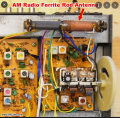
As has been mentioned, the antenna in these is a ferrite rod (also called a loopstick):

1627095842740.png

In a bigger radio it is typically a round rod about 10mm dia and 100mm+ long. In small radios it can be very compact, and a rectangular bar is also common. What really matters for picking up distant stations is the length, and so what used to be called a mantel piece radio with an antenna say 200mm long, gives good performance, compact radios with rods only 50mm or so in length, in general have much poorer sensitivity. The antenna is only part of the equation, it has to be attached to a sensitive radio. If cost is a factor, you might be able to find a second-hand radio with better performance, but as a guide, go for the larger units - they have more chance of having a longer rod, and a known brand perhaps a better chance of having sensitive electronics.
 

Tesla23

Joined May 10, 2009
560
My comment about the car radio and my question was about the technology the car radio manufacturers employ to get the radio to not be sensitive to directional tuning. I said that the car radio operates well, picking up the 972 am frequency well while the car is travelling and stationary. Because the car is continually changing direction and therefore alignment with the broadcasting antenna, there must be something in the technology that overcomes the limitations of "normal" radios. Briefly, what do you suppose that is?
The car antenna is fundamentally different, if it is an old car then it may have a simple telescoping rod on the front fender. Newer models have antennas printed usually on the windscreen (typically, but not always, the rear I think). The rod certainly, and I think the windscreen antennas, respond to the E-field, and the rod is easily seen to be relatively omni-directional, and the windscreen ones are designed to be reasonably so (but I don't know much detail about them).

This does raise another possibility for your problem, now that we know that your radio doesn't work any better out of the house, your portables are responding to the H-field, and your car to the E-field. As far as the distant radio station is concerned this shouldn't matter, but if you had any local interference, there is a possibility that it produced mainly H-fields locally and so would interfere more with your portables. This shouldn't be a possibility unless there was some sort of industry within a few hundred metres of your house.
 

Thread Starter

Mellisa_K

Joined Apr 2, 2017
391
The pics help. What I can't see is the size of the last two, but I suspect that they are much much smaller than the philips.

As has been mentioned, the antenna in these is a ferrite rod (also called a loopstick):

View attachment 244273

In a bigger radio it is typically a round rod about 10mm dia and 100mm+ long. In small radios it can be very compact, and a rectangular bar is also common. What really matters for picking up distant stations is the length, and so what used to be called a mantel piece radio with an antenna say 200mm long, gives good performance, compact radios with rods only 50mm or so in length, in general have much poorer sensitivity. The antenna is only part of the equation, it has to be attached to a sensitive radio. If cost is a factor, you might be able to find a second-hand radio with better performance, but as a guide, go for the larger units - they have more chance of having a longer rod, and a known brand perhaps a better chance of having sensitive electronics.
Yes the last two are small. As youve explained that is a key factor explaining performance.. Thankyou.
Great advice about second hand radios. Thankyou. i am prowler of opp shops. I will look for a ghetto blaster and go from there. I will build the antenna and the antenna amp as well
 

Thread Starter

Mellisa_K

Joined Apr 2, 2017
391
The car antenna is fundamentally different, if it is an old car then it may have a simple telescoping rod on the front fender. Newer models have antennas printed usually on the windscreen (typically, but not always, the rear I think). The rod certainly, and I think the windscreen antennas, respond to the E-field, and the rod is easily seen to be relatively omni-directional, and the windscreen ones are designed to be reasonably so (but I don't know much detail about them).

This does raise another possibility for your problem, now that we know that your radio doesn't work any better out of the house, your portables are responding to the H-field, and your car to the E-field. As far as the distant radio station is concerned this shouldn't matter, but if you had any local interference, there is a possibility that it produced mainly H-fields locally and so would interfere more with your portables. This shouldn't be a possibility unless there was some sort of industry within a few hundred metres of your house.
Incredibly useful information thankyou.

The cas has no telescopic antenna and so has a windscreen print and so is responding to the E field. Got it.

The radios are responding to the H field - got it. No industry nearby but plenty of high ground.
 

Thread Starter

Mellisa_K

Joined Apr 2, 2017
391
The car antenna is fundamentally different, if it is an old car then it may have a simple telescoping rod on the front fender. Newer models have antennas printed usually on the windscreen (typically, but not always, the rear I think). The rod certainly, and I think the windscreen antennas, respond to the E-field, and the rod is easily seen to be relatively omni-directional, and the windscreen ones are designed to be reasonably so (but I don't know much detail about them).

This does raise another possibility for your problem, now that we know that your radio doesn't work any better out of the house, your portables are responding to the H-field, and your car to the E-field. As far as the distant radio station is concerned this shouldn't matter, but if you had any local interference, there is a possibility that it produced mainly H-fields locally and so would interfere more with your portables. This shouldn't be a possibility unless there was some sort of industry within a few hundred metres of your house.
I am may have missed this in the videos i have looked at. Can I make the portable radios respond to the E field? Something in the antenna build maybe?
 

Thread Starter

Mellisa_K

Joined Apr 2, 2017
391
If you want to improve reception for just one frequency there are many ways to improve performance. The first is antenna and ground, second preamplier with narrow band high Q tank and filters if necessary. You can simply re-broadcast that locally and that station will always strong on your favorite radio.
" The first is antenna and ground, " Got it thankyou.

"second preamplier with narrow band high Q tank and filters if necessary."
-- @MrChips offering here: https://forum.allaboutcircuits.com/threads/am-radio.180713/post-1651655 is an example of a preamp. Any thing to add?

-- "narrow band high Q tank and filters" - point me towards more information pls?

If you want to improve reception for just one frequency there are many ways to improve performance. The first is antenna and ground, second preamplier with narrow band high Q tank and filters if necessary. You can simply re-broadcast that locally and that station will always strong on your favorite radio.
 

Tesla23

Joined May 10, 2009
560
"Take your portable out to where your car is, if your car is picking up 972 well and the portable isn't, get a better portable. "
I did and its still lousy. so the radio is not up to it. However, i will try suggestions regarding antenna loops and mr chips amplifier before i buy another one coz i am poor
The best suggestion to improve your portable is probably to try an external wire antenna wrapped with a few turns around the receiver, and then to a ground (e.g. water pipe). If you want to experiment, open up one of the radios, find the ferrite rod and wind a few turns of plastic covered wire around it (away from the main coil), and bring them out of the box. Throw one end over something high, connect the other to a ground, (e.g. water pipe) or just leave a few metres lying on the ground (pipe is better).

Before going to the trouble of building the amp, try just touching the telescopic rod or connecting a longer wire to it, if you don't hear any difference (and I suspect you won't), then it probably isn't connected to the AM receiver and there is no point building an amp.

BTW, I found this on the ABC reception site - if you click on Map, then news radio:

1627097576540.png

Which, if I'm interpreting it correctly, suggests you should get good reception all the way down to kangaroo Island.
 

Tesla23

Joined May 10, 2009
560
Thankyou. i am prowler of opp shops. I will look for a ghetto blaster and go from there. I will build the antenna and the antenna amp as well
Whilst I don't really know, I'd tend to avoid the ghetto blasters and tend towards an old multiband radio - one of those that has AM and a couple of short wave bands. I would hope that they were designed more with sensitivity in mind.
 

Bordodynov

Joined May 20, 2015
3,431
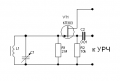
I used to make a preamplifier like this. The transistor could be different. In the source I recommend a smaller resistor R2 value of 1 - 2 kOhm. I also did not put resistor R1. This resistor widens the band, but on medium waves this resistor is of little use.
I have rebuilt about five different receivers this way. The sensitivity of the receiver has improved significantly.
I give links in Russian. Google translator to help you!
https://pandia.ru/text/78/586/53144.phpamp.png
 
Last edited:

bassbindevil

Joined Jan 23, 2014
922
Old car radios can be bought cheaply at car enthusiast swap meets; the OEM radios tend to be high performance and built like tanks. They're also well-documented; car wiring diagrams show all the connections, and there were companies that reverse engineered car radios and published service diagrams. Tube radios from the '50s are going to be troublesome, '60s models might be getting collectible (and solid state electronics was still maturing), so I'd lean towards '70s to '80s radios. Some car radios from the mid-'80s to early '90s included AM stereo; that may mean better regular AM performance. Clues would be an AM ST button or indicator. Radios from the '90s up are apt to be useless without being plugged into a car (or a gizmo that simulates the car's digital bus) or have a passcode that must be entered after a power loss (not unusual to find that written on or near the radio).

Add a speaker and a suitable power supply (12V power bricks rated at 3 amps or so can be found at thrift stores; I have one from a Wii that's rated at 3.7A). Oh, yeah, and an antenna. If you're going for really long distance, don't worry about exact length, more is usually better.

Or, watch out for high-performance portable radios wherever you shop for used goods. GE sold "Superadios", Radio Shack had some with TRF tuning for long range, and Panasonic still makes a nice basic AM/FM AC/DC portable, the RF-2400D. And any portable (or table) radio that includes shortwave bands is a good candidate, and likely to have a connection for an external antenna.
 
Last edited:

MrChips

Joined Oct 2, 2009
34,807
I am experimenting with various ways of improving radio reception.
I have a crystal radio set up with a long horizontal wire antenna.
I tuned a portable (battery operated) radio to a weak MW station and assess any improvements in reception.

1) Connect the antenna directly to the telescopic antenna.

2) Loop the wire around the radio with the end of the wire connected to ground.

3) Connect the antenna a tuned LC circuit (coil and tuning capacitor) with the radio just in the vicinity of the coil and tune the capacitor for resonance.

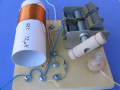
Here is my crystal radio set up. I removed the diode and earpiece for this experiment.
1627180627936.png

All methods show significant increase in signal strength. It is difficult to decide which one gives the best result.
 

Thread Starter

Mellisa_K

Joined Apr 2, 2017
391
I am experimenting with various ways of improving radio reception.
I have a crystal radio set up with a long horizontal wire antenna.
I tuned a portable (battery operated) radio to a weak MW station and assess any improvements in reception.

1) Connect the antenna directly to the telescopic antenna.

2) Loop the wire around the radio with the end of the wire connected to ground.

3) Connect the antenna a tuned LC circuit (coil and tuning capacitor) with the radio just in the vicinity of the coil and tune the capacitor for resonance.

Here is my crystal radio set up. I removed the diode and earpiece for this experiment.
View attachment 244344

All methods show significant increase in signal strength. It is difficult to decide which one gives the best result.
Thanks @MrChips,

You're introducing me to another oscillator type, the LC oscillator. Another oscillator type, the RC oscillator was the subject of a series of projects I did under the guidance of AAC members a few years ago. This post on irrigation controllers was in fact was my first post: https://forum.allaboutcircuits.com/threads/relay-switching-circuit.133857/post-1114613. I mastered that and some other oscillator applications of the same type. I must admit however, i haven't been able to practice my electronics hobby since then. But I've saved all my notes.

Now there is the LC type! https://www.electronics-tutorials.ws/oscillator/oscillators.html and https://en.wikipedia.org/wiki/LC_circuit I will read and think. So much to learn. Thankyou

I will probably just start with your first two suggestions for now. Regardless, you and others on AAC probably dont realise that once you plant the seed of the idea in my head I will try to put it in perspective and be more likely to give it a go however long in between spells at my hobby. Thanks again.
 

Thread Starter

Mellisa_K

Joined Apr 2, 2017
391
Old car radios can be bought cheaply at car enthusiast swap meets; the OEM radios tend to be high performance and built like tanks. They're also well-documented; car wiring diagrams show all the connections, and there were companies that reverse engineered car radios and published service diagrams. Tube radios from the '50s are going to be troublesome, '60s models might be getting collectible (and solid state electronics was still maturing), so I'd lean towards '70s to '80s radios. Some car radios from the mid-'80s to early '90s included AM stereo; that may mean better regular AM performance. Clues would be an AM ST button or indicator. Radios from the '90s up are apt to be useless without being plugged into a car (or a gizmo that simulates the car's digital bus) or have a passcode that must be entered after a power loss (not unusual to find that written on or near the radio).

Add a speaker and a suitable power supply (12V power bricks rated at 3 amps or so can be found at thrift stores; I have one from a Wii that's rated at 3.7A). Oh, yeah, and an antenna. If you're going for really long distance, don't worry about exact length, more is usually better.

Or, watch out for high-performance portable radios wherever you shop for used goods. GE sold "Superadios", Radio Shack had some with TRF tuning for long range, and Panasonic still makes a nice basic AM/FM AC/DC portable, the RF-2400D. And any portable (or table) radio that includes shortwave bands is a good candidate, and likely to have a connection for an external antenna.
All great advice thankyou @bassbindevil . I can see you like to hunt and gather with an eye on value for money. me too! Ive got a good idea what to look for. Thankyou for a very comprehensive review of options and recommendations.
 
Top