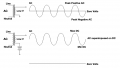
This has been a silly argument! Certainly the ripple on top of the alternator DC output is AC, but it never reverses direction. It varies the amplitude, just like the ripples on the surface of a lake. The overall depth is in fact changing by the height of the ripples, but it does not matter. So the ripple on an alternator output will tend to vary a bit with the load current, and it will be much greater when one of the diodes fails open. Also, it is usually not quite a sine wave.
And certainly there is such a thing as a "pure DC voltage". Switch off the engine and disconnect the battery positive cable. Now you have a "pure DC voltage between the positive and negative terminals. Almost all of the variations come from the effect of variations in the load current causing variations in the voltage drop across the battery's effective internal resistance. That is basic Ohm's Law!
This has been a silly argument! Certainly the ripple on top of the alternator DC output is AC, but it never reverses direction. It varies the amplitude, just like the ripples on the surface of a lake.
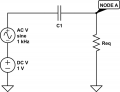
You are going to have a difficult time explaining to someone the function of the DC-AC option on an oscilloscope input channel and trigger option, also explaining how a DC blocking capacitor works in AC coupled amplifiers.
OK, MAX, it is an alternating VOLTAGE LEVEL on top of DC. It alternates between two positive values, No, the CURRENT never reverses, but the voltage level varies. An excellent example is the DC voltage modulating a class "C" power amplifier in an AM transmitter. It is an alternating VOLTAGE on top of a DC supply voltage.
And I'll say again.
Common usage is that AC is STILL AC whether its riding on DC on not.
The presence or absence of DC has no effect on the primary characteristics of the varying AC portion (pp or RMS value, frequency spectrum, etc.).
I guess when I took my training I WAS in a minority, as we were taught the characteristic that distinguishes it, is that AC (alternating CURRENT) refers to the fact the current must change direction.
One quote of many that are out there for the definition.
, ' Definition: Alternating Current (AC) is a type of electrical current, in which the direction of the flow of electrons switches back and forth at regular intervals or cycles. Current flowing in power lines and normal household electricity that comes from a wall outlet is alternating current. '
The DC examples quoted we always referred to as pulsating DC.
Quotes so far: "Common usage is that AC is STILL AC whether its riding on DC on not".
I have several devices that are marked 120v AC 60Hz , I know for sure that they are NOT capable of running on the "AC" riding on rectified DC.
Of course not for power line AC.
But that is irrelevant to the discussion of whether AC riding on DC is still AC.
You want to be pedantic about the definition, and that's fine, but that is not the common usage for the word AC, except perhaps when referring to main's power.
For example, the phrase "pulsating DC" is never used for the signal going through an AC amplifier, even though internally it is riding on the DC bias voltages.
The DC is not a factor in the characteristics of the AC signal and is thus ignored.
And the small voltage variation on a DC supply is commonly referred to as AC ripple, not pulsating DC.
To me, pulsating DC refers to large variations, such as unfiltered rectified single-phase AC power.
Reminds me of other standards that are set out by institutions and then blindly ignored causing possible confusion.
One is the earth ground signal that was set out in the '50's in N.A. and in some parts of Europe,
but is largely ignored, and used indiscriminately by most, even highly touted publications that otherwise should know better.
I guess the definition of AC is one that can join it.
As a further comment, I think it would be appropriate, given the evolved common usage of the term, to define AC as a time-varying current or voltage and ignore the "current-reversal" definition that originally came from its description of one of the two types of main's power.
OK, Max has a point and I do not argue THAT POINT, BUT what we certainly have is AN ALTERNATING VOLTAGE AMPLITUDE, on top of a DC AMPLITUDE. AKA Ripple, (not the beverage.)

 Facebook
 Google
 GitHub
 Linkedin