New learning project: Lawn mower alternator

Thread Starter

rebelrider.mike

Joined Feb 2, 2024
53
My 92 Toro has this neat little alternator:
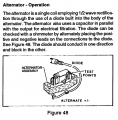
Alternator.pngAccording to documentation, it only puts out 0.5A for a 12V starter battery. I've been doing a "20 foot" restoration on the mower and I'm almost done. When I went to put the alternator back on though, I noticed the capacitor lead was broken. I could just replace the capacitor, but now that it's caught my attention, I must tinker with it.

I was not able to find any specifications for this particular alternator, but I believe the capacitor is rated for 68μF, (I measured 70μF) and 50vNP (50V?).
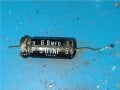
20251105_165517.jpg
I don't know what the resistance of the coil should be. I read 0.7 ohm on the coil. My multimeter leads read about 0.1 ohm, so the coil is probably about 0.6 ohm. Seems low for a coil, but what do I know about coils? Not enough.

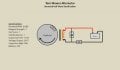
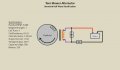
I thought I'd reverse engineer things a bit, and came up with a couple diagrams:
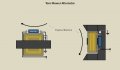
ToroAlt1.jpg

ToroAlt2.jpg
Is there enough information here to predict this thing working using math?
I'm also wondering what would happen if I put a full wave rectifier on it.

This is all just tinkering for fun. I usually just use the pull chord to start the mower anyway, so no big loss if I can't get it working.
 

schmitt trigger

Joined Jul 12, 2010
2,027
Please do us a favor;
Most, but not all electrolytic capacitors are POLARIZED. However, some non-polarized electrolytic caps are also available.
Please post, or double check yourself, the opposite side of the capacitor, look for a polarity indicator.
If there is none, then my suspicion about the meaning of the letters VNP (voltage non polarized) is correct.
Which means that the capacitor’s position in your drawing is correct.

Non polarized electrolytic capacitors are made from two regular polarized capacitors in series, with their positive leads connected together.
 

Thread Starter

rebelrider.mike

Joined Feb 2, 2024
53
Interesting. Beyond the picture of the capacitor I shared, I've got nothing else to go on. My understanding is that the "crimped" end of an axial capacitor is the positive if it's polarized. I can tell you that the position of the capacitor is correct, because that's where it is on the alternator. It's also described as for electrical filtration in the documentation I have. Though no other details are given. I guess I've interpreted electrical filtration as smoothing, though I could be wrong about that.

Is there a way to test for polarity? I have an LCR meter, in addition to a regular multimeter. What would be the purpose of a non polarized capacitor? The diode prevents current from going both directions.

I wish I could have tested this before it broke. Replacements are over $100, if they even exist, so that's not happening. What would happen if I replaced the capacitor with a regular polarized one?
 

Thread Starter

rebelrider.mike

Joined Feb 2, 2024
53
I've use an equation in the past to size an appropriate capacitor for smoothing rectified DC voltage:

I * t / dV = C

I is the current in mA, t is time in ms for a full cycle of whatever's going on (usually an AC sine wave) and dV is the difference in the maximum and minimum desired voltage. C is capacitance in μF.

I is easy, that's already given as 500mA.

t can be calculated. The cycle is a revolution of the engine, which is 3,000 RPM at full throttle. That would be 50 revolutions per second, or 0.05 per ms. I think I have that right.

dV is harder to figure. I don't know the maximum voltage from the coil would be. I'm guessing there is a relationship between the magnet strength, the iron core size, and the number of turns in the coil. But I only know one of those, and I don't have that equation anyway.

The minimum without the capacitor would be 0V, but I'm charging a 12V lead acid battery, so the desired minimum would be closer to 12V. I would hope the maximum would be somewhere between 13.2V and 14.6V

C is already known to be 68μF, so if I assume the maximum voltage is 14.6V, then I can find the minimum voltage to be 14.2V. Or, if I assume the maximum voltage is 13.2, then I can find the minimum voltage to be 12.8V. Either would be acceptable.

This all assumes that the capacitor is actually for smoothing. Old alternators used to have a capacitor on them to keep from interfering with the radio in cars. But that was before they had resistor spark plugs and modern plug wires. My lawn mower has no radio. I would guess that an EMI filtering capacitor would have a smaller capacitance. But I don't know much about those, so I could be way off.
 

schmitt trigger

Joined Jul 12, 2010
2,027
Your post, and the schematic confirms that it IS NOT a polarized capacitor.
And because it is located prior to the rectifier it IS NOT a smoothing capacitor.

Rather I think that it is used as a resonant tank.
 

Thread Starter

rebelrider.mike

Joined Feb 2, 2024
53
I had to look up resonant tank circuits, but that makes sense. The capacitor is definitely before, in parallel with the coil. The diode goes directly to ground. I need to get smoothing capacitors out of my head. I suppose a battery wouldn't need a smooth DC voltage anyway, right? Here's an amended diagram with updated information:
ToroAlt2.jpg
So as far as repairing the alternator back to it's original self, I could either replace the capacitor, or put the original capacitor in shrink tube or something, since it seems to work, just the outer wrapping is coming off. Here is the closest thing I've found as a replacement.

I'm very interested now to get the mower running and try out the alternator with an oscilloscope. I bought a cheap oscilloscope a while ago, but never had the chance to use it. Should be fun!
 

MisterBill2

Joined Jan 23, 2018
27,159
Interesting. Beyond the picture of the capacitor I shared, I've got nothing else to go on. My understanding is that the "crimped" end of an axial capacitor is the positive if it's polarized. I can tell you that the position of the capacitor is correct, because that's where it is on the alternator. It's also described as for electrical filtration in the documentation I have. Though no other details are given. I guess I've interpreted electrical filtration as smoothing, though I could be wrong about that.

Is there a way to test for polarity? I have an LCR meter, in addition to a regular multimeter. What would be the purpose of a non polarized capacitor? The diode prevents current from going both directions.

I wish I could have tested this before it broke. Replacements are over $100, if they even exist, so that's not happening. What would happen if I replaced the capacitor with a regular polarized one?
MOST non-polarized capacitors are built with different materials than polarized ones. Two caps back to back is the work around if the right part is not available.
 
Top