Alternator as adjustable output DC generator

Thread Starter

papagayor

Joined Dec 20, 2025
18
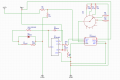
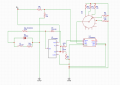
Hello, please I'm trying to make a circuit of this project: On a 6.5Hp petrol engine I fitted a car alternator with pulleys 2:1. Alternator is a BorgWarner 13.5V-130A, and I removed internal regulator so now have 2 free contacts for feeding rotor. The rotor resistance is 2.6Ω and by feeding it with 1.8V I had about 14V on output. I want to make this project for powering 1-3 olive harvester tools at different voltages and A but all the same (e.x. 12V-400W, 12V-800W, W is the peak), or 1 to 2 at about 12-21V and 800-1200W. The tools in normal working do not draw out more than 8-12A and only when they stack on tree they ask more, not over 25A. I'm going to feed rotor with a 12V-7Ah lead-acid battery with the attached circuit. My need is to control output at a stable voltage by a rotary switch and resistances, but when the connected tool or tools ask more current the circuit, to feed rotor with more current to balance the extra load. This approach is made because there are different olive harvesters, and I want to have complete control on construction's output, so that be able to feed every time each tool with the voltage and current that is needed. Please check the circuit and tell me if it's ok or need to make changes and where. It is based on 2 modules the XL as converter and LM as controller. Thank youLM358.png
 

wayneh

Joined Sep 9, 2010
18,096
If I understand your circuit, you want S1 to provide a selectable voltage reference to the In+ of the op-amp. As drawn though, the applied voltage will always be ground.

Is the op-amp meant to be a comparator (as drawn) or as a voltage follower (would need a feedback signal)?

The In- is set to a reference voltage determined by a resistor divider. You might consider using a genuine voltage reference that doesn't vary with battery voltage.

Please add to your drawing where the output to the field coil of the alternator is.

I think ultimately you're going to need feedback from the output of the alternator in order to control the voltage of that output.
 

Ian0

Joined Aug 7, 2020
13,117
I want to make this project for powering 1-3 olive harvester tools at different voltages and A but all the same (e.x. 12V-400W, 12V-800W, W is the peak), or 1 to 2 at about 12-21V and 800-1200W.
I'm not sure what this means.
You need an error amplifier, but there is one built into the XL4016, so all you need to do is to arrange the switch so that, at the required output voltage, the resistive divider outputs output 1.25V to the FB input.
If you're lucky that be all you need.
If you're not so lucky, it will be unstable and the voltage will oscillate, because the error amplifier inside the XL4016 is set up for something that will react rather more quickly than an alternator, and it's not something you can adjust.
If that happens you will have to look for a regulator which has a COMP terminal so you can attach external compensation components.
 

MisterBill2

Joined Jan 23, 2018
27,362
WHAT VOLTAGES do the different tools require?? And how close do those voltages need to be held??
IF the internal regulator was fully functional I would say removing it was a mistake. The plan, (not original with me, invented long ago) is very reliable. Tap into the three phases and feed an external transformer, or transformers to provide the required voltages, and add rectifier diodes to provide the DC. The internal regulator will hold the voltages fairly constant by adjusting the field current. And you can have multiple voltages at the same time using transformer taps. And if the internal regulator fails it is simple to replace and get back to work.
 

Thread Starter

papagayor

Joined Dec 20, 2025
18
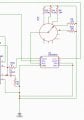
The circuit was incorrect, I attach a new one that shows the alternator output and is the point that must be measured and used for comparison, so the LM358 must work as comparator, the circuit have to check when the ALTERNATOR+ goes up or down at different value that S1 has been set, and correct it to selected value. The L1 and R1 is the rotor, having a 2.6Ω resistance.
MisterBill2: The factory alternator regulators are made to give about 14V, but sometimes I need more than this, and I want to have full control by setting different resistance values on S1. The other point on your suggestion is that had to use a lot of transformers, and also as I said need to the ALTERNATOR+ to be full controlled by adjusting the rotor's current.
 

Attachments

MisterBill2

Joined Jan 23, 2018
27,362
Really, the transformer scheme could be done with one transformer that had suitable taps. The benefits would be that multiple voltages would be available at the same time. The regulation of ALL the voltages would be due to the internal regulator adjusting the field current to hold the DC output at 14 volts, which will also increase the other voltages, since setting the field current affects the AC output to the internal diodes as well as the AC output to the transformer.

What I do not see in the posted circuit is any connection to power the alternator field that controls the output voltage. That field current may be several amps at higher current outputs. None of the circuit shown can provide that much current.
 

wayneh

Joined Sep 9, 2010
18,096
All settings of S1 still apply ground to IN+. You might consider a potentiometer instead of a multi-position switch. It'll be a lot cheaper. But the switch allows for preset values and I can see why you'd want that.

Is ALT+ a rectified (DC) signal? It needs to be, and should be filtered to eliminate virtually all ripple.

Is U1 capable of supplying enough current to drive the alternator to full performance?
 

Thread Starter

papagayor

Joined Dec 20, 2025
18
All settings of S1 still apply ground to IN+. You might consider a potentiometer instead of a multi-position switch. It'll be a lot cheaper. But the switch allows for preset values and I can see why you'd want that.

Is ALT+ a rectified (DC) signal? It needs to be, and should be filtered to eliminate virtually all ripple.

Is U1 capable of supplying enough current to drive the alternator to full performance?
ALT+ is the DC+ output of alternator. And as I can see at U1 specs it can give enough current but also rotor does not need too much.
 

Thread Starter

papagayor

Joined Dec 20, 2025
18
Really, the transformer scheme could be done with one transformer that had suitable taps. The benefits would be that multiple voltages would be available at the same time. The regulation of ALL the voltages would be due to the internal regulator adjusting the field current to hold the DC output at 14 volts, which will also increase the other voltages, since setting the field current affects the AC output to the internal diodes as well as the AC output to the transformer.

What I do not see in the posted circuit is any connection to power the alternator field that controls the output voltage. That field current may be several amps at higher current outputs. None of the circuit shown can provide that much current.
Sir, have you in mind where could I find a transformer with different DC voltage outputs, otherwise how to make one? Also, by doing this, what if one tool "pull" more Amps? Thank you.
 

Thread Starter

papagayor

Joined Dec 20, 2025
18
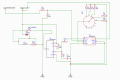
Made some corrections again after some friendly suggestions and going on for final circuit, I'm expecting your comments please.
 

Attachments

wayneh

Joined Sep 9, 2010
18,096
You need to place a resistor from IN+ to ground, and then send Vcc (instead of ground) through the S1 contacts. Then, the voltage on IN+ will be determined by the divider established by one of the S1 resistors and the fixed resistor you choose for IN+ to ground. Note that in this configuration, IN+ is pulled to ground during any "dead" or open positions of S1. As I understand it, this will likely cause a low or no current thru the field. I'm pretty sure you don't want such open spots to send high voltage to IN+ and thus the field.

I haven't yet looked into the operation of U1 but I suspect the input to FB should not just be on or off but should be a voltage proportional to the error between ALT+ and the reference target. Having the LM358 op-amp acting as a comparator as currently shown is not achieving that. Don't build this circuit until we get that resolved.
 

Thread Starter

papagayor

Joined Dec 20, 2025
18
You need to place a resistor from IN+ to ground, and then send Vcc (instead of ground) through the S1 contacts. Then, the voltage on IN+ will be determined by the divider established by one of the S1 resistors and the fixed resistor you choose for IN+ to ground. Note that in this configuration, IN+ is pulled to ground during any "dead" or open positions of S1. As I understand it, this will likely cause a low or no current thru the field. I'm pretty sure you don't want such open spots to send high voltage to IN+ and thus the field.

I haven't yet looked into the operation of U1 but I suspect the input to FB should not just be on or off but should be a voltage proportional to the error between ALT+ and the reference target. Having the LM358 op-amp acting as a comparator as currently shown is not achieving that. Don't build this circuit until we get that resolved.
I posted the circuit in easyEDA format, please could make the suggested connections and reply? Thank you.
 

Attachments

wayneh

Joined Sep 9, 2010
18,096
I posted the circuit in easyEDA format...
Not sure about anyone else, but I can't do anything with that format.

I have since looked up the XL4016E1 buck converter IC and now I have the same question as @schmitt trigger : Why is the op-amp there?

The buck converter has a feedback FB pin and that's what should be seeing the output of the alternator. Of course you will use your variable resistor divider as described in the data sheet so that the FB pin voltage corresponds to the desired ALT+ voltage. It may take some experimentation to determine that relationship.
 
Last edited:

Ian0

Joined Aug 7, 2020
13,117
The buck converter has a feedback FB pin and that's what should be seeing the output of the alternator. Of course you will use your variable resistor divider as described in the data sheet so that the FB pin voltage corresponds to the desired ALT+ voltage. It may take some experimentation to determine that relationship.
The buck regulator already has an error amplifier, so it will adjust its output so that the FB pin is 1.25V, so the potential divider is perfectly predictable.
However, the device has no COMP pin, so its frequency compensation is built-in and non-adjusable. Whether it can cope with something as slow to respond as an alternator is anybody's guess. It might just oscillate.
A device with a COMP pin would be preferably as you could set the dominant pole in the error amplifier at a low enough frequency to keep it stable.
[Apologies for paraphrasing post #3]
 

Thread Starter

papagayor

Joined Dec 20, 2025
18
Thank you all for your posts, I'm not an expert so trying to find solutions by asking for help for this project. BUT if you think it is not suitable for this, please help by suggesting a circuit or a module, modules, to make a regulator. The problem is not simple because most alternator regulators are used for charging batteries and not as power suppliers/generators. I looked every where for something similar bat was unable to find something, so trying to make it from start because need to make it work on my way, which is not common. Also car alternators differs somehow from generators, and even I found some circuits they had a note as "not for car alternators". So could by using only the LM358, with a position switch and maybe with MOSFET, or as I saw some similar circuits using TIP3055, TIP31 e.t.c.? Please for your help.
 

MisterBill2

Joined Jan 23, 2018
27,362
A mopar two terminal voltage regulator, with the field terminals having battery voltage on one end of the firld, and the regulator pulling down the other terminal I think. Then the other terminal on the rgulator senses the battery voltage. So put a 12 volt zener in series so it delibvers 24volts to sense 12volts. Or a six volt zener in series to make it produce 18 volts to sense 12 volts. NO IC devices needed.
 
Top