Alternator loading engine

LowQCab

Joined Nov 6, 2012
5,101
An Alternator creates a Torsional-Load that is in direct proportion to
the amount of Electrical-Power it is producing,
plus a small Frictional-Load,
plus a very-small Aerodynamic-Load, ( especially for Alternators that have a built-in Cooling-Fan ).

A V-Belt/Pulley Drive-System will also create some drag,
a Cogged-Belt Drive-System would be more efficient.

The Drag on the Motor will vary substantially depending upon the Battery's State of Charge.

~14.7-Volts is TO HIGH,
~14.0-Volts would be ideal for this type of setup, and would reduce Engine-Load.
.
.
.
 

shortbus

Joined Sep 30, 2009
10,050
With all of the riding mowers having a built in alternator to charge the battery and for lights why not just put an alternator and flywheel made to fit the engine? I looked but didn't see a manufacture for the engine in the kart mentioned. It looks like a Honda clone or even a Harbor Freight Predator. Both of them have alternators and the correct flywheel available, if you look for them. No belts or mounts needed, just add the correct flywheel and alternator coils.
 

Thread Starter

Denny B

Joined Aug 30, 2022
11
Well, “The operation was a success…but the patient died”.

Here’s the latest. I picked up the alternator today with new voltage regulator installed. Went home and installed it in the buggy. Everything works as it should. The “T” wire must be connected to the battery positive terminal before it is able to produce output to the battery. The “Charge Light” (connected to the “L” terminal) works just as it should (didn’t work at all before). When running, the battery voltage reads 14.2v instead of 14.7.

That’s the good news.

Here’s the bad new…Other than everything working as it should I still have the same scenario. Cranks slow (however I could tell there was a little less load on the engine and starter), but still too slow and struggles while idling.

Ah…but I do have a solution. I will install a switch in the 14-gauge wire coming from the “T” terminal to the battery (instead of the #8 wire running from the output terminal). I will have it in the “off” position while starting and idling. I will install a voltmeter. When I switch on the lights or notice the voltage getting low, I will switch the alternator to the “on” position until the voltage builds back up. No biggie.

Something I forgot to mention is that while cranking, the charge light immediately goes out meaning the alternator is putting out “full charge/load” before the engine even starts.

The only other solution that I can think of is to get another alternator that requires higher RPM before it starts putting out voltage. The problem with that is “size”. I don’t have much room and the unit I have now almost fits in the palm of my hand and a regular size alternator is almost twice the size. Maybe just for kicks I’ll pick up a used “full size” car alternator and try it out and see what happens.

Thanks for all your input and help. :)
 

Thread Starter

Denny B

Joined Aug 30, 2022
11
With all of the riding mowers having a built in alternator to charge the battery and for lights why not just put an alternator and flywheel made to fit the engine? I looked but didn't see a manufacture for the engine in the kart mentioned. It looks like a Honda clone or even a Harbor Freight Predator. Both of them have alternators and the correct flywheel available, if you look for them. No belts or mounts needed, just add the correct flywheel and alternator coils.

Sorry I didn't reply earlier, I just saw your post.

Yes, I know about alternative flywheels. I have already installed one. But, here's the situation.

You are correct, the engine is a Predator 212cc from Harbor Freight, 6.5 HP. It did not come with electric start, so, I purchased and installed an "electric start kit" that came with a new flywheel and a "charging coil". But, the charging coil is too small to run lights (it says so in the directions). It's kind of like a trickle charger. They do offer another set-up to run lights, but you have to remove the charging coil that charges the battery. The instructions even say you should keep the battery on a charger while not in use to keep a full charge.

I guess I want the "best of both worlds". I want to charge and battery and run my lights all at the same time. :cool:
 

LowQCab

Joined Nov 6, 2012
5,101
One tip that has been overlooked so far ............
You keep referring to the Engine being "Bogged-Down".
You have to remember that normally, at Idle, the Engine has "Zero-Load".
If your Battery needs to be Charged, the Alternator jumps-right-on-the-job and starts Charging.
This creates a Load on the Engine,
this extra-Load "should" taper-off to almost nothing as the Battery reaches a Full-Charge.
Starting with a fully charged Battery, and after cranking with the Electric-Starter,
this tapering-off may take as much as ~5-minutes or so.
If the Battery is mostly dead, it may take ~30-minutes for the Load to taper-off.

Here's the solution ............
Study the operation of the Mechanical-Engine-Speed-Governor.
On most small Engines, the Governor is NOT being used to regulate Engine-RPM at Idle-Speeds.
You may have adjustable "Screw-Stops" on the travel of the Throttle-Lever which will
allow You to slightly increase the Spring-Tension on the Governor at, or close to, Idle-Speeds.
This will cause the Governor to regulate the RPM of the Engine at all times, thus compensating
for the variable Load imposed by the Alternator.

If You move the Throttle-Lever to the "Idle-Position", and You observe that the
Governor-Spring goes slack, with no tension on it, You are looking at the problem.
The Governor-Spring should have slight tension on it at all times.

A small Engine that is idling at ~500-RPM is not going to be able to handle any additional Loads.
Idle-Speed needs to be a properly "Governor-Controlled" ~1000-RPM or greater.
The Governor should do a reasonable job of keeping the
RPM right-around ~1000-RPM regardless of the Load imposed by the Alternator.
.
.
.
 

crutschow

Joined Mar 14, 2008
38,525
The only other solution that I can think of is to get another alternator that requires higher RPM before it starts putting out voltage.
But there is a third solution.
That would also happen if you used a larger pulley on the alternator as previously suggested.
 

shortbus

Joined Sep 30, 2009
10,050
On most small Engines, the Governor is NOT being used to regulate Engine-RPM at Idle-Speeds.
You may have adjustable "Screw-Stops" on the travel of the Throttle-Lever which will
allow
You are looking at the problem.
The Governor-Spring should have slight tension on it at all times.
Wrong, according to all of the different small engine shop manuals I have. The goveror spring only keeps the governor gears from breaking if someone tries to over ride it by hand. The gears are usually made of plastic.

Idle speed is controlled by the idle speed screw on the throttle lever. This screw controls how far the throttle blade is opened at idle. If you have idle speed set too high, throttle opened too much, the fuel transfer ports are exposed and the motor may stumble when accelerated.
 

LowQCab

Joined Nov 6, 2012
5,101
All right Shortbus, what is your beef with me ?,
go ahead and get it off of your chest, you'll feel better.

I'm kinda getting tired of You routinely trying to pick a fight with me, or trying to "make me wrong".
This is somewhere between the ~20th to ~30th time this type of thing has occurred.
I normally just ignore the situation, but it's getting out of hand, it's getting really old.

So what's the deal ???,
Let's resolve this situation and try to get along.
.
.
.
 

300-3056

Joined Sep 9, 2022
26
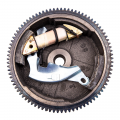
1662825678653.png
Aftermarket charging kit for a clone. ( amazon )
This is a small one but some are 5 amp as I recall.
You will need to add a charge controller too to prevent over charging batteries.
Be aware the taper on some 208 and 212 engine is different so the Honda clone pars might not fit correctly
If that's not enough power to run your lights maybe look at using LED lights.
 

300-3056

Joined Sep 9, 2022
26
Wrong, according to all of the different small engine shop manuals I have. The goveror spring only keeps the governor gears from breaking if someone tries to over ride it by hand. The gears are usually made of plastic.

Idle speed is controlled by the idle speed screw on the throttle lever. This screw controls how far the throttle blade is opened at idle. If you have idle speed set too high, throttle opened too much, the fuel transfer ports are exposed and the motor may stumble when accelerated.
I'm new here this is my forth post.
I think your understanding of mechanical governors needs some polish

Here's a great link to all kinds of manuals.
Look up governor adjustments and principles of opperation
http://www.skilledcrafting.com/onanfiles/
 

shortbus

Joined Sep 30, 2009
10,050
All right Shortbus, what is your beef with me ?,
go ahead and get it off of your chest, you'll feel better.

I'm kinda getting tired of You routinely trying to pick a fight with me, or trying to "make me wrong".
This is somewhere between the ~20th to ~30th time this type of thing has occurred.
I normally just ignore the situation, but it's getting out of hand, it's getting really old.

So what's the deal ???,
Let's resolve this situation and try to get along.
.
.
.
So then let me get this right. You seem to think when I know something you don't and I tell you your wrong I have a problem with you?

I can tell you don't like to be wrong but when you are you are. Sorry. I can't let you or your buddies miss lead people when I know better. Just how I am.

People don't seem to have a problem correcting me and I don't act like a cry baby when they do. I thought we all were here to learn the way things work, so grow up.
,
,
,
,
,
 
Top