Probably not a bad idea to go ahead and replace the electrolytics, huh? They're at least 26 years go. Radio is made in Japan, though...good build quality.
The input (+) side of the audio output cap (C110) shows 5V p-p at max volume while the output (-) side of the cap shows about 100mV p-p. I guess this could have been diagnosed with just a multimeter?
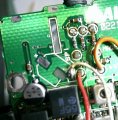
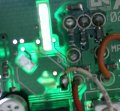
While fumbling with the worklight for a better picture I found out that light from under the board really shows up the traces. Yep, it only goes to the white wire.
And it works! I used the white wire to bridge to the repaired pad. Immediately after that I powered it up and volume is normal again.
I still have to resolder the rotary encoder that I removed, and the antenna BNC, do a general cleanup and reassemble. And replace the channel EEPROM (SOIC). This HT will probably see some service in high altitude balloon tracking, which was the original reason I bought it. I had occasionally used it on my desk, but the audio just quit out of the blue.
Thanks for the help @sghioto. And for the earlier help from others.
I´ve repaired several audio problems just replacing electrolitic condensers from AF circuit.
Some standard like C112 and similars had this "age problems".
Some kenwoods failed about audio, TX and RX issues, almost always due to electrolitic capacitors leaking.
If you change them early, may be acid has not destroy circuitery. Sometimes is too late and is neccesary to repair circuitery lines.
Abut Alinco DJ-180, I had a look to schemes and I saw there were two electrolitics caps at AF power side.
I opened the radio and I saw this aluminuim caps. When I tried to desolder, they smell bad, tipycal very old caps.
I could only desolder one side of the caps, so I cut them with help of a sharp and little electrical sccisors.
Once I cut the aluminum, I removed the remains of the cap with tweezers. Then I was able to desolder the small portion of the leg of the cap, and finally a good cleaning with isopropyl alcohol.
Finally, I have used new tantalum caps to replace the aluminum ones. They are smaller, easier to weld and relocate.

 Facebook
 Google
 GitHub
 Linkedin