Facebook
 Google
 GitHub
 Linkedin
I would appreciate some advice on this circuit.
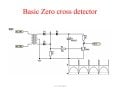
I need to detect zero-cross on a 16VAC signal. This circuit shows my attempt at a Schmitt trigger - it simulates fine on LTSpice, but I'm not sure about a few things.

First of all, R21 and R20 are there to limit the voltage at the inverting input to below Vin. However I think I can leave these out as the Linear Technology spec states that "The LT1716 has a unique input stage that can be taken 44V above V–, independent of V+ supply.". -IN won't go more than 24V above ground (with R21 and R20 out of the circuit).
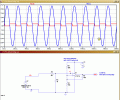
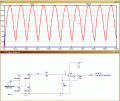
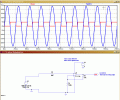
Secondly, the spec says: "(Built-in resistors protect the inputs for faults below the negative supply of up to 5V)". So I thought that I could get rid of the bridge rectifier. With the R21 and R20 voltage divider left in that would limit the -IN voltage to less than +/-5V. However, the LTSpice simulation shows the negative half wave clipped to zero. I don't know if this is an LTSpice error, or if the simulation is correct and the comparator is preventing -IN from going below ground.
What I'm trying to do is to cut down the components as much as possible as I'm very limited on board space. Also, as I will be using SMD components, doing a prototype is a bit tricky: so I would like to be fairly sure I'm right before going down that route.
I need to detect zero-cross on a 16VAC signal. This circuit shows my attempt at a Schmitt trigger - it simulates fine on LTSpice, but I'm not sure about a few things.
First of all, R21 and R20 are there to limit the voltage at the inverting input to below Vin. However I think I can leave these out as the Linear Technology spec states that "The LT1716 has a unique input stage that can be taken 44V above V–, independent of V+ supply.". -IN won't go more than 24V above ground (with R21 and R20 out of the circuit).
Secondly, the spec says: "(Built-in resistors protect the inputs for faults below the negative supply of up to 5V)". So I thought that I could get rid of the bridge rectifier. With the R21 and R20 voltage divider left in that would limit the -IN voltage to less than +/-5V. However, the LTSpice simulation shows the negative half wave clipped to zero. I don't know if this is an LTSpice error, or if the simulation is correct and the comparator is preventing -IN from going below ground.
What I'm trying to do is to cut down the components as much as possible as I'm very limited on board space. Also, as I will be using SMD components, doing a prototype is a bit tricky: so I would like to be fairly sure I'm right before going down that route.