Yes, high and low edge and also high and low level.hi ra,
Does the ESP have the option of High or Low going edge detection for interrupts..?
I use PIC's which have that option.
E
Yes, high and low edge and also high and low level.hi ra,
Does the ESP have the option of High or Low going edge detection for interrupts..?
I use PIC's which have that option.
E
Hi Eric,hi ebp,
That looks better.
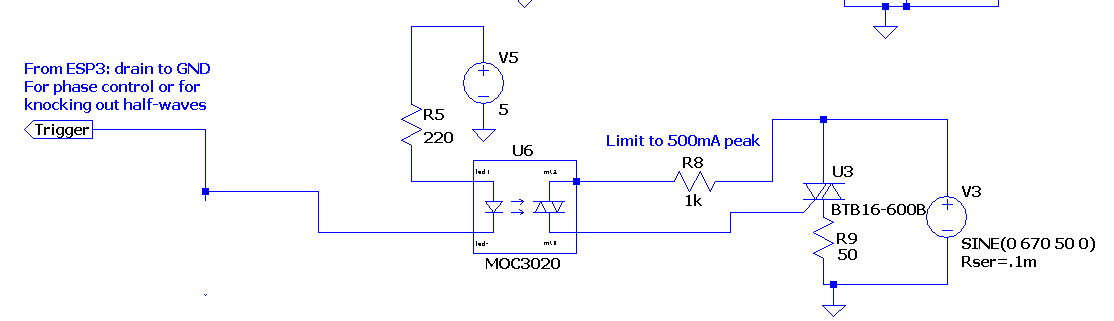
Thanks for pointing that out. I took out the voltage divider and of course the circuit stopped working as the output of the rectifier went to around 5V. So the attached circuit is probably as paired down as possible for 'a-bit-before-zero-cross' and a bridge, would you agree?The bridge would need a loading resistor to be sure the output [edit - output of bridge, that is is] was pulled to zero.
Yes, the circuit will be used to fire a triac. I have tested the simulation with noise ... see attached LTSpice .asc. And here's a plot:Be careful with putting a phase lead cap in the attenuator since that may make the circuit more sensitive to high frequency noise.
When simulating circuits like this it is useful to add a noise source (noise, as such, if available as a source, otherwise some convenient standard waveform; you can even add two or three different ones in series) in series with the input source.
Filtering the input can sometimes be useful, but of course a low pass filter will introduce phase lag. Adding phase lead after the filter is safer than with no filter.
If a circuit like this is ultimately used to control something like SCR firing (e.g. for a half controlled bridge rectifier), everything related to phasing becomes an issue, depending on how the SCRs are fired. You can get into issues of firing on the wrong half cycle altogether, or firing when you think you are at the end of the half cycle you want to control when you are actually into the beginning of the next half cycle.
Don't forget that temperature of the parts (particularly any caps you use) also play a part and can shift your phase lead/lag as well. This is not a trivial thing. Especially if you need to operate over a large temp range.If a circuit like this is ultimately used to control something like SCR firing (e.g. for a half controlled bridge rectifier), everything related to phasing becomes an issue, depending on how the SCRs are fired. You can get into issues of firing on the wrong half cycle altogether, or firing when you think you are at the end of the half cycle you want to control when you are actually into the beginning of the next half cycle.