Advice on power supply for circuit

Alec_t

Joined Sep 17, 2013
15,121
The voltages are rather low for a nominally 6V supply. Are the batteries a respectable brand and fresh?
Those vibrations suggest the receiver isn't getting a high enough voltage and is switching off.
Are you sure the receiver is putting out a continuous signal when the button is kept pressed?

Re-running a simulation of the circuit I find that the pulse when the button is pressed or released is particularly sensitive to the Vgs threshold of the FETs. Datasheets indicate your chosen FETs can have a threshold as high as +-2V, which simulation shows is too high to give a reliable pulse. However, if the circuit was working ok at one stage, the implication is that the thresholds of the particular FET samples you actually have are closer to +-1V, which is good.

A clear breadboard pic might be informative.
 
Last edited:

Thread Starter

NickB

Joined Feb 1, 2016
95
The voltages are rather low for a nominally 6V supply. Are the batteries a respectable brand and fresh?
Those vibrations suggest the receiver isn't getting a high enough voltage and is switching off.
Are you sure the receiver is putting out a continuous signal when the button is kept pressed?

Re-running a simulation of the circuit I find that the pulse when the button is pressed or released is particularly sensitive to the Vgs threshold of the FETs. Datasheets indicate your chosen FETs can have a threshold as high as +-2V, which simulation shows is too high to give a reliable pulse. However, if the circuit was working ok at one stage, the implication is that the thresholds of the particular FET samples you actually have are closer to +-1V, which is good.

A clear breadboard pic might be informative.
Hi Alec, batteries are new Duracells, I've also tried rechargeable AAAs as well. Sounds like that may be the issue - not enough power getting to the receiver. Receiver is a 'momentary' type so signal is high for the duration of time the button is pressed.

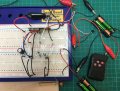
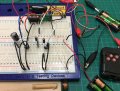
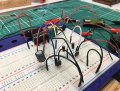
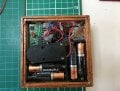
I've attached a few pics of the breadboard, the little coil is at the bottom next to the magnet on the end of a stick (for test purposes) - please let me know if you spot any obvious errors! I've also shown a pic of the project installed in it's box so you can see how tight I am on space. This was the first prototype which used an additional supply (2 x 2032 button cells in the black case) to power the receiver. Another option I was going to try this evening was to swap the AAAs for CR2s. My thinking is there may be slightly more power in these, plus as they are used for camera flashes - more current. I ruled out 3.7v LiPo as connecting and charging in series is too much of a faff. Only other thing I can think of would be to use a boost converter but I suspect that would mean a shed load of other components as well?

Kind regards
Nick
 

Attachments

Alec_t

Joined Sep 17, 2013
15,121
Having seen the breadboard layout I wonder if the rat's nest of wiring could be causing spurious high frequency oscillations in one or more of the FETs? That would give odd results. Also, those croc-clip connections may be introducing undesired resistance.
 

Thread Starter

NickB

Joined Feb 1, 2016
95
Having seen the breadboard layout I wonder if the rat's nest of wiring could be causing spurious high frequency oscillations in one or more of the FETs? That would give odd results. Also, those croc-clip connections may be introducing undesired resistance.
Rat's nest? LOL
I'll tidy the rat's nest up this evening and get rid of all the clips to see if it makes a difference.

Kind regards
Nick
 

Thread Starter

NickB

Joined Feb 1, 2016
95
Having seen the breadboard layout I wonder if the rat's nest of wiring could be causing spurious high frequency oscillations in one or more of the FETs? That would give odd results. Also, those croc-clip connections may be introducing undesired resistance.
Hi Alec

Been playing around with this for a few hours this evening. Hooked up a 10v 1000uF cap with the diode - similar result. It pulls the magnet towards the coil then vibrates. I then hooked up a 10v 3300uF cap which was interesting as it worked the first time I tried it but then just vibrated when i hit the remote again. Interestingly, if I disconnected the batteries, waited a while, then reconnected them it works again the first time but is a bit inconsistent (and drains the batteries fairly quick). This is all using fresh AAAs. I then replaced both AAA 3v supplies with 6v supplies to make sure the receiver is getting enough power, again same result. Hooked up a separate 6v supply to the receiver again and it works perfect.

Don't think we can be far off with this but I can't think of anything else I can try - any suggestions welcome.

Kind regards
Nick
 

ebeowulf17

Joined Aug 12, 2014
3,307
Hi Alec

Been playing around with this for a few hours this evening. Hooked up a 10v 1000uF cap with the diode - similar result. It pulls the magnet towards the coil then vibrates. I then hooked up a 10v 3300uF cap which was interesting as it worked the first time I tried it but then just vibrated when i hit the remote again. Interestingly, if I disconnected the batteries, waited a while, then reconnected them it works again the first time but is a bit inconsistent (and drains the batteries fairly quick). This is all using fresh AAAs. I then replaced both AAA 3v supplies with 6v supplies to make sure the receiver is getting enough power, again same result. Hooked up a separate 6v supply to the receiver again and it works perfect.

Don't think we can be far off with this but I can't think of anything else I can try - any suggestions welcome.

Kind regards
Nick
It still sounds like the 4x AAA batteries just can't keep up with the load. Two thoughts here:

1) Have you experimented with the coil pulse length, as determined by the 47k and 10uF? The resulting time constant seems like an awfully long time to be drawing over 1 amp from little alkaline batteries. I doubt this is the whole solution, but you might want to see how short of a pulse reliably moves the magnet. Do you really need 470ms time constant? The shorter the pulse, the less you deplete your batteries, and the better the odds that the super caps can power the receiver during the shortened pulse period.

2) Just for testing purposes, try a beefy 6V supply with your diode / cap single supply circuit. If everything works with a better supply then you at least know that's the root of the problem. Not sure how best to achieve this - when I started writing I was thinking wall wart, lantern battery, or motorcycle battery, but those are all 6V, not +/-3V like you need. Maybe just replace AAAs with D cells?
 

Thread Starter

NickB

Joined Feb 1, 2016
95
It still sounds like the 4x AAA batteries just can't keep up with the load. Two thoughts here:

1) Have you experimented with the coil pulse length, as determined by the 47k and 10uF? The resulting time constant seems like an awfully long time to be drawing over 1 amp from little alkaline batteries. I doubt this is the whole solution, but you might want to see how short of a pulse reliably moves the magnet. Do you really need 470ms time constant? The shorter the pulse, the less you deplete your batteries, and the better the odds that the super caps can power the receiver during the shortened pulse period.

2) Just for testing purposes, try a beefy 6V supply with your diode / cap single supply circuit. If everything works with a better supply then you at least know that's the root of the problem. Not sure how best to achieve this - when I started writing I was thinking wall wart, lantern battery, or motorcycle battery, but those are all 6V, not +/-3V like you need. Maybe just replace AAAs with D cells?
Hi ebowulf17,

1) no I've not tried that but I will. The pulse only needs to be very short to have the desired effect.

2) I did try 2 x 6v (2 x 4 AAAs) either side of the coil but got similar results. I'm tempted to think the vibrating issue is to do with the FET gates opening and closing rapidly as I tested the voltage between the diode and receiver and it appeared to be getting enough power when the remote is pressed. Yes it dipped but not below 5v which is the min for this receiver.

Unfortunately I can't use anything larger that AAAs as space is limited. If you look at the pics i posted of the earlier prototype you'll see what I mean.

I'll try your suggestions above but I'm getting to the stage where I'd happily commission someone far more experienced than myself to prototype this. Many thanks for your input with this I greatly appreciate it!

Kind regards
Nick
 

Thread Starter

NickB

Joined Feb 1, 2016
95
I agree with both observations. Sorry, but I'm out of ideas if pulse shortening doesn't work for you.
Hey Alec

I'm going to try pulse shortening. Failing that I may stick with a separate supply for the receiver. My main issue with this has been space as it's such a small device so the ideal would have been to use the same supply to power coil and receiver. I can power the receiver from 2 x CR2032 button cells no problem. I just need to find some smaller cells for the coil - drawing enough current from them may be challenging.

Many thanks for your input on this all along, it's been a huge help and also helped advance my learning. Would be great to collaborate on other projects in the future.

Kind regards
Nick
 

Alec_t

Joined Sep 17, 2013
15,121
Do you have enough space to put more turns on the coil? That would reduce the current needed to give a particular magnetic field strength, so would be kinder on the batteries and cause less of a voltage drop.
 

Alec_t

Joined Sep 17, 2013
15,121
Another thought. 'Ground bounce' may be causing the receiver supply to be reduced.
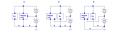
Consider these three layouts :-
PulserLayout.PNG
In the first two layouts, finite resistance of section B of the ground rail will cause the voltage of section A to rise when the coil draws a heavy current from the lower battery. A voltmeter connected directly across the two batteries in series would not detect this, yet the supply voltage to the receiver will be reduced, perhaps to drop-out point.
The third layout uses a 'star ground' arrangement, in which the heavy current through A does not affect the voltage at B (neglecting voltage drop internal to the lower battery), so the receiver supply is substantially unaffected. I'd recommend a star ground configuration if you aren't already using that.
 
Last edited:

Thread Starter

NickB

Joined Feb 1, 2016
95
Another thought. 'Ground bounce' may be causing the receiver supply to be reduced.
Consider these three layouts :-
View attachment 157412
In the first two layouts, finite resistance of section B of the ground rail will cause the voltage of section A to rise when the coil draws a heavy current from the lower battery. A voltmeter connected directly across the two batteries in series would not detect this, yet the supply voltage to the receiver will be reduced, perhaps to drop-out point.
The third layout uses a 'star ground' arrangement, in which the heavy current through A does not affect the voltage at B (neglecting voltage drop internal to the lower battery), so the receiver supply is substantially unaffected. I'd recommend a star ground configuration if you aren't already using that.
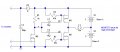
Hi Alec, your description makes complete sense but I'm struggling to understand how diagram 3 would overlay my current schema (attached).

Diagram 3 shows three connections to the receiver - what is the third one for?

Kind regards
Nick
 

Attachments

ebeowulf17

Joined Aug 12, 2014
3,307
Hi Alec, your description makes complete sense but I'm struggling to understand how diagram 3 would overlay my current schema (attached).

Diagram 3 shows three connections to the receiver - what is the third one for?

Kind regards
Nick
None of his drawings show three receiver connections.

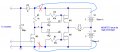
As for relating it to your drawing, here's my take on it. In an ideal world, with no parasitics, this would be the same thing, but in a non-ideal real world, it's good to separate supply lines for high current and low current devices.

In the image below, break connections where the red X symbols are, and replace them with wires straight to the battery, where the blue lines are.
3F36075A-7380-449C-8ECF-4A391B3C3289.jpeg
Again, your schematic is technically right either way, but if you can make the actual physical layout more closely match the modified drawings (if they don't already,) you may see improvement.
 

Thread Starter

NickB

Joined Feb 1, 2016
95
Sorry guys. The pic I posted originally showed 3 connections in error. Edited to show only 2.
Hi Alec

Played around with this and separated the supply lines as per Ebowulf17's suggestion above. It works!! However, the trade off is there's very little power getting to the coil initially. When the remote is pressed the coil attracts the magnet but only very slightly, when the button is released it repels the magnet fine with what appears to be more power. Not sure which FET is responsible for which action?

Increasing the power to 6v either side of the coil makes a slight difference but the coil still hardly attracts the magnet initially. If I can just get more power to the coil at the first stage we've cracked it!

Could be wrong but it's almost as if the receiver is now hogging the power.

Kind regards
Nick
 

Thread Starter

NickB

Joined Feb 1, 2016
95
None of his drawings show three receiver connections.

As for relating it to your drawing, here's my take on it. In an ideal world, with no parasitics, this would be the same thing, but in a non-ideal real world, it's good to separate supply lines for high current and low current devices.

In the image below, break connections where the red X symbols are, and replace them with wires straight to the battery, where the blue lines are.
View attachment 157425
Again, your schematic is technically right either way, but if you can make the actual physical layout more closely match the modified drawings (if they don't already,) you may see improvement.
Appreciate the diagram. That helped a lot. It works - almost! Now just got to figure out how I can get more power to the coil during the first action of pressing the remote. Any thoughts greatly appreciated.

Kind regards
Nick
 

ebeowulf17

Joined Aug 12, 2014
3,307
Appreciate the diagram. That helped a lot. It works - almost! Now just got to figure out how I can get more power to the coil during the first action of pressing the remote. Any thoughts greatly appreciated.

Kind regards
Nick
I don't have any good explanation for the change impacting coil pull strength. Any chance you use a dubious piece of wire or a bad breadboard connection when rearranging power connections? I'd double check all that, but otherwise not sure.

The pull when you first press the button should be M1, and the push when you read l release the button should be M2.
 
Top