Advice on power supply for circuit

Thread Starter

NickB

Joined Feb 1, 2016
95
Which is the intent of the circuit,

a:
coil current left to right
off time
coil current right to left
off time
repeat

or b:
coil current left to right
coil current right to left
repeat

?

ak
Hi AK

Perhaps easier if I explain the actions used to control it.

The receiver being used is a momentary type so the signal to the pin goes high for the duration that you press the button on the remote. Release it and it goes low. So..

Press the button and it activates the coil left to right
Release the button and it activates it right to left

The coil is being used to attract and repel a small circular, diametrically opposed neodymium magnet. The button will only be held down for a second or so before being released - just enough to spin the magnet.

I've attached the data sheet for the receiver if it helps.

Hope this helps.
Nick
 

Attachments

AnalogKid

Joined Aug 1, 2013
12,158
R2-C1 have a 0.5 s time constant. If the FET threshold voltage is 2 V, then 0.67 (4 / 6) is close enough to 0.63 for guestimating. So, if you hold down the switch for longer than 0.5 s, the coil will turn off before the switch is released. When the switch is released, the coil will turn on in the other direction for 0.5 s. Is this what you want?

ak
 

Thread Starter

NickB

Joined Feb 1, 2016
95
R2-C1 have a 0.5 s time constant. If the FET threshold voltage is 2 V, then 0.67 (4 / 6) is close enough to 0.63 for guestimating. So, if you hold down the switch for longer than 0.5 s, the coil will turn off before the switch is released. When the switch is released, the coil will turn on in the other direction for 0.5 s. Is this what you want?

ak
HI AK

That's what I'm after.

I can post the spec sheets for the N and P FETS I'm using if that helps?

Cheers
Nick
 

AnalogKid

Joined Aug 1, 2013
12,158
Back to the original question, I think it doesn't reverse when you release the button because C2 has not had enough time to discharge through R3.

ak
 

crutschow

Joined Mar 14, 2008
38,540
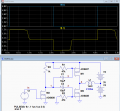
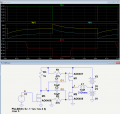
Here's an LTspice simulation of the circuit.
The coil is energized for nearly 1 second in each direction when the input pulse off and on time is longer than that, otherwise it's equal to the pulse time.
Positive coil current is left to right.
I see no reason it shouldn't work for you, unless the batteries have a problem delivering that much current.

upload_2018-6-27_9-7-26.png
 
Last edited:

Thread Starter

NickB

Joined Feb 1, 2016
95
Here's an LTspice simulation of the circuit.
The coil is energized for nearly 1 second in each direction when the input pulse off and on time is longer than that, otherwise it's equal to the pulse time.
Positive coil current is left to right.
I see no reason it shouldn't work for you, unless the batteries have a problem delivering that much current.

View attachment 155175
Hi Crutschow

Thanks for that, really appreciate your input. I'll give it a try with rechargeable AAAs as they have a bit more current.

Cheers
Nick
 

Thread Starter

NickB

Joined Feb 1, 2016
95
Here's an LTspice simulation of the circuit.
The coil is energized for nearly 1 second in each direction when the input pulse off and on time is longer than that, otherwise it's equal to the pulse time.
Positive coil current is left to right.
I see no reason it shouldn't work for you, unless the batteries have a problem delivering that much current.

View attachment 155175
Been playing around with this some more this evening and when I press and hold the remote for a couple of seconds the magnet is being attracted to the coil in very quick pulses to the point where it's vibrating.

Still can't get it to repel the magnet though.

Nick
 
Last edited:

Thread Starter

NickB

Joined Feb 1, 2016
95
Apologies for bouncing this thread but just wondered if anyone had any further suggestions?

I've breadboarded the project several times now with the same result. I just need a way to decouple the power supply for the receiver. Any suggestions great fully received.

Cheers
Nick
 

Alec_t

Joined Sep 17, 2013
15,120
Check R1 is indeed 1k and is making a good connection in the breadboard.
Add another 100uF cap across the 6V supply, to the right of the diode.
 

Thread Starter

NickB

Joined Feb 1, 2016
95
Check R1 is indeed 1k and is making a good connection in the breadboard.
Add another 100uF cap across the 6V supply, to the right of the diode.
Hi Alec_t

Many thanks for the reply, I was kind of hoping you'd weigh in given you designed the circuit.

Just tried a couple of 1k resistors made sure they are seated correctly, also tried a couple of 100uF caps across the supply, before and after the diode but same result. The magnet is drawn to the coil but doesn't repel when the button is released. The magnet actually vibrates against the coil when I hold the button on the remote for longer than 1 second - not sure the significance of that?

Regards
Nick
 

Alec_t

Joined Sep 17, 2013
15,120
The magnet is drawn to the coil but doesn't repel when the button is released.
That would happen if the N-MOSFET has a high-ish Vgs(th) threshold voltage and is not switching fully on because the positve supply rail is being pulled down close to or below the threshold, due to resistance in the supply. If you are using rechargeable cells, what is their voltage? Which FETs are you using?
Note that breadboards are not designed for high currents such as your coil draws, so may account for unwanted resistance in the supply circuit.
The magnet actually vibrates against the coil when I hold the button on the remote for longer than 1 second
If the positve supply rail is being pulled down, the diode drop is likely taking the receiver supply voltage below its correct value, so the receiver is switching off, then switching back on when the supply recovers. Rinse and repeat.
 
Last edited:

Thread Starter

NickB

Joined Feb 1, 2016
95
That would happen if the N-MOSFET has a high-ish Vgs(th) threshold voltage and is not switching fully on because the positve supply rail is being pulled down close to or below the threshold, due to resistance in the supply. If you are using rechargeable cells, what is their voltage? Which FETs are you using?

Note that breadboards are not designed for high currents such as your coil draws, so may account for unwanted resistance in the supply circuit.

If the positve supply rail is being pulled down, the diode drop is likely taking the receiver supply voltage below its correct value, so the receiver is switching off, then switching back on when the supply recovers. Rinse and repeat.
I've tried both rechargeables and standard AAAs. Rechargeables are providing 1.43v each. These are the FETS I'm using:

https://www.mouser.co.uk/ProductDetail/ON-Semiconductor/NTD25P03L?qs=ZXBb0xZ9WeA0AV3O9p9FIg==
https://www.mouser.co.uk/ProductDet...9nfSE1PFLFpRUU/ZLLM0I92SKHYRZutb9xSq24xGN3A==

I'm also using the same spec N channel FET for the switch.

Didn't realise that about breadboards. Just tried a different breadboard - same result. Min voltage for the receiver is 5v so if forward supply is losing 1v or so that may explain the vibration. However, I just removed the diode and 100uF cap and it's still vibrating.

If you could let me know your thoughts on those FETS before I fire up the iron and dispense with the breadboard that would be much appreciated.

Cheers
Nick
 

mtripoli3

Joined Mar 1, 2016
35
Just to be clear - the first circuit posted is setup the way it is (two separate battery banks) so that it can be used half-bridge. By turning on one switch or the other, you get "forward/reverse" action. Now, you want to do the same thing, using just one battery (power source). This is done with a full-bridge... Ton's of references out there for this, so I won't go into it here. Stay with FET's to minimize voltage drops...

Let me know if you have any questions, I could throw together an LTSpice drawing...

Mike Tripoli
 
Last edited by a moderator:

Thread Starter

NickB

Joined Feb 1, 2016
95
Just to be clear - the first circuit posted is setup the way it is (two separate battery banks) so that it can be used half-bridge. By turning on one switch or the other, you get "forward/reverse" action. Now, you want to do the same thing, using just one battery (power source). This is done with a full-bridge... Ton's of references out there for this, so I won't go into it here. Stay with FET's to minimize voltage drops...

Let me know if you have any questions, I could throw together an LTSpice drawing...

Mike Tripoli
Hi Mike, thanks for the input. The first schema is the way it's currently set up - this won't change. The arrangement of 2 x 3v (AAA) battery banks will remain. My issue is how to power the receiver. The chaps on here have kindly done several simulations and said it should work as per the first or second schema using the combined 6v supply. As I mentioned in my reply to Alec above it's just not working as it should.

It works fine if I add a separate 6v supply for the receiver though (an additional 4 x AAA) and tie it to a common ground. Unfortunately there's just not the room for an additional supply, hence why I'd like to try and use the two banks of AAAs for everything.

Any suggestions welcome.

Nick
 

Alec_t

Joined Sep 17, 2013
15,120
I'm also using the same spec N channel FET for the switch.
Try swapping the two N-FETs over, in case one has a higher Vgs(th) than the other.
The specs look ok for both the P and N FETs.
I just removed the diode and 100uF cap and it's still vibrating.
No surprise there. They were intended to decouple the receiver from brief transient dips in the supply, but 100uF can't hold much reserve juice. Do you have a higher value cap to hand (say 470uF or more), to help test the theory that supply drop is the problem? Do you have an analogue voltmeter to check if the supply dips?
If you had access to a 'scope it would useful for debugging.
 

Thread Starter

NickB

Joined Feb 1, 2016
95
Try swapping the two N-FETs over, in case one has a higher Vgs(th) than the other.
The specs look ok for both the P and N FETs.

No surprise there. They were intended to decouple the receiver from brief transient dips in the supply, but 100uF can't hold much reserve juice. Do you have a higher value cap to hand (say 470uF or more), to help test the theory that supply drop is the problem? Do you have an analogue voltmeter to check if the supply dips?
If you had access to a 'scope it would useful for debugging.
Hi Alec

Tried swapping the N-FETS, no difference. Played around with different caps (I've got loads), first a 470uF, 10v cap, then a 1000uF, 6.3v cap. Using these caps, when the button on the remote is pressed and held for 1 second it attracts the magnet, jitters, then repels it?? Not sure what's going on as it's supposed to reverse when the button is released.

Voltmeter between cap/receiver and ground reads 4.75v - when button is pressed it drops to 4.65v. Without caps and diode, voltmeter reads 5.5v between 1k resistor/receiver and ground, dipping to 5.3v when button is pressed. Without the diode and cap in place magnet just vibrates slightly. Would it be useful if I posted a pic of the breadboard setup for sanity checking?

Regards
Nick
 
Top