Take a photo and post it.Okay thanks! I have got some long wires and I am using a breadboard to wire everything so maybe they could be a source of noise. Other than that I am not too sure what else.
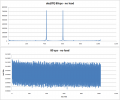
Actually, you do have periodic noise -- at exactly 31.49Hz.Hi..
I just managed to get rid of some of the peaks. (I had been measuring data with the DMM connected at the input, so I am guessing this was causing problems). I also Placed a 1uf cap between AINPP and AINN. Now I get about noise of about 2000-3000 codes P-P at 80sps.
I still have one more peak to get rid of, which is the one occuring at the 419th sample (freq = 31.49).
I have attached the data how it looks now.. I do not have anymore periodically repeating data now! does the data look like something I can work with? or I need to get rid of that peak before I do anything else?
Sorry to go back to this, but I actually did not understand this line.This is just math. The noise is "referred" to the input -- in other words, what would input signal noise have to look like in order to produce the same digital result.
35 nVrms is equivalent to 35 nVrms / (1.416 nV/count) = 24.8 counts RMS.
.
Correct.So lets say my system and the ADS1231 are ideal and I get a constant no load output of 300000 (offset) (therefore 1.416nV * 300000 = 0.425mV).
Yes. Keep in mind the individual code numbers represent really, really small incremental voltages. This is due both to the resolution of the converter (24 bits) and the internal PGA (x128).for me to get the noise data in nV (Which should be 0 p-p since all the data will be constant 300000 or 0.425mV as a voltage) is it just a matter of dividing this by 1000000 to get the data in nV?
I don't understand what you mean by "represent", but 24.8 counts RMS of noise on the digital output is equivalent to 35 nVrms of noise referred to the input.In your calculations above you used 35nVrms that they have in the table to get 24.8 counts RMS but what does that represent?
Thanks for the explanation I finally understand!Lets put it another way.
You haven't told us what the full-scale output of your load cell is, but let's assume for discussion it's 2 mV/V, which is typical.
You are supplying 3.04V to the load cell, so the full-scale output voltage (difference between no load and full load) is 3.04V * 2 mV/V = 6.08 mV.
At 80 sps, you are getting a max p-p noise of 3,000 counts. Referring this back to the input, this is equivalent to (3000 counts) * (1.416 nV/count) = 4.248 uV p-p. This is the best resolution you will attain (i.e. you can resolve the input signal to no more than 4.248 uV).
Your dynamic range is (6.08 mV / 4.248 uV) = 1431 to 1 (63dB). In other words, there are 1,431 individual steps you can actually resolve -- anything smaller will be uncertain.
1,431 steps (or, divisions as they are called) is equivalent to log(1,431)/log(2) = 10.5 bits of performance.
This is no where near the actual capability of the chip (15.4 noise-free bits at 80sps and 3V Vref).
15.4 bits represents 43,238 divisions (92db dynamic range).
Edit: Oh! I should point out that you are consuming about 2 bits of your dynamic range because your full-scale output voltage (6.08mV) is about 1/4 of the total input voltage range of the ADS1231 with 3.04V reference voltage (input range from -11.875 mV to +11.875 mV or 23.75mV overall). Therefore, the best you can expect is 13.4 bits or 10,809 divisions (80.6 dB).
Is that something standard or there is a way to get those numbers? why would it be 30Hz for 50Hz power etc.? Is there a way of knowing what type of noise it is at different frequencies or it is just something u have from experience?It's not. You'd see peaks at precisely 20Hz (for 60 Hz power) or 30Hz (for 50 hz power). I don't see that.
At 80sps, your Nyquist frequency is 80Hz / 2 = 40Hz.Is that something standard or there is a way to get those numbers? why would it be 30Hz for 50Hz power etc.? Is there a way of knowing what type of noise it is at different frequencies or it is just something u have from experience?
How are you calculating these sum acquisitions? 61 and 49? just incase the peak does appear at a different frequency, I will know how to calculate this?
additionally.
If you want, post a .txt file with the actual 1,024 datapoints, and let me run my own FFT. Then I can confirm the actual frequency if I am wrong.
ahh No worriesBTW, my motivation for helping you is selfish. I usually use the ADS1242 -- and I know exactly what to expect from it.
The ADS1231 is slightly less pricey, and I may have a use for it. I am using you to help me gauge its ultimate performance. So, I'd really like you to find and eliminate that noise peak.
This comment is not helpful. In what way are you not able to open it?I cannot seem to open your file.
It downloads as ads1231.ods.txt. but I cannot edit out the .txt extention.This comment is not helpful. In what way are you not able to open it?
Thanks!Hello,
Here is Joey's file again.
You can open it in OpenOffice or LibreOffice.
Bertus
PS I enabled the .ods and .odt extentions