ADC Do we need a split ground.

Thread Starter

hoyyoth

Joined Mar 21, 2020
528
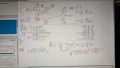
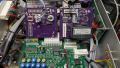
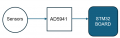
I am using AD5941 for my measurements from different sensors.I will be making a breakout board such that in my board I will be providing pads for connecting the sensors and the output of AD5941 will be connected to STM32 board.
1752176026983.png

The power requirements of AD5941 is given below.

1752176100796.png

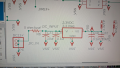
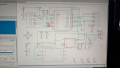
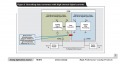
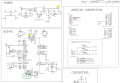
I checked the reference design provided in their website.AVDD (3.3V) is generated in the board with the help of a voltage regulator and DVDD (3.3V) is coming from an Arduino board and also the digital ground of AD5941(DGND) is Arduino ground.
1752176133829.png


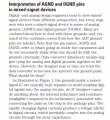
As per my literature study what I understood is split plane is not a good idea.

If I am not using split plane can I use single LDO for powering the ADC( for both AVDD and DVDD)?


Also what do you think,why analog devices reference design they provided split ground and different power supply for Analog and digital domain.

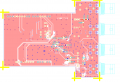
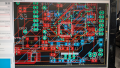
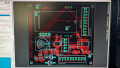
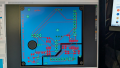
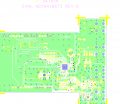
The reference design file downloaded from AD website is attached here.

TOP Layer:
1752176435980.png

BOTTOM LAYER:

1752176461716.png
 

Attachments

crutschow

Joined Mar 14, 2008
38,321
Don't know what "literature" you studied, but there's nothing wrong with a split ground-plane if done properly (split underneath the ADC with a single-point connection between the two (can be made with a surface-mount ferrite bead to improve noise isolation between the two).
Using only one ground plane for both will invite digital noise into the analog signal.

You could also use a single power supply for both the analog and digital circuits, but separate them with ferrite beads and separate decoupling capacitors to their respective ground planes for minimum noise.

I once had to troubleshoot an ADC board with excessive noise from the ADC, which turned out to be improper connection of the ADC to the split analog and digital ground planes.
Relaying the PCB to correct that solved the problem.
 

nsaspook

Joined Aug 27, 2009
16,251
If the DVDD (3.3V) is from a linear LDO Voltage Regulator the task of conducted noise reduction will be much easier but not guaranteed. The REF design doesn't assume the AVDD (3.3V) will be clean and the OP shouldn't either.

There are tons of builds with noise issues from shared DVDD and AVDD supplies when using high resolution (16-bit or greater)ADC circuits with SPI data links.

https://www.mouser.com/datasheet/2/609/ADM7155-3120627.pdf
GENERAL DESCRIPTION The ADM7155 is an adjustable linear regulator that operates from 2.3 V to 5.5 V and provides up to 600 mA of load current. Output voltages from 1.2 V to 3.4 V are possible depending on the model. Using an advanced proprietary architecture, it provides high power supply rejection and ultralow noise, achieving excellent line and load transient response with only a 10 μF ceramic output capacitor.

https://www.analog.com/en/products/ad5941.html
  • 16-bit ADC with both 800 kSPS and 1.6 MSPS options
  • Voltage DACs
    • Dual output voltage DAC with an output range of 0.2 V to 2.4 V
  • 12-bit VBIAS0 output to bias potentiostat
    • 6-bit VZERO0 output to bias TIA
    • Ultra low power: 1 µA
    • 1 high speed, 12-bit DAC
      • Output range to sensor: ±607 mV
      • Programmable gain amplifier on output with gain settings of 2 and 0.05
  • 1 low noise, low power TIA, suitable for measuring sensor current output
    • 50 pA to 3 mA range

With device features like that, the frontend power noise is critical for small signal measurement.
 

Thread Starter

hoyyoth

Joined Mar 21, 2020
528
Don't know what "literature" you studied, but there's nothing wrong with a split ground-plane if done properly (split underneath the ADC with a single-point connection between the two (can be made with a surface-mount ferrite bead to improve noise isolation between the two).
Using only one ground plane for both will invite digital noise into the analog signal.

You could also use a single power supply for both the analog and digital circuits, but separate them with ferrite beads and separate decoupling capacitors to their respective ground planes for minimum noise.

I once had to troubleshoot an ADC board with excessive noise from the ADC, which turned out to be improper connection of the ADC to the split analog and digital ground planes.
Relaying the PCB to correct that solved the problem.
Below are the literature I checked.


https://www.analog.com/en/resources... Grounds,Example of Good Circuit Partitioning.

https://resources.altium.com/p/how-properly-ground-adcs

https://resources.pcb.cadence.com/b...ver-separate-analog-and-digital-ground-planes
 

Thread Starter

hoyyoth

Joined Mar 21, 2020
528
If the DVDD (3.3V) is from a linear LDO Voltage Regulator the task of conducted noise reduction will be much easier but not guaranteed. The REF design doesn't assume the AVDD (3.3V) will be clean and the OP shouldn't either.

There are tons of builds with noise issues from shared DVDD and AVDD supplies when using high resolution (16-bit or greater)ADC circuits with SPI data links.

https://www.mouser.com/datasheet/2/609/ADM7155-3120627.pdf
GENERAL DESCRIPTION The ADM7155 is an adjustable linear regulator that operates from 2.3 V to 5.5 V and provides up to 600 mA of load current. Output voltages from 1.2 V to 3.4 V are possible depending on the model. Using an advanced proprietary architecture, it provides high power supply rejection and ultralow noise, achieving excellent line and load transient response with only a 10 μF ceramic output capacitor.

https://www.analog.com/en/products/ad5941.html
  • 16-bit ADC with both 800 kSPS and 1.6 MSPS options
  • Voltage DACs
    • Dual output voltage DAC with an output range of 0.2 V to 2.4 V
  • 12-bit VBIAS0 output to bias potentiostat
    • 6-bit VZERO0 output to bias TIA
    • Ultra low power: 1 µA
    • 1 high speed, 12-bit DAC
      • Output range to sensor: ±607 mV
      • Programmable gain amplifier on output with gain settings of 2 and 0.05
  • 1 low noise, low power TIA, suitable for measuring sensor current output
    • 50 pA to 3 mA range

With device features like that, the frontend power noise is critical for small signal measurement.
May I know can I use the one more ADM7155 for powering DVDD.
 

MrChips

Joined Oct 2, 2009
34,628
A circuit layout with an ADC is a typical mixed signal application. You should keep AGND and DGND separate.

AVDD and DVDD can come from the same 3.3 V source but apply additional HF filtering using a ferrite bead.
 

Thread Starter

hoyyoth

Joined Mar 21, 2020
528
AVDD and DVDD can come from the same 3.3 V source but apply additional HF filtering using a ferrite bead.
May I know you have any circuit suggestion for this .Or how do I design the circuit.
Some reference will help me.I will go through it and come here for clarification.
 

nsaspook

Joined Aug 27, 2009
16,251
May I know can I use the one more ADM7155 for powering DVDD.
I wouldn't share the regulated power. It's good engineering (and not a luxury with sensitive applications) to keep the digital and analog power separate with a 16-bit adc that has active sensor capabilities for bio-medical applications. For a simple 12-bit adc that measures DC volts or amps in power systems, I have just used a HF filter but with high resolution devices, the issues are more complex than simple digital noise pulses and require both a quiet, very stable power source and a quiet ground to reference from.

https://www.ti.com/video/5422297166001

https://ez.analog.com/data_converte...6/ad9707-do-i-need-to-separate-dvdd-avdd-cvdd
 

crutschow

Joined Mar 14, 2008
38,321
Below are the literature I checked.
Okay, you can follow those recommendations if you like
Certainly Analog Devices likely gives expert advice on that.

But you asked here, and my experience is that a split plane works well for AD applications to minimize noise in the converted signal, if properly implemented.
 

Thread Starter

hoyyoth

Joined Mar 21, 2020
528
I wouldn't share the regulated power. It's good engineering (and not a luxury with sensitive applications) to keep the digital and analog power separate with a 16-bit adc that has active sensor capabilities for bio-medical applications. For a simple 12-bit adc that measures DC volts or amps in power systems, I have just used a HF filter but with high resolution devices, the issues are more complex than simple digital noise pulses and require both a quiet, very stable power source and a quiet ground to reference from.
Thank you.Those links are very useful.

I will use two LDO's in my design for powering AVDD and DVDD.

My question is can I use same part number for these two LOD's(Like ADM7155 ).

Or do I need to use an Ultra Low noise LDO for AVDD and another LDO for DVDD(for example ADM7155 )

Please reply
 

Thread Starter

hoyyoth

Joined Mar 21, 2020
528
I normally use split-plane when the sensor analog/digital electronics are remote from the main controller and its power ground plane.
May I know in this design how you connected Digital Ground and Analog Ground.Did you use schottky diodes?

Where you kept that connection is it below the ADC in the bottom layer
 

MrChips

Joined Oct 2, 2009
34,628
The split ground plane is underneath the ADC package.
The AGND and DGND meet at the GND of the input voltage regulator. No Schottky diodes are requuired.
 

MrChips

Joined Oct 2, 2009
34,628
Power supply enters the board on Vs (+5 V) and GND. There should be a 100-470μF across Vs and GND.
These go to the +3.3 V 3-terminal regulator.
AGND and DGND both connect to the GND of the regulator.

If you are using separate +3.3 V regulators, AGND and DGND go to the GND pin of the corresponding regulator. In any case, both GND pins are connected together to supply GND.
 

Thread Starter

hoyyoth

Joined Mar 21, 2020
528
If you are using separate +3.3 V regulators, AGND and DGND go to the GND pin of the corresponding regulator. In any case, both GND pins are connected together to supply GND.
In this case we have dedicated GND plane and GND planes for AGND and DGND exits.(Please don't feel bad,I am a beginner trying to learn).Then how the stackup will look like if it is a 4 layer board.
 

Thread Starter

hoyyoth

Joined Mar 21, 2020
528
Thank you.
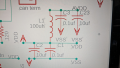
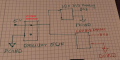
Suppose I have a schematic as shown below.
5V is entering (5V and PGND)
This 5V is going to two LDO's they are generating 3.3V for Analog(3V3,AGND) and 3.3V for Digital(3V3,DGND)

My question is how do I connect these 3 grounds in the schematic?If connection is made in the schematic,then only I
will get the connection in layout.

1752264924136.png
 
Top