AC Powering contacts?

Thread Starter

pjreijiri

Joined Aug 19, 2015
116
Hello,
I know this question was asked here before and it seems it didn't have an answer, but also that was back in 2013.
I am trying to make a custom PCB and I need to be able to plug into it an AC male plug Type B. Is there any contacts that I can use?
I need enough for 18 plugs per panel and I need to make 20 panels. It would be cheaper and easier than buying the plastic plugs.
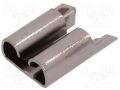
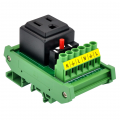
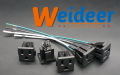
I have been trying to look for a solution for the past week but still haven't found anything other than fuse connector, which seems to be good dimension wise and load wise, but the company's chat support said no it doesn't work. It was the keystone 3555 (attached picture)

Any insight would be very helpful.
 

Attachments

Last edited by a moderator:
MisterBill2

Joined Jan 23, 2018
27,524
Plugging directly into contacts installed rigidly onto a PC board is not normally done. The reason is that AC line plugs tend to not be consistent enough in the pin spacing to avoid connection problems.
What sort of applications is this?? Certainly there will need to be additional support of the female portion of the connection, how would that be achieved??
I addition, that sort of design may not meet U.L. standards as far as not causing fires. THAT is why you have not been able to find products for it.
 

Thread Starter

pjreijiri

Joined Aug 19, 2015
116
Hello MisterBill,
It is meant for a specialized power strip. And I am trying to make it where it is simpler to put together. I want to see if it is feasible first before running it through some UL testing.

I was thinking I there is not one out there to design the contact myself and make it where it is through hole and maybe add a protective sleeve to be sold with it to reduce arcing. I have a lot of experience in manufacturing so that wouldn't be a problem to get it sourced.

Do you think there would be a demand for it?
 

panic mode

Joined Oct 10, 2011
4,985
this is not dimensionally compatible for accepting AC style plug though one may try to make it work in a jam.
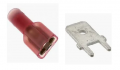
what you show is a spade type terminal. the one you show is female, non-insulated.
i use them occasionally as cheap high current board to board interconnect.
1743435367477.png

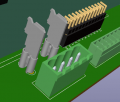
but for AC or anything above 30VDC I would rather go like this:
1743434783714.png
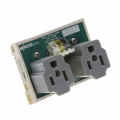
if you want PCB mount AC receptacle, why not get proper one?
the ones on Wago duplex are from Leviton but others exist too:
1743435478233.png
1743435127837.png
 
Last edited:

Thread Starter

pjreijiri

Joined Aug 19, 2015
116
I did look into the "green giant" you sent, if I needed just one that would fine, but the power strip needs 18 receptacles. So the price adds up drastically and the level of bulkiness goes to hulk level in 0.2 seconds :p

I did look into the spades and possibly find something similar, the only thing that seemed promising is the 3555 from keystone, but the company does not deem it safe for the application. And I am trying to see if it is a product that the market might need if there is nothing out there.
 

panic mode

Joined Oct 10, 2011
4,985
Last edited:

MisterBill2

Joined Jan 23, 2018
27,524
I can not imagine a plug-strip with rigid mounted contacts. The variable condition of mains plugs usually demands a bit of movement ability. in the mating part of the connector. Presently decent quality plug strips are commonly available in lengths up to eight feet,. So what would be the intended market for these specialized power strip. plug strips??
In addition, "easier to assemble" is a part of "design for manufacturing", which, in the examples that I have seen, is also "Designed to not be repaired."
And that always implies to me that the product is considered NOT WORTH REPAIRING!
 
Last edited:

Tonyr1084

Joined Sep 24, 2015
9,744
You say it would be cheaper. OK, perhaps. But how many hours are you going to spend assembling this / these? What's your time worth? You might save $20 but spend 10 hours building. Is your time worth $2.00 per hour? Those numbers are random, but hopefully you get my point.
 

MisterBill2

Joined Jan 23, 2018
27,524
Actually, the individual contacts could be machine inserted into punched holes quite rapidly. It is not likely thatpoking in a bunch of contact inserts would take even ten minutes, let alone ten hours.
 

Tonyr1084

Joined Sep 24, 2015
9,744
Actually, the individual contacts could be machine inserted into punched holes quite rapidly. It is not likely that poking in a bunch of contact inserts would take even ten minutes, let alone ten hours.
Automation always reduces costs. However, the machinery for automation can be quite expensive. If the TS is looking for a way to reduce the cost of building this/these - a $100,000 machine isn't going to be in the budget. Not unless this project is going to result in hundreds of thousands of product being produced each year. Even then there's maintenance on machinery that the cost has to be factored into the project.

As I said, I was stabbing at numbers only for the sake of making a point - it might be cheaper to get the parts to make yourself as a home hobbiest where I might be making a one-off device, and not be concerned with the amount of time put into the project. For the sake of the argument I was making is that a person's time can be just as precious as the dollars saved. Whether it's 10 hours, 10 minutes or 23.7 seconds. All numbers are arbitrary.
 

Tonyr1084

Joined Sep 24, 2015
9,744
Reviewing post #1 & 3
I need enough for 18 plugs per panel and I need to make 20 panels.
360 of these to be inserted. By machine - - - quick. But there's the cost of the machine. Even if it's a hand operated press, there's still that expense. A purpose built machine for inserting these plugs would have to hold the plugs securely while pressing them into a PCB. Certainly not $100K, but the TS did say he's looking for the cheapest approach.
I want to see if it is feasible first before running it through some UL testing.
If UL approval is going to be part of the project then it may be a potential project that may become a commercially available product. In that case, UL approval would be needed. There's a lot of expense going into the project, so perhaps a machine might be more cost effective. But we don't know if this is being built for a business or more so as a potential business. Or personal use. If for personal use - UL wouldn't be needed. If I build a bomb (HomeLand Security - take note - I'm not building bombs, I value my freedom) for personal use - no approval would be necessary. And yes, a "bomb" is a poor example, but the point is that I'm not making something for someone else to use, and potentially harm themselves. Or others. If it were for public use then safety protocol for consumers is 100% necessary.
 

MisterBill2

Joined Jan 23, 2018
27,524
REALY, I have designed and had PCBs built that used smaller inserts to connect modules, a long time ago. In addition I designed and created a hand tool to insert 0.o25 square pins five at a time in a PCB. The good assembly tech who did that in production easily could load five to six boards a minute, which for a production run of 25 PCBs was quite acceptable, as it provided a 100% production yield. Not a bit of automation needed. Of course, the mechanical tool production folks did have more resources than a claw hammer and a wood chisel.
 

Thread Starter

pjreijiri

Joined Aug 19, 2015
116
Thank you for all your feedback. Concerning the black plugs, they tend to be cheap if you want 1 or 2. But When you want to have 18 of them, you are talking about 30-40$ for a power strip. Plus I did build a few of those power strips, and they were taking multiple hours each. I had to place them and wire them, and that looked horrible, Then I tried to use copper strips and soldering those was a problem. Then I switched to custom PCBs, but I thought that eliminating the thermal reliefs won't be much of a problem, so soldering those took a long time.

My thought behind having receptacles that can be soldered to a PCB, they should be easy to install even soldering it by hand. If there is more demand to it, I can hire an assembler and they have their pick and place machines. I understand I would need UL certification if I want to start selling it. But I am exploring the possibility of a new product for the market.

Having small contacts like that might also help reduce the depth required for the enclosure. They can also be stamped, where I can make each for a few cents. Plus right now I am having to use an aluminum panel to hold the plugs, and the assembly goes into a plastic enclosure. If I use one big PCB, I can eliminate the need for an aluminum panel, and that reduces cost but 10-15$. With just these two modifications, I can reduce the cost by 50-60%. Then I have less need for wires, so assembly time can be reduced, and cost of wires can be reduced as well. At that point, I can hire lower skilled labor to do the assembly, instead of highly skilled. Right now my cost is around 120$ each. plus assembly. I might be able to reduce cost to 20-30$ if I am able to get those contacts
 
Top