AC or DC/Active or Passive piezo buzzers?

Audioguru again

Joined Oct 21, 2019
6,826
If you add an inductor parallel with the piezo as a DC load for the transistor then it will play only one loud frequency since the inductor and the capacitance of the piezo make a tuned LC circuit. If a high power resistor is used as a DC load then the squeaker can play a few high pitched frequencies.
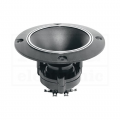
The horn of the squeaker concentrates its few high frequencies in one direction.

The maximum voltage of the piezo horn squeaker is +35V and -35V which is 70V peak-to-peak. Then it can be driven from a push-pull audio amplifier powered from +37V and -37V which would produce 153 real Watts into 4 ohms or 77 real watts into 8 ohms. Driven with 70V peak-to-peak the piezo squeaker will produce a few loud high-pitched frequencies.
 

Audioguru again

Joined Oct 21, 2019
6,826
Using your transistor circuit with a higher voltage (maybe 35VDC), simply connect an inductor parallel with the piezo squeaker for it to play a single high frequency or connect a resistor parallel with the piezo squeaker for it to play a few high frequencies.
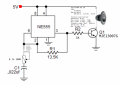
For a 5 volt supply

Like this if limited to a 5 volt supply?
View attachment 300357
A 555 does not have a single-ended output like an open-collector transistor. Instead its output is push-pull going close to ground and going to about 1.4V less than the power supply voltage. Since a piezo is a capacitor, the resistor parallel to it in the 555 output is not needed but might make the sound level slightly louder. For the loudest squeak the 555 frequency must be tuned to a resonant frequency of the piezo squeaker.
 

Thread Starter

cmpx

Joined Oct 23, 2021
48
By conclusion I need to take a power supply with a greater voltage than +12, +5V. A power supply voltage should have greater than 35VDC.
 

Thread Starter

cmpx

Joined Oct 23, 2021
48
If you add an inductor parallel with the piezo as a DC load for the transistor then it will play only one loud frequency since the inductor and the capacitance of the piezo make a tuned LC circuit. If a high power resistor is used as a DC load then the squeaker can play a few high pitched frequencies.
The horn of the squeaker concentrates its few high frequencies in one direction.
The maximum voltage of the piezo horn squeaker is +35V and -35V which is 70V peak-to-peak. Then it can be driven from a push-pull audio amplifier powered from +37V and -37V which would produce 153 real Watts into 4 ohms or 77 real watts into 8 ohms. Driven with 70V peak-to-peak the piezo squeaker will produce a few loud high-pitched frequencies.
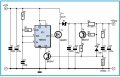
Can I use this Horn on this circuit below?
3.png
2.png

It is only for 12 Volts and Horn should be louder on it.

A piezo tweeter cannot be driven by a single-ended signal but works when it is parallel with a resistor or the coil of a woofer.
The specs rate the woofer speaker with 4 ohms or 8 ohms so that the piezo tweeter can match the loudness of the woofer.
The piezo horn speaker will not work being driven with only one transistor because it does not have a coil, it is a capacitor. The 555 can drive it but with a supply of only 5V it will not be loud.
I understand there is type of sound speaker with coil and magnet.
A am new to it and I don't claim I am right.

Piezo Horn iz Capacitive hight tone speaker if I think right.
 

Audioguru again

Joined Oct 21, 2019
6,826
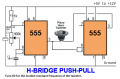
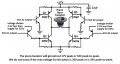
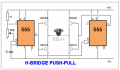
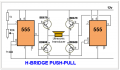
The H-Bridge circuit you found is for a 4 ohms or 8 ohms coil and magnet speaker that draws a current of 4.5A peak into a 4 ohms speaker. Its current into a Piezo tweeter is much less then you do not need the darlington transistors and their voltage losses.
The circuit you posted is not an H-bridge because you have one side of the piezo tweeter grounded and are not even using the right side of the bridge.
Make the circuit and its connections like this and tune the frequency for the loudest resonance of a few kHz:
 

Attachments

Thread Starter

cmpx

Joined Oct 23, 2021
48
The circuit you posted is not an H-bridge because you have one side of the piezo tweeter grounded and are not even using the right side of the bridge.
It was just my try.
I want to drive this piezo tweeter until 30 to 35 Volts.
I understand it is not an H-bridge.

If I connect piezo tweeter by original circuit diagram with 1nF capacitor I get very disturbing sound that sounds
like searching for empty radio frequencies. It is not piezo sound like.

My circuit is connected to the circuit below by the following order:
1704313814362.jpeg
After that it is connected over Bench power supply so the voltage output is only +5 to +12 volts
I want to drive this piezo tweeter until 30 to 35 Volts.

I want to use transistors for piezo tweeter because NE555 cannot be driven over 15 volts.
Thank you for your diagram but I need to use it with transistors for the reason I want to drive this piezo tweeter until 30 to 35 Volts.
 

Audioguru again

Joined Oct 21, 2019
6,826
When you wrongly used only half of the H-bridge circuit and a 12V supply, the output high of the 555 cannot go to +12V because its datasheet shows that it goes high to only +10.6V. The datasheet for the NPN darlington transistor shows that with a base voltage of +10.6V then the emitter goes to only about +9.2V. The output low of the 555 goes to about 0.2V then the emitter of the PNP darlington goes low to +1.6V. Then the piezo tweeter got a peak-to-peak voltage of only 9.2V - 1.6V= 7.6V. The peak voltage is only 3.8V and the RMS voltage is only 2.7V.

When the tweeter is connected properly (as I showed) to the H-Bridge circuit then the peak voltage to the tweeter is doubled.

Only low impedance high current coil and magnet speakers need the darlington transistors.
The piezo tweeter does not need the darlington transistors and their voltage losses.

Without the darlington transistors and a 12V supply, the piezo tweeter gets a positive peak voltage of 10.6V - 0.2V= 10.4V and a negative peak voltage of 12V - 0.2V= -11.8V. The average peak voltage is 11.1V and the RMS voltage is 7.9V.

The maximum voltage to the piezo tweeter is 35V but they do not say RMS, peak or peak-to-peak volts.
They say music power at 4 ohms= 300W (which might be peak power) then the peak voltage is 35V (34.7V squared/4 ohms= 301W) and the RMS voltage is 24.8V.
 

Thread Starter

cmpx

Joined Oct 23, 2021
48
Ok I will try this circuit.
Can you show me an example how to drive this tweeter on by NE555 with maximum power.
I want to drive it on higher voltage to get maximum power of sound.
I cannot drive NE555 over 15 Volts?


Audioguru again

Joined Oct 21, 2019
6,826
If the NE555s are powered from +16V then the piezo will get 27V or 28V p-p in that H-Bridge circuit.
Watch out that the loud sound does not destroy your hearing.
 

Thread Starter

cmpx

Joined Oct 23, 2021
48
Yes but it is abosolute maximum for NE555.
Supply- voltage operating range for the 555 is +4.5 volts (minimum) to +16 volts (maximum), and it is specified for operation between +5 volts and + 15 volts.
Is it possible to connect transistors and tweeter to 27V but NE555 to stay connected at +5 to +12 volts at the same power supply?
 

Thread Starter

cmpx

Joined Oct 23, 2021
48
5.png
At begin of this thread I asked for piezo is it AC or DC.
I did not look at begin at my Horn speaker chasis there is signed at the back as Plus and Minus input wires.
How I understand in this thread if it is capacitive it must has peak-to-peak.
 

Alec_t

Joined Sep 17, 2013
15,123
The plus and minus markings are useful if you wanted to drive two speakers in parallel. The drive signals would still be AC, but by connecting the "+" of one speaker to the "+" of the other (likewise the two "-" ) the speakers would be in phase. (If they were in anti-phase the sound outputs would tend to cancel each other.)
 

jiggermole

Joined Jul 29, 2016
186
Just my two cents in, maybe related maybe not. When I was having a volume issue I didn't have the correct size parallel resistor to discharge the capacitance of the peizo when my square wave went low. Its important that it is sized correctly is all I have to add.
 

Thread Starter

cmpx

Joined Oct 23, 2021
48
I tried this circuit with BD139 and BD140 but they blew up for the reason they are
just about 12.5 watts.

Can I use this circuit with BD679 and BD680?

1.png

What PNP and NPN transistors should I use to get maximum power?

I am going to drive this circuit like at 12 Volts (+6V and -6V) to hear how much loud it will be in practic.

What is the total power of load I can connect if there are four transistors with identical power in the H-Bridge circuit.

How to calculate it?
Is it related to the four sum of powers per each separate transistor?
Is it related to the double sum of powers per each separate transistor?

I have MJE13007 and MJE13009G. Are they sutable for this kind of circuit application?
What are their PNP closest equivalent?
 
Top