Does a Linear Active Diode Run Cooler than a Passive Diode?

crutschow

Joined Mar 14, 2008
38,430
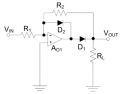
Will linear active diode like this run cooler than a passive diode? Or is it just to eliminate the voltage drop?
https://www.allaboutcircuits.com/video-tutorials/op-amp-applications-active-rectifier/
It does both.
Reducing the voltage drop, reduces the power dissipation for a given current, which thus would allow the device to run cooler (assuming they both have about the same thermal resistance to ambient).

Edit: Correction. I was mistakenly talking about an ideal rectifier circuit, not the active rectifier circuit in your reference. The active rectifier will dissipate the same power for the same current as a normal rectifier.
 
Last edited:

crutschow

Joined Mar 14, 2008
38,430
But it will run cooler than a passive diode?
The switched-MOSFET will.

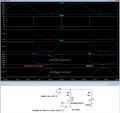
Below is the LTspice sim of a switched-MOSFET rectifier versus a silicon-junction rectifier for a 1A peak rectified current:
The N-MOSFET is switched on (yellow trace) for the negative have cycle of the supply voltage (blue trace) to perform the low drop rectify function.
The forward drop of the MOSFET (pink trace) is 76mV while the diode drop (purple trace) is near 1V
This gives a diode peak dissipation (white trace) of near 1W, and a MOSFET peak dissipation (orange trace) of <76mW.

1726640169033.png
 
Last edited:

schmitt trigger

Joined Jul 12, 2010
2,056
To complement Crut’s excellent answer, the ideal diode will generate less power losses for the same forward current.

Whether it will run cooler, depends on the thermal resistance from junction to ambient. In other words, how well the device can dissipate the heat.
 

crutschow

Joined Mar 14, 2008
38,430
My question is about the linear op amp active rectifier in the article.
And as I previously noted (why do I need to repeat this?), the dissipation in the active rectifier diode is the same as the normal rectifier at the same current.
All the op amp does is reduce the diode offset in the output by a factor equal to its open-loop gain.
 

BobTPH

Joined Jun 5, 2013
11,491
And as I previously noted (why do I need to repeat this?), the dissipation in the active rectifier diode is the same as the normal rectifier at the same current.
All the op amp does is reduce the diode offset in the output by a factor equal to its open-loop gain.
But isn’t the opamp dissipating additional power? Correct me if I am wrong, but isn’t the current coming from the opamp output? And doesn’t it drop the voltage between its supply and the output?
 

crutschow

Joined Mar 14, 2008
38,430
But isn’t the opamp dissipating additional power? Correct me if I am wrong, but isn’t the current coming from the opamp output? And doesn’t it drop the voltage between its supply and the output?
Of course.
But did you not read the TS's first post?
The question was only about the diode dissipation/temperature, not total power.
 

BobTPH

Joined Jun 5, 2013
11,491
That is one possible interpretation. I took “linear active diode” to refer to the whole circuit, not just the diode.

In any case, assuming a typical op amp that can output 20mA t most, the diode ain't gettin’ all that hot.
 

Thread Starter

johnyradio

Joined Oct 26, 2012
615
why do I need to repeat this?), the dissipation in the active rectifier diode is the same as the normal rectifier
I asked: "Will linear active diode like this run cooler than a passive diode? Or is it just to eliminate the voltage drop?"
You replied: "It does both."
I see you went back and edited your answer later. Not fair to be annoyed that i missed your later edit.
The question was only about the diode dissipation/temperature
My question is about the entire circuit, not just the diode.
I took “linear active diode” to refer to the whole circuit, not just the diode.
Yep. In usage, the entire active diode replaces the passive diode, so a meaningful comparison looks at heat of the entire circuit.

Although, this op amp based circuit might not be practical for my purpose anyway, since my load wants 3A. If this requires an op amp that can deliver 3A, then i cannot find an op amp that can do that.
the ideal diode will generate less power losses for the same forward current.
Whether it will run cooler, depends on the thermal resistance from junction to ambient. In other words, how well the device can dissipate the heat.
So losses are lower, but heat depends on device dissipation. In the linear circuit, do you mean dissipation in the op amp or the diode? If it's the same diode as used in the passive rectifier, then if losses are lower, then heat must be lower too, right?
 
Last edited:

BobTPH

Joined Jun 5, 2013
11,491
If it's the same diode as used in the passive rectifier, then if losses are lower, then heat must be lower too, right?
The diode carries the same current, so it alone dissipates the same power as the simple diode circuit. But that same current goes through the op amp, so it also dissipates power.

Also, the power is coming from a different place. Without the opamp, it is coming from Vin, with the active circuit it is coming from the supply to the opamp.
 

crutschow

Joined Mar 14, 2008
38,430
this op amp based circuit might not be practical for my purpose anyway, since my load wants 3A.
No it would not.
The reason for the precision rectifier circuit is to eliminate the forward-drop voltage of a diode in signal processing applications.
It makes no sense to use it for 3A in a power application, as there's no advantage, and it would just dissipate more power.

If you want to rectify 3A with minimum loss, then you would use a switched MOSFET ideal-diode circuit.
 
Last edited:
Top