AC motor soft start. Surprised there's not a simple solution

MrAl

Joined Jun 17, 2014
13,722
Hi,

If it is not a universal then probably the only solution is a VFD.

Some motors simply wont start unless they get nearly the full voltage to start with anyway. They will drop into thermal cutout and thus turn off.

For the triac and relay idea, may not be too bad but a failure mode is of course the relay sticks open or closed. if it sticks open then the triac is doing all the work until it is shut off.
 

MisterBill2

Joined Jan 23, 2018
27,683
There are quite a few soft-start packages available, and the good ones work very well indeed. They prevent both the huge inrush and the violent mechanical forces of a system being yanked up to full speed in much less than a second. They are even more beneficial on the bigger motors.
 

MaxHeadRoom

Joined Jul 18, 2013
30,695
If a Universal motor then the Triac method is typically used, IF it is an induction motor there is no satisfactory method using VFD as 1ph AC motors typically do not react well to VF.
Most in this case obtain a 3ph motor and use a VFD, 1ph AC fed.
Max.
 

Thread Starter

Robin66

Joined Jan 5, 2016
281
I can't see any confirmation from the the TS that it is a universal (Series wound motor.) At the momment it seems that it is only an assumption that it is a universal motor. If it is a single phase induction motor I don't think a soft start is possible.

Les.
I can confirm it's a series wound brushed motor
 

MaxHeadRoom

Joined Jul 18, 2013
30,695
What I did was detect the zero crossing and delay until around 6ms, (the next crossing occurs at 8.1ms) then fire the Triac, after the next Z.C. incrementally shorten the firing time over the desired delay period, e.g. 5sec etc, until the triac is full on.
Max.
 

MisterBill2

Joined Jan 23, 2018
27,683
If it is, as you say it is, a series brush/comutator motor, then an ordinary triac or SCR series motor control can work fairly well. In fact, just a variable voltage transformer will work well, except that switching to direct may be a bit more complicated. You could also use a transformer with just a few taps and start the motor in 3 or 4 steps and probably limit the inrush just as well.
But a table saw having a universal motor is indeed a bit unusual, all of them that I have used had induction motors. That is why folks asked about it, it is unusual.
 

Thread Starter

Robin66

Joined Jan 5, 2016
281
If it is, as you say it is, a series brush/comutator motor, then an ordinary triac or SCR series motor control can work fairly well. In fact, just a variable voltage transformer will work well, except that switching to direct may be a bit more complicated. You could also use a transformer with just a few taps and start the motor in 3 or 4 steps and probably limit the inrush just as well.
But a table saw having a universal motor is indeed a bit unusual, all of them that I have used had induction motors. That is why folks asked about it, it is unusual.
It's a low-end contractor's saw, so the power to weight ratio has been prioritized over smooth-running/longevity. I have scavenged the motor/gear/blade unit and mounted it under my own table made from mdf and ply.
 

Thread Starter

Robin66

Joined Jan 5, 2016
281
What I did was detect the zero crossing and delay until around 6ms, (the next crossing occurs at 8.1ms) then fire the Triac, after the next Z.C. incrementally shorten the firing time over the desired delay period, e.g. 5sec etc, until the triac is full on.
Max.
Yep sounds good, although I'm going to regulate the speed so it isn't going mad with no load. I'll use the PIC's ADC to detect the commutation ripple and modify the TRIAC firing based on if it's over or under-speed.
 

MisterBill2

Joined Jan 23, 2018
27,683
@THE_RB was a member here that developed a Universal motor rpm controller and he used a retro-reflective sensor for rpm detection, http://www.vhipe.com/product-private/index.htm
It uses a PID closed loop control.
A little fancy for what you need but the sensor method may be of interest.
Max.

At this point, with it being a series brushed motor and also set up for soft start, you can save all of the idling power by making it into a "run on demand only" setup. Not only saving power, but also safer, and less ambient noise level. And almost free to do it.
 

Thread Starter

Robin66

Joined Jan 5, 2016
281
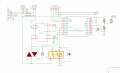
How does this look?
  • In series with TRIAC, I have an ACS712: ripple current measured to determine motor rpm
  • Neutral is connected to +5V from my floating 240VAC-5VDC module (I'll test with batteries to start)
  • I've connected a relay across the TRIAC, ON when 100% duty cycle
  • The PD on the righthand side of the PIC is determine the mains zero-cross
  • I've omitted decoupling caps for clarity
  • I'll use spare pins for a sounder and an LED power light

upload_2018-4-13_21-1-36.png
 

Thread Starter

Robin66

Joined Jan 5, 2016
281
I am trying to figure if this is going to fire the Triac satisfactorily from RB4/RA4.?
Max.
The max trigger current needed in Q2,3 is 10mA according to datasheet (typ. 4mA). Max Vgate is 1V, so that's ~4V across 220R = 18mA. Lots of headroom over 10mA if RB4/RA4 struggle to get to GND sinking Igate
 

shortbus

Joined Sep 30, 2009
10,049
But a table saw having a universal motor is indeed a bit unusual, all of them that I have used had induction motors.
Show just how much you really know. All of the portable saws and many other wood working tools made in the last 15 or so years have a universal motor in them. You really need to think before you type, before you get some one hurt. A high post count isn't as important as giving good workable information.
 

dendad

Joined Feb 20, 2016
4,641
A couple of questions
Will the port pin drive the relay ok without a FET?
And would it be better to have the PIC supply 0V to Neutral so the TRIAC gate goes high to turn on?
I'd still use a TRIAC driver opto as it makes the driving easier,even if you don't use it for isolation
Please keep us updated on you progress.
 

MisterBill2

Joined Jan 23, 2018
27,683
Show just how much you really know. All of the portable saws and many other wood working tools made in the last 15 or so years have a universal motor in them. You really need to think before you type, before you get some one hurt. A high post count isn't as important as giving good workable information.
The discussion was about table saws, no other kind of tools was mentioned. In addition, I was not making any comments about how to do anything. Besides that, that it was a motor from a portable contractor style table saw had not been mentioned. AND, you will notice that the one serious comment was qualified with "If it is a brush type" motor is certainly not a statement of what it must be,
So I suggest following the moderators admonitions and being more civil and not jumping down other people's throats.
 

Thread Starter

Robin66

Joined Jan 5, 2016
281
A couple of questions
Will the port pin drive the relay ok without a FET?
And would it be better to have the PIC supply 0V to Neutral so the TRIAC gate goes high to turn on?
I'd still use a TRIAC driver opto as it makes the driving easier,even if you don't use it for isolation
Please keep us updated on you progress.
  • RS sell 5V 10A relays for £1 with a coil resistance of 125R so that's 40mA which I could do with 2 or 3 pins 18mA pins
  • Quadrant 4 of the TRIAC (G+, T2-) is the least sensitive so best to avoid that one. Putting TRIAC gate low for ON uses Q2,3
  • Willdo
 

dendad

Joined Feb 20, 2016
4,641
RS sell 5V 10A relays for £1 with a coil resistance of 125R so that's 40mA which I could do with 2 or 3 pins 18mA pins
I still think it would be wise to have a transistor or FET switching the relay so the PIC pins are not running near max. The extra cost is just a few cents.
 
Top