AC-DC Rectifier with scrap components

Thread Starter

Murizg

Joined Mar 23, 2018
49
Hello everyone!
After I've introduced myself in Community subforum, I decided to ask for a help over here, although, I will also ask for forgiveness if I misplaced this thread or did anything else that is against the rules (I've read the Rules though :) ).
So, the thing is, I have a few electronic parts laying around that I've mostly salvaged from old computers, power amplifiers etc.
I am trying to build myself a decent variable power supply, single channel will do with outputs of around 30-40V, current limiting feature and it should be able to provide at least 5A. USB power connector would be also great and since I ordered a Arduino with a LCD display shield, I might even go and integrate a voltage-current meter. If not, I'll just go and buy that Red-Blue meter that you can buy online for a few dollars...
Now, I do realize that in most cases it might be smarter if not even cheaper to go ahead and buy myself a PSU from store, however, as I am quite new to electronics and this would be my first real project from which I hope to learn something as well as have a nice product in the end, I would really appreciate if you would go easy on me with this one. :)

So, first things first.
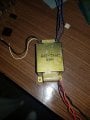
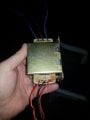
I want to design and create my first part of this PS, a circuit that will provide DC voltage. Now, I have a transformer whose photo I will attach here that is taking 220VAC on primary (I live in Croatia, Europe) and spits out 60VAC on one secondary with center tap (so I can have 30VAC here as well) and 32VAC on the other secondary also with a center tap (16VAC available here). Since the transformer has no markings whatsoever besides 641-788C and 15Q0ZP on itself, I got these data by connecting it to my mains and measuring voltage on secondaries.

Now, I really don't put too much hope that someone here will be able to tell me if this transformer will be capable of delivering 6-7 amps or not, but I will say that it is a quite heavy transformer, 1,94 kilograms to be more precise (4,27 pounds) and since I really can't say by anything else, I'll just have to believe it will be good enough for its purpose in this project. Of course, I'm open to any argument if someone thinks it won't be.

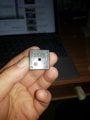
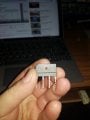
Second thing here is a Full Bridge Rectifier. I have two rectifiers that I'm really not 100% sure what are their capabilities. As I mentioned, I'm quite a newbie here so I would really appreciate if someone could point me to datasheet and actually what data should I be looking for there. I do know it should be able to take at least 10-20% more Voltage than the Transformer is going to feed it with, it should be able to take at least 6-7 of amps of current (if I'm not wrong) and it shouldn't dissipate too much heat.

So, rectifiers that I have are:
S5VB 60 63 (number 3 at the end has a horizontal line above it as you can see on the photo)
D3SBA20

Anyway, thank you very much for taking time to at least read this huge post, and even more if you bother yourself with replying. :)
PS
Sorry for my bad english
 

Attachments

Thread Starter

Murizg

Joined Mar 23, 2018
49
Hey Dana! :)
Thanks for your reply. Actually, I've gone through most of that thread, but, as I said, I'll just assume that my transformer will be able to handle that current as I don't think there is a reliable way of figuring out max current capability without disassembling the transformer or without some fancy equipment that I don't have nor would I know how to use. :)
I was actually more going after if the voltage outputs of the transformer will be enough for my application and if any of these two rectifiers will be suitable. As far as I can see from datasheet you've attached, this one, D3SBA20 will not as it can handle 4A of rectified current with a heatsink attached (if I read that datasheet correctly)...
 

Ylli

Joined Nov 13, 2015
1,092
Data sheets on your diodes. The first is rated up to 6 A with a heatsink, 3.5 A without. Second is rated at 4 A. Both are good on voltage.

http://pdf1.alldatasheet.com/datasheet-pdf/view/44016/SHINDENGEN/S5VB60.html
https://www.digchip.com/datasheets/parts/datasheet/3886/D3SBA20-4003-pdf.php

Estimate for transformer is 20 Watts per pound. If the transformer is 4.27 pounds, that translates to about 90 watts. If you are looking for an output of the power supply to be in the 30 - 40 volt area, that transformer will likely only give you between 2 - 3 amps.
 

ElectricSpidey

Joined Dec 2, 2017
3,316
A transformer that you can hold in your hand like that and at those voltages will probably not give you 5 amps...reliably.

But that is only a guess based on the power transformers I have used.
 

Thread Starter

Murizg

Joined Mar 23, 2018
49
Thank you Ylli!
So, basically, I should look for another Transformer?
Let's say I will limit my voltage to 30V, and if my Transformer can handle 90W, that would mean I could get 3A in best case scenario? I=P/V; I=90/30; I=3?
It wouldn't matter what secondary winding I use nor if I use center tap or not I suppose?
 

crutschow

Joined Mar 14, 2008
38,400
Assuming 20w/lb, your transformer can supply about 90W.
It you rectify and filter that to give a DC output of about 42Vdc, the transformer RMS current rating needs to be derated about 60% for a maximum safe DC output current of 2Adc.
This is due to the high peak RMS currents in the transformer from the typical peak rectifier/filter supply.
 
Last edited:

AnalogKid

Joined Aug 1, 2013
12,085
Since both outputs are center-tapped, consider a full wave center tap rectifier configuration. This needs only two diodes for each center-tapped secondary winding. You still can use the bridges you have, but they will run cooler. The transformer will run cooler, and you won't be dumping nearly as much excess power as heat. 60 VCT for the 30 V output, and 16 VCT for lower voltage fixed outputs like 12 V, 5 V, 3.3 V. Lotsa possible combinations.

ak
 

MrChips

Joined Oct 2, 2009
34,698
If you are now starting out, your first project and first power supply should be a fixed 5VDC 1A supply. You will find lots of reasons for using this.
You will need:

7-9VAC transformer
bridge rectified
LM7805 regulator
1000μF/16V electrolytic capacitor
10μF 16V electrolytic capacitor
100nF ceramic capacitor
470Ω ½W resistor
LED

Power cord
Strain relief
ON/OFF switch
Fuse holder
300mA fuse
Two banana jacks
Metal case

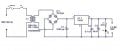
Something like this. I will post an updated circuit diagram later.


Thread Starter

Murizg

Joined Mar 23, 2018
49
Thank you very much guys!
Well, since I probably won't be making this variable power supply for obvious reasons, maybe I'll just go ahead and build this 5V one, just to kick off somehow.
MrChips, thanks for the diagram, I'll have to check if I have a 220/VAC-9VAC power transformer. I do know I have a 24V transformer, but I don't think the LM7805 would like that very much, would it?
 

MrChips

Joined Oct 2, 2009
34,698
You want the rectified and smoothed DC input voltage to the regulator to be about 3-4V higher than the regulated DC output voltage. Too low and the regulator would not have enough input headroom. Too high and the regulator has to dissipate this wasted wattage as heat.

Here is the revised circuit diagram:

Power Supply 5V.jpg
I have added an AC Line fuse and power switch. I have also added an LED ON indicator. If the output is shorted the LED will go out indicating a fault in the connected load circuit.

Note how I have drawn the fuse and ON/OFF switch. The fuse is connected to the AC LINE input followed by the switch. The fuse must be the first thing connected to the AC LINE. The switch must be on the same side as the AC LINE and fuse. The RETURN from the transformer primary winding is connected to AC NEUTRAL.

The metal chassis must be connected to the 3-conductor EARTH connection.
 

Thread Starter

Murizg

Joined Mar 23, 2018
49
Great!
Thanks a lot...
Just to double check, max current that this circuit will be able to handle will be determined by the transformer, bridge rectifier or the LM7805 IC? I suppose that the component with smallest current rating will be determining it?
 

MrChips

Joined Oct 2, 2009
34,698
Correct. Standard LM7805 is good for 1A. You can get similar three terminal regulators that will deliver 3A. For most experiments and hobby circuits you don't need 3A and 1A will do nicely. Leave a higher adjustable voltage and higher current power supply uint (PSU) for a later construction project.

In any case, yes, plan on installing a heat sink on the regular. An easy solution would be to bolt the TO220 package directly on to the metal case of the PSU.
 

crutschow

Joined Mar 14, 2008
38,400
n any case, yes, plan on installing a heat sink on the regular. An easy solution would be to bolt the TO220 package directly on to the metal case of the PSU.
You need to add an isolation washer when mounting it to avoid voltage appearing on the case.
 

MrChips

Joined Oct 2, 2009
34,698
Every newcomer to electronics must know and understand the meaning of a "floating" supply and a "non-floating" supply.

A standard battery such as any AA or 9V battery is a floating voltage supply, i.e. the +ve and -ve terminals on the battery are not referenced to any absolute potential voltage.

Once you connect one of the terminals to a ground connection, the battery is no longer floating.

Many commercial bench PSUs are floating, i.e. there is no reference to GND.

If you design and build the 5VDC PSU as suggested, the LM7805 regulator is floating and hence you will be creating a floating supply. The case of the TO220 package is internally connected to pin-2 of the IC. If you choose to mount the TO220 package directly to the metal chassis, then the chassis, pin-2, and hence the -ve output terminal are all connected. The power supply and case would still be still floating if the case is not grounded.

As @crustchow mentioned above, this can be a concern and danger to the uninitiated hobbyist.

The metal chassis must be grounded to the GROUND cable of the 3-conductor AC power cord. When you do this, the 5VDC PSU as wired above is no longer floating. The -ve terminal is now at GROUND potential. The +ve terminal is now at +5VDC.

In summary, you have to choose if you want your PSU to be floating or grounded. There are valid reasons for either option. The metal chassis must always be connected to SAFETY GROUND if the PSU is powered from AC mains.
 

MrChips

Joined Oct 2, 2009
34,698
In Croatia, which AC plugs do you have?

Type C


Type E


Type F


Type E and F are grounded. Type C is not grounded.

If you do not have access to a GROUND connection then obviously you cannot ground your chassis. In that case, do not connect your -ve supply to ground and do not bolt the voltage regulator to the metal case.

If you want to use the case as a heat sink you will need a TO220 insulation kit which consists of an insulation spacer and washer. The IC package must be insulated from the metal case.
 

Thread Starter

Murizg

Joined Mar 23, 2018
49
Once again, thank you all for your replies.
For starter, yes, I have to admit that I am struggling with grounding principles. I do know what the difference between earthing and grounding is, but more complex ideas get me quite confused. I went through few threads here with some discussion about it and I am getting a more clear picture of how it works now, but I believe that, as I suppose with every other novice in this field, I really need to see, maybe even design a few examples to realize how it all works and why.
Regarding the build itself, for now I managed to acquire banana posts, switch, LED with a housing holder, I have a C13 type power connector and a cable from an old, broken PC power supply, I believe that would work as well instead of a regular cable and a strain relief? This type, as I'm sure you know has a dedicated earth ground wire.
Also, as I do have several salvaged aluminium heatsinks salvaged from some components that can be fitted to LM7805, can I use those insted of attaching it to the case? As I was actually planning to use a plastic case for this project, I do have 3 laying around...
In Croatia, 99% of wall sockets are Type F, but some devices have Type C plugs. I knew that those don't have earth ground connection, but I wasn't really aware why is that.
 

Thread Starter

Murizg

Joined Mar 23, 2018
49
Or you can order the Full Pack version of the IC.
Well, to be honest, I think that I will struggle with finding components in general. Here in Croatia besides two specialized shops that I know of there is no really much of a choice.
I know I can order most of that online, but I would really like to get started with this ASAP. :)
 
Top