AC circuit

Thread Starter

Jony130

Joined Feb 17, 2009
5,598
Hi, I have a hard time with this simple circuit from the book.
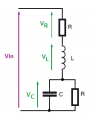
0.1aab.png
We know that VL = 3*VR and additional we know that the phase shift between VR and VC is 45°.
And our task is to find Vin in terms of VR.
I did this

\( Vin = V_R + 3 V_R*e^{j90} + V_R*\sqrt{2}*e^{-j45} \)

And my answer is Vin = 2*√2*VR ≈ 2.83 but this is wrong because the answer given by the book is Vin = 2.86*VR .

So what is wrong ?
 
Last edited:

WBahn

Joined Mar 31, 2012
32,823
Your formatting has problems and so I can't tell what you answer is for sure. If it is 2.83*Vr, then that is close enough to 2.86*Vr to likely be roundoff error (on either your part of the author's part of both).
 

Thread Starter

Jony130

Joined Feb 17, 2009
5,598
For E = 10V and R = 1Ω and Xc = -j1Ω ; XL = j3Ω
I get
Ztot = R1 + XL1 + 1/(1/R2 + 1/Xc1) = 2.91548Ω
and
Itot = E/Ztot = 3.42997A therefore VR = 3.42997V and

10V/3.42997V = 2.91547739 ??

So how should I approach this problem?
 
Last edited:

DGElder

Joined Apr 3, 2016
351
Your 3rd term is incorrect.

My answer agreed with the book's value: 2.86

I got Vin = 2.859 * Vr /_53.3 deg. w/r to current

Because of the given 45 deg phase shift: Xc = R, which means the current in each is one half the source current.
Therefore the voltage across R||C is 1/2 Vr.

Vin/_ = Vr/_0 + 3Vr/_90 + 1/2*Vr/_-45
Vin /_ = Vr + j3Vr + 1/2*Vr * (2^0.5 - j*2^0.5)
 
Last edited:

Thread Starter

Jony130

Joined Feb 17, 2009
5,598
But in terms of a magnitude Vc is not equal to 0.5VR if we assume Xc = -j 1Ω ; XL = j 3Ω; R = 1Ω
 

DGElder

Joined Apr 3, 2016
351
But in terms of a magnitude Vc is not equal to 0.5VR if we assume Xc = -j 1Ω ; XL = j 3Ω; R = 1Ω
Why not?
Vr is the voltage across the upper resistor, the problem says nothing about the lower resistor voltage

But you can infer it since the voltage across the lower R has to be half the upper R because it sees half the current. So Xc which sees the other half of the current has to be half of Vr as well.

Your approach in #6 is wrong. You can't add the voltage magnitudes together when they are out of phase. You have to covert to complex numbers and add real and imaginary parts separately.
 
Last edited:

Thread Starter

Jony130

Joined Feb 17, 2009
5,598
In term of a magnitude I get this VR_top = 3.43V and Vc = 2.43V and for Vin = 10V I got Vin/VR_top = 10V/3.43V = 2.91
 

DGElder

Joined Apr 3, 2016
351
In term of a magnitude I get this VR_top = 3.43V and Vc = 2.43V and for Vin = 10V I got Vin/VR_top = 10V/3.43V = 2.91
Ztot is wrong.
You can't add magnitudes together that are out of phase - whether they are Z, I or V values.

What is the peak value of this resultant sine wave?

2sin(wt) + 2sin(wt+45deg) = ?
 
Last edited:

DGElder

Joined Apr 3, 2016
351
Why ? The Ztot is not equal to R1 + XL1 + 1/(1/R2 + 1/Xc1) = 1.5 + j 2.5 = 2.91Ω < 59°


3.69V ??
Sorry, Ztot does look correct as was your sin additions. Hmmm, not sure why your answer is different.
Your approach is more involved, more steps, so maybe roundoff error explains it. Still I would expect closer results.
 
Your 3rd term is incorrect.

My answer agreed with the book's value: 2.86

I got Vin = 2.859 * Vr /_53.3 deg. w/r to current

Because of the given 45 deg phase shift: Xc = R, which means the current in each is one half the source current.
Therefore the voltage across R||C is 1/2 Vr.

Vin/_ = Vr/_0 + 3Vr/_90 + 1/2*Vr/_-45
Vin /_ = Vr + j3Vr + 1/2*Vr * (2^0.5 - j*2^0.5)
I see a couple of errors here.

AC Prob.png
 

DGElder

Joined Apr 3, 2016
351
Jony,
I made a mistake in my original assumption and was filled with confidence because the book apparently made the same assumption. The magnitude of the current into R and C in the Xc||R combi will not be 1/2 of the magnitude of the source current but rather (2^0.5)/2 * the source current. This is because the currents are 90 deg out of phase with each other and must be added as such. You are correct.
 
It just shows how the inclusion of reactive components in a circuit can add complication that can be quite non-intuitive. Even when one has a lot of experience with this sort of thing, it's possible to get thrown off course by a brain fart.

When I first read your assertion that for a 45 degree phase in the R||C circuit, Xc = R and therefore the current in each would be 1/2 the current in the upper R, I thought, OK. But, I had solved the problem another way and got jony130's result. So I had to think hard about it and realized why the 1/2 current assumption had to be false, even though it seemed ok at first. It seemed so right! :oops:

We EEs should all be thankful for C.P. Steinmetz's promulgation of the phasor method of solution for AC circuits, as opposed to the previous method of setting up and then solving differential equations for the circuit. Imagine how easy it would be to make a mistake then! Even with his method it can still be tricky.
 
Last edited:
Top