About Stepper Motors

sarahMCML

Joined May 11, 2019
697
Said and done.
I was sincerely expecting a blowing resistor ! I really-really did. I was prepared to sacrifice a 1/4 2R2. I inserted as a substitute for one of the coils. The motor was unplugged. SO I had only 1 Resistor in the entire mosfet output. And for my surprise, it didn't. It didn't blow up and it didn't heat up !
What was more surprising, was the fact, that the entire power consumption form the PSU was actually over the mosfet circuit. The entire Voltage (5V-8V) and the entire Amperage (1A-for 2min or so) and for a short time 2A; all of that was falling exclusively over the mosfets. WITH or WITHOUT the resistor dummy !!! That was the shocking discovery. The mosfets are the ones limiting the current. At least at 5V as I drive them today. I know I have to put them at 10V or 12V, so this experiment might not be the proper one. But I learned something. I will try my best to find a way to drive the mosfets from 1 source with 12V and from another different source the motors. So far I start testing. Bad or good, Im doing something. And yes, I am not completely 100% sure on what im doing, so Im doing it blindly in most of the case. Any advice is very good right now/ today. My real fear is to burn the motor. That's why Im trying with resistors first and from 5V up.
If you built my driver circuit exactly as in your post #162 then you must have made a mistake, as my circuit works perfectly.
Then, drive that section from 10 to 12V, and the MOSFET section from whatever your motors need. You can try a resistor in series with the motor if you wish to drive it with a higher voltage for current limiting purposes.

I've just noticed that you now have some P Channel MOSFETs. That means, assuming they are not logic level versions, you MUST use at least enough motor voltage for the fully on upper Fet to turn on opposite lower Fet. That probably means somewhere around 10V. So you may have to put a resistor in series with the motor! It's a function of this particular circuit.
 
Last edited:

Thread Starter

q12x

Joined Sep 25, 2015
2,227
Two of the gates are driven by the 5V motor supply.
I think you are right. I just looked now and they are exactly the "VeryHot" ones. Oau. I didnt see them. Well done !
How can I modify them, then?
I only look at the top Transistors. All the bottom ones are drive at 5V ! So 4 mosfets in the lower side. Hmmm. I didnt notice it.
But it worked like that, haha.
 

Thread Starter

q12x

Joined Sep 25, 2015
2,227
You can drive each low side from the same signal that drives the one above it.
It's the best I could think of. But is not working in simulation.
The best thing is really to reverse engineer an already made commercial stepper mosfet board.
Its the best way I can think of. We can try until our hair fall off. Its a special recipe for this thing and we can not guess it.
1666900002381.png
 
Last edited:

shortbus

Joined Sep 30, 2009
10,050
I have a proven schematic from an old magazine that many people used to run a 4 wire motor if you want I scan it and post it. But be aware no micro controller is used in it.
Sorry to sat I was wrong, I don't have one for 4 wire motors. It's been quite a while since I last looked at that article turns out it was for driving 5, 6 and 8 wire motors.
 

Thread Starter

q12x

Joined Sep 25, 2015
2,227
Sorry to sat I was wrong, I don't have one for 4 wire motors. It's been quite a while since I last looked at that article turns out it was for driving 5, 6 and 8 wire motors.
No problem, don't worry. I appreciate you tried. But still, do put it here as it is, I still have 5wires motors as well. Diversity is good. So please post it anyway. Thank you.
If you built my driver circuit exactly as in your post #162 then you must have made a mistake, as my circuit works perfectly.
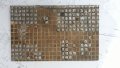
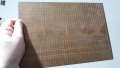
- I do think as well I very much made a mistake somewhere. Also the PNP's I have are partially new. Most of them are scrapped. I only have brand new NPN's in my arsenal. I should have test every Tr when I plug it into the circuit, but I forgot and even if I remembered, I probably was lazy. I will probably come back to your circuit later in time. But what is throwing me off is it's complexity. Is not THAT complex but it is moderately complex. Im not used to it. I will come back to it and when I will do, I will properly test every Tr and plug it in knowing for sure it is good. I was also thinking like you mentioned already, to not make it on breadboard, but solder it on some sort of test board, most probably with square copper pads on it. I have such thing, made by myself in the 90's, its very ugly and very beat up but it served me very well. I dont think is big enough for this circuit, thats the problem. We'll see.
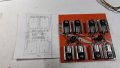
- The black squares represents the copper peeled off. I remember I excessively put a long time a lot of heat on those pads. In the end they give up.
Everything you see here, these 2 test boards are my invention and my ideas how to prototype. This is a blast from the past, in the 90's when I was an adolescent and got my first Tr's back then at a considerable price. I got some very expensive BC549 like 2$ per piece back then. But I never give up trying. These boards are cut literally with a kitchen knife and some sharpened nails, if I remember right. Manually ! They are long before breadboard invention. At least in my country and the internet era. I am prepared for anything ! Haha.
20221028_002320.jpg20221028_002350.jpg
 
Last edited:

sarahMCML

Joined May 11, 2019
697
It's the best I could think of. But is not working in simulation.
The best thing is really to reverse engineer an already made commercial stepper mosfet board.
Its the best way I can think of. We can try until our hair fall off. Its a special recipe for this thing and we can not guess it.
View attachment 279452
You have a short circuit between the MOSFET drains in your diagram. Is it really there?
Also, take those 1N4148 diodes out, they serve no useful purpose, and could actually be detrimental.

I'll post a photo of my strip board tomorrow.
 

cmartinez

Joined Jan 17, 2007
8,768
You have a short circuit between the MOSFET drains in your diagram. Is it really there?
Also, take those 1N4148 diodes out, they serve no useful purpose, and could actually be detrimental.

I'll post a photo of my strip board tomorrow.
Regarding those diodes. Yes, the circuit is better off without them. But I'd replace them with a properly rated TVS diode, to protect the mosfets from inductive kickback.
 

Jony130

Joined Feb 17, 2009
5,598
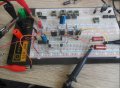
Today I tested this H-bridge on the breadboard.

Step_motor_driver_0.1.png

I build one half only because I do not have any step motor. I've used IRL44n and NDP6020p. And supply for H-bridge was +8V and 5V for a CD4017.
untitled.JPG


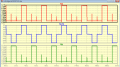
The LTspice results (I attached the simulation file ):

h_bridge_r.PNG

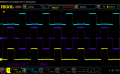
And the real-world measurement

RigolDS3.png

What you see is the voltage at the drains and in purple the voltage difference seen by the "motor windings".
 

Attachments

Last edited:

BobTPH

Joined Jun 5, 2013
11,524
It's the best I could think of. But is not working in simulation.
The best thing is really to reverse engineer an already made commercial stepper mosfet board.
Its the best way I can think of. We can try until our hair fall off. Its a special recipe for this thing and we can not guess it.
View attachment 279452
That is not what I suggested. Simply connect the gates of the top and bottom transistors together. Because one is N-channel and the other us P, that makes one of the pair on and the other off always.
 

Thread Starter

q12x

Joined Sep 25, 2015
2,227
to @Jony130 Thank you for showing me these results !
Very interesting. I believe you powered it at 5V, I read it from the DSO screenshot. Those bigger brown resistors are for the substituting coil. And your NDP6020p is a P-ch mosfet. You also made the circuit as well using P-ch mosfet. BTW, what software you used for the circuit image? So you built there the proper way, not the "all P-ch way" as we did so far. Im aware of how this thing should work dont worry, the thing is I dont have ANY P-ch Power mosfet. I only have very low power ones and they are smd. (All these are my observations over what you presented).
My stuff:
- I am building the 'All BJT-NPN' cct that worked, and it worked again now when I remade it on the breadboard. Exactly as before. With it's limits but spinning very well both 4wires motors !
Your/Our stuff:
- In your last cct with 'all N-ch mosfets', the circuit worked quite good and I learned a thing or two from it. But it was wrong, as someone notice it, that all the Lower side Tr's are having the gate powered from 5V instead of 10V. Only the TOP gate Tr's are drive correctly from 10V!!! But even as that, what's more important, is that it worked ! A bit hot for a couple, but good enough in my book. I modified your original 'All N-ch mosfets' circuit to make it a bit more general to other types of motors voltages. Your cct here is the same as the original you give me the first time ! In my version I split the voltage rails. One rail is specific 10V only for the gates of the mosfets and another rail is a variable voltage rail for a wider voltage range of motors. You understand me. It is the exact same cct as yours. The only difference is this split rails I did there. But is still dependent to over 10V and less than 15V probably (in theory) as your original cct was originally. At this point, I dont know how to make it full 10V gate drive for all the transistors. Only the TOP ones ! Not the bottom ones.
1666968518667.png
Thank you so far !
 

sarahMCML

Joined May 11, 2019
697
Hi again,
Glad to see your trying a BJT one again, but do try the Sziklai pair cct, it truly does drive the transistors better and produces less heat.

You are going to have to bite the bullet and build the proper high side drive circuits for the upper MOSFETs, as in my previous post, and in the one below. Then all your problems will be solved. Its only 4 more components per side!

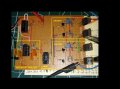
Here's a pic of my board, just 2 sections as an H-bridge, along with 2 photos of it.
Note, I've naughtily not put ANY decoupling caps on the board, but the logic ground and the driver grounds only meet at the (3) PSU's. I would have used a single CD40106 but don't have any, hence the 4093 instead. The clock input is from a TTi TG120 Function Gen, and the CMOS/TTL output seems particularly messy for some reason, with a nasty negative spike below ground. Hence the input resistor to the CD4017.

StepMOS2Brd2.jpg

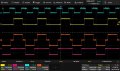
The first running at 1Khz.

Mosfet_1KHz.jpg

This running at 10Khz.

Mosfet_10KHz.jpg

As you can see, the anti-shoot through delay is a bit excessive at 10KHz, and would be much less on a unit for real use, but I was playing on the safe side!
 

Thread Starter

q12x

Joined Sep 25, 2015
2,227
Glad to see your trying a BJT one again, but do try the Sziklai pair cct, it truly does drive the transistors better and produces less heat.
Yes, I understand. One thing at a time though. I will retry your cct after I finish this one I have to make now.
Also thanks for the pictures !!! Very nice !
---
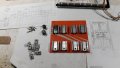
Here is the update on the H-bridges board. This is the beginning.
20221028_234637.jpg20221028_234656.jpg
I literally saw it with black string and needle. It took me 2h. Looking nice :]
Those gray Tr's are NPN scrapped ones I have for a long time. I tested them and they read ok. Will see how well they behave compared to BD139. If they are weaker or stronger. Hopefully they will be the same.... Their markings are BFQ164 and BFQ232a. I noticed they have a protection diode EtoC like a mosfet, internally. In the datasheet is not mentioned. They appear were used in old magnetic band video players. Hmmm, I dont remember scrapping one, but my youth was full. I can change them at any time if they are weaker. I design this thing to permit easy changing of the Tr's.
Some radiators will not really be necessary. So its a waste of radiators on the Tr's that are not overheating. After the final tests, I will mark which one is heating and remove the others that are not. Thats the plan, but will see when I will reach that stage. So far I will do the redundant work and go with everything at once, in its proper place.
 
Last edited:

sarahMCML

Joined May 11, 2019
697
Yes, I understand. One thing at a time though. I will retry your cct after I finish this one I have to make now.
Also thanks for the pictures !!! Very nice !
---
Here is the update on the H-bridges board. This is the beginning.
View attachment 279516View attachment 279517
I literally saw it with black string and needle. It took me 2h. Looking nice :]
Those gray Tr's are NPN scrapped ones I have for a long time. I tested them and they read ok. Will see how well they behave compared to BD139. If they are weaker or stronger. Hopefully they will be the same.... Their markings are BFQ164 and BFQ232a. I noticed they have a protection diode EtoC like a mosfet, internally. In the datasheet is not mentioned. They appear were used in old magnetic band video players. Hmmm, I dont remember scrapping one, but my youth was full. I can change them at any time if they are weaker. I design this thing to permit easy changing of the Tr's.
Some radiators will not really be necessary. So its a waste of radiators on the Tr's that are not overheating. After the final tests, I will mark which one is heating and remove the others that are not. Thats the plan, but will see when I will reach that stage. So far I will do the redundant work and go with everything at once, in its proper place.
The BFQ232A devices are only 300mA maximum current, video devices, so are no good for this purpose. I cannot find any data on the BFQ164. Who made it?
 

Thread Starter

q12x

Joined Sep 25, 2015
2,227
The BFQ232A devices are only 300mA maximum current, video devices, so are no good for this purpose. I cannot find any data on the BFQ164. Who made it?
You may be right. I read as well they are for 300mA. So much for Power Transistors. Haha. Why do I keep c**p like this around? Hmmm... BD139 is 1.5A in comparation. I will have to move them into the low power tr's pile then.
I didnt find any datasheet about BFQ164 either. The BFQ232A from its datasheet, results its made by Philips Semiconductors Company. The same might be true for the BFQ164. As a simple analogy.
 

Thread Starter

q12x

Joined Sep 25, 2015
2,227
I was looking more carefully into my power NPN's and I notice a few BD441. I jumped to my PC and their datasheet tell me they are 80V 4A 36W - WOW. - I realized I was stupid until now. Why? because I didn't ever searched seriously for more powerful NPN's. I kind of did with 100pcs of BD139 NPN 80V 1.5A 12.5W that I already have, and they are usually more cheaper but not with much compared to a 4A one. I also find another candidate and I think this is my new favorite: BD681 4A 100V 40W. Now that's some POWER !
Following this direction, and I ask everyone here:
- What is the most powerful and many in number BJT NPN's that you have in your inventory?
 

Thread Starter

q12x

Joined Sep 25, 2015
2,227
I find 10pcs BD441 very old stock but brand new, never used and not scrapped. I changed the Upper Transistors in my original BJT ALL NPN's with 4xBD441. I can tell you :
- What a difference !!! Ohohoa... I could bring up the voltage to 10V and they barely got warm.
The only hot component was the Voltage Regulator and its radiator. My next step, I changed its radiator with a bigger one. Now is staying moderately warm.
I believe what @sarahMCML did in her circuit, without realizing most probably, was to insert some more powerful Tr's in the TOP line, where they are usually getting hot. But she forget to mention this detail. I really dont remember what transistors you used in the TOP line for your ALL-BJT circuit? Can you tell me what Tr you used? Thank you.
 

sarahMCML

Joined May 11, 2019
697
I find 10pcs BD441 very old stock but brand new, never used and not scrapped. I changed the Upper Transistors in my original BJT ALL NPN's with 4xBD441. I can tell you :
- What a difference !!! Ohohoa... I could bring up the voltage to 10V and they barely got warm.
The only hot component was the Voltage Regulator and its radiator. My next step, I changed its radiator with a bigger one. Now is staying moderately warm.
I believe what @sarahMCML did in her circuit, without realizing most probably, was to insert some more powerful Tr's in the TOP line, where they are usually getting hot. But she forget to mention this detail. I really dont remember what transistors you used in the TOP line for your ALL-BJT circuit? Can you tell me what Tr you used? Thank you.
I used BD361 transistors in both places. They are in the same package as yours were, and were rated at 20V, 3A, 15W. What made all the difference was that I used them with a smaller transistor as either a Darlington pair, or a Sziklai pair, meaning that they were always driven very hard into saturation. I suspect that yours weren't getting that because of the base resistors not being able to supply enough current.

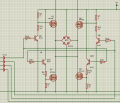
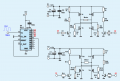
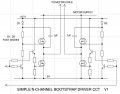
I've enclosed a circuit of a simple bootstrap driver for your MOSFET circuit that you may like to try, if you still have it. it just needs 1 diode and 1 capacitor extra for each driver.

SimpleBoot.jpg
Note: Edited 30/10/2022
 
Last edited:

Thread Starter

q12x

Joined Sep 25, 2015
2,227
- Thank you for your answer. Indeed your BD361 is at 15W similar to mine that is 12.5W. But I tell you, that 3A of yours matter!!! Mine at 1.5A is very weak, Much more weaker, than apparently close wattage. Is my observation. (note: BD361 NPN 20V 3A 15W)
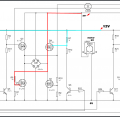
- I see your new cct with mosfets and I see the difference from the other one before. I still have the boards with the wired mosfets put aside. But trust my word when I say to always put values on your components and proper numbering. As others told me, I tell you the same. Be perfectionist in everything you do, as hard as it is. You have no component value and number. Please put YOUR values and I will adapt to mine afterwards. Those arrows point to... 4017 right? or the 4 protection diodes that stay on 4017 outputs. Right? (where I put my red marking)
1667050602118.png
About my stuff:
The board Im making is very hard and very slow to make. A lot of small wires I had to search for and bent and fit and solder. But Im finishing it soon. Very hard ! Here is some progress: - this board is almost finished. It remains to drag wires to all the resistors and the 5V power to those 2 rails. All the 10R resistors are scrapped, and verified.
20221029_173906.jpg
 
Last edited:
Top