Facebook
 Google
 GitHub
 Linkedin
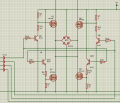
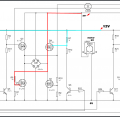
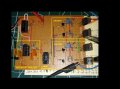
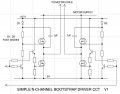
If you built my driver circuit exactly as in your post #162 then you must have made a mistake, as my circuit works perfectly.Said and done.
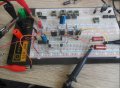
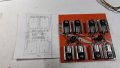
I was sincerely expecting a blowing resistor ! I really-really did. I was prepared to sacrifice a 1/4 2R2. I inserted as a substitute for one of the coils. The motor was unplugged. SO I had only 1 Resistor in the entire mosfet output. And for my surprise, it didn't. It didn't blow up and it didn't heat up !
What was more surprising, was the fact, that the entire power consumption form the PSU was actually over the mosfet circuit. The entire Voltage (5V-8V) and the entire Amperage (1A-for 2min or so) and for a short time 2A; all of that was falling exclusively over the mosfets. WITH or WITHOUT the resistor dummy !!! That was the shocking discovery. The mosfets are the ones limiting the current. At least at 5V as I drive them today. I know I have to put them at 10V or 12V, so this experiment might not be the proper one. But I learned something. I will try my best to find a way to drive the mosfets from 1 source with 12V and from another different source the motors. So far I start testing. Bad or good, Im doing something. And yes, I am not completely 100% sure on what im doing, so Im doing it blindly in most of the case. Any advice is very good right now/ today. My real fear is to burn the motor. That's why Im trying with resistors first and from 5V up.
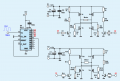
Then, drive that section from 10 to 12V, and the MOSFET section from whatever your motors need. You can try a resistor in series with the motor if you wish to drive it with a higher voltage for current limiting purposes.
I've just noticed that you now have some P Channel MOSFETs. That means, assuming they are not logic level versions, you MUST use at least enough motor voltage for the fully on upper Fet to turn on opposite lower Fet. That probably means somewhere around 10V. So you may have to put a resistor in series with the motor! It's a function of this particular circuit.
Last edited: