About Stepper Motors

sarahMCML

Joined May 11, 2019
697
This is the theory I dont know at all ! This is the first time Im reading it ! Formidable.
So... a BJT transistor is voltage dependent? I never knew. I was having the impression that is behaving like a mechanical switch, also in the sense of letting whatever current and accepting whatever voltage on its C-E to drive higher voltage components/loads. Also in any BJT Tr is specified a maximum voltage over C-E, I was sure I got it right. Very curious !
My friend, you are a fountain of knowledge for me !
Check post #138 above for the circuit I added!
 
Last edited:

Thread Starter

q12x

Joined Sep 25, 2015
2,227
Check post #138 above for the circuit I added!
Checked. Thanks.
Also...
I know you want to be better !
write normally in your new post your [#138] in this case, and then right click on the desired # thread and choose "copy link"
1666610578239.png
Now come back to your normal written "#138" and select it. You can select only the '3' or only the '#' from it. It is nice to have it all selected. Then press on that [Insert link] button.
1666610787088.png
A new window opens and in it you can paste the copied Link. And then Press on the big Orange [Insert] button to finalize the command.
1666610873432.png
With welcome.
Haha.
 

sarahMCML

Joined May 11, 2019
697
Checked. Thanks.
Also...
I know you want to be better !
write normally in your new post your [#138] in this case, and then right click on the desired # thread and choose "copy link"
View attachment 279213
Now come back to your normal written "#138" and select it. You can select only the '3' or only the '#' from it. It is nice to have it all selected. Then press on that [Insert link] button.
View attachment 279214
A new window opens and in it you can paste the copied Link. And then Press on the big Orange [Insert] button to finalize the command.
View attachment 279215
With welcome.
Haha.
I tried to do the above by editing file #141, but nothing happened, the URL of the original post didn't copy over. Maybe it only works when making the original post?
 

sarahMCML

Joined May 11, 2019
697
Here it is:
Thanks for the video. As I said in #144, I did get it working eventually.
Anyway, I'm now in the process of building a MOSFET version of the driver circuit, but on stripboard this time. I've discovered that it is so much easier than trying to do it on a plug-in breadboard, quicker and more reliable. I have so many MOSFET's that even if I never use the board again, it'll be worth it for the tests.
See you tomorrow: dinner time again!
 

Thread Starter

q12x

Joined Sep 25, 2015
2,227
I'm now in the process of building a MOSFET version of the driver circuit,
Before building anything, try to first lay down the circuit and show it to me here. I will build it in the same time as you and report the problems I will encounter.
 

sarahMCML

Joined May 11, 2019
697
Before building anything, try to first lay down the circuit and show it to me here. I will build it in the same time as you and report the problems I will encounter.
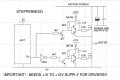
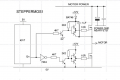
Here is the circuit. This version is for your breadboard setup as you had it with your bipolar transistors, whereas mine will be with the anti "Shoot Through" circuitry added. but it is basically identical.
The NPN and PNP transistors should be rated for at least 0.5A, the diode should be any fast one such as a Schottky 1N5417 etc, and the gate resistor can be up to around 100 Ohms.
Especially note that you will need an additional 10V or 12V power line for the gate drivers, even if you use a lower voltage for the motors. This is so that the MOSFETS are driven fully on.

StepperMOS1.jpg
 
Last edited:

Thread Starter

q12x

Joined Sep 25, 2015
2,227
I finished testing with BJT's. The conclusion was that they are increasing the current proportional when I increased the voltage. So it was voltage dependent. Or at least the circuit was behaving like that. So I changed them already with Mosfets. But the mosfets are not working with the current circuit as it is. Like you told me, it has to be modified with what you specified in post #136 :
1) The MOSFET's would barely turn on with 5V on the gates, needing around 10V to be fully on.
2) Their input capacitance means they need high current drive to switch quickly, so as not to stay in their linear region and overheat.
3) The upper N-Channel devices need "boot strapping" to drive the gates above the supply voltage to work properly.
And you still need the anti "shoot through" circuitry!
I am waiting for your circuit with the Mosfets now.
Thank you.
 

sarahMCML

Joined May 11, 2019
697
I finished testing with BJT's. The conclusion was that they are increasing the current proportional when I increased the voltage. So it was voltage dependent. Or at least the circuit was behaving like that. So I changed them already with Mosfets. But the mosfets are not working with the current circuit as it is. Like you told me, it has to be modified with what you specified in post #136 :

I am waiting for your circuit with the Mosfets now.
Thank you.
Check post #148 again!
 

Thread Starter

q12x

Joined Sep 25, 2015
2,227
I could barely see the mosfets there. I was used with the full BJT cct you did before. I see. It looks awful complicated. Can you summarize in a couple of words what all of those means. Why that many? Can't we use a chip for all those BJT's? Preferably one that I have and is common. Heh.
- I must ask this first. But if this is the answer, if this will actually drive successfully the 2.4R coil of the motor with 1.7A @ 5V, or around this high power value, then I will make it, no problem. But I must know your concept that you used here. Also, did you test it already with a resistor instead of a motor? Like you said you tested the lower power cct before?
Thank you for the circuit !
 

sarahMCML

Joined May 11, 2019
697
I could barely see the mosfets there. I was used with the full BJT cct you did before. I see. It looks awful complicated. Can you summarize in a couple of words what all of those means. Why that many? Can't we use a chip for all those BJT's? Preferably one that I have and is common. Heh.
- I must ask this first. But if this is the answer, if this will actually drive successfully the 2.4R coil of the motor with 1.7A @ 5V, or around this high power value, then I will make it, no problem. But I must know your concept that you used here. Also, did you test it already with a resistor instead of a motor? Like you said you tested the lower power cct before?
Thank you for the circuit !
I doubt you have any complimentary pair BJT chips in your stock, I don't know of any common ones.
They act like the output stage of an audio power amplifier, supplying high current to charge the large capacitance of the MOSFET gate.
The capacitor and diode serve to "shove" the gate of the MOSFET 12V above the motor supply, driving it into full conduction.
It's not really complicated, one complete circuit for a side take about one square inch on my stripboard!
I'm still building it, but won't be able to test it until later today.

You should have tried one of my earlier Darlington or Sziklai pair circuits that I posted, they worked very well, and would easily supply as much current as needed.
 

Thread Starter

q12x

Joined Sep 25, 2015
2,227
Qst1- You probably mean that the capacitor to be over the power supply? But close to the mosfets? I dont get it.
1666703921589.png
Qst2- And this one as well I dont completely get it. This means it can NOT work at 5V? Only from 10 or 12V up? Is voltage dependent?
1666704062046.png
 

Jony130

Joined Feb 17, 2009
5,598
Here is the circuit. This version is for your breadboard setup as you had it with your bipolar transistors, whereas mine will be with the anti "Shoot Through" circuitry added. but it is basically identical.
The NPN and PNP transistors should be rated for at least 0.5A, the diode should be any fast one such as a Schottky 1N5417 etc, and the gate resistor can be up to around 100 Ohms.
Especially note that you will need an additional 10V or 12V power line for the gate drivers, even if you use a lower voltage for the motors. This is so that the MOSFETS are driven fully on.
The bootstrap circuit as shown will not be going to work as expected. And the low side doesn't need a bootstrap circuit.

a1d.PNG
 

sarahMCML

Joined May 11, 2019
697
The bootstrap circuit as shown will not be going to work as expected. And the low side doesn't need a bootstrap circuit.

View attachment 279287
Hi Jony130,

You're right about the low side. I originally drew it your way, then confused myself and re-drew it the way it is in #148. I'm definitely starting to worry about myself!
Still not 100% sure about the high side though. It's normally shown as you have it, but somebody made a suggestion that the other way would be better, so I thought I'd try it out.
 

sarahMCML

Joined May 11, 2019
697
Qst1- You probably mean that the capacitor to be over the power supply? But close to the mosfets? I dont get it.
View attachment 279278
Qst2- And this one as well I dont completely get it. This means it can NOT work at 5V? Only from 10 or 12V up? Is voltage dependent?
View attachment 279280
Qst1 - Those 2 capacitors need to be physically sited near to the MOSFETS so that they can supply surge currents to the load.

Qst2 - Your logic circuits work at 5V, but the MOSFET gate drives need 10 to 12V to work properly, UNLESS you get yourself some LOGIC LEVEL type ones which are guaranteed to turn on fully with a < 5V gate drive. This circuit will still drive 5V motors, but would have a 5V MOTOR supply!
 

Thread Starter

q12x

Joined Sep 25, 2015
2,227
Qst2 - Your logic circuits work at 5V, but the MOSFET gate drives need 10 to 12V to work properly, UNLESS you get yourself some LOGIC LEVEL type ones which are guaranteed to turn on fully with a < 5V gate drive. This circuit will still drive 5V motors, but would have a 5V MOTOR supply!
I think I get you. So 10 or 12V needed for the GATE mosfet driver cct and 5, or 10, or 20 for the motor voltage. So 2 separate voltages. Right? Or maybe 3 voltages, lets not forget the logic cct that only needs 5V or even 3V. Yes, I dont have (digital or logic) mosfets that can be drive from 5V alone. I have only these that I mentioned. So 10V it is. Interesting !
I am like a kid right now. Im finding everything interesting, haha.
 

sarahMCML

Joined May 11, 2019
697
I think I get you. So 10 or 12V needed for the GATE mosfet driver cct and 5, or 10, or 20 for the motor voltage. So 2 separate voltages. Right? Or maybe 3 voltages, lets not forget the logic cct that only needs 5V or even 3V. Yes, I dont have (digital or logic) mosfets that can be drive from 5V alone. I have only these that I mentioned. So 10V it is. Interesting !
I am like a kid right now. Im finding everything interesting, haha.
Three voltages, yes. There is one thing though. If you found that you could drive your motors with LESS than the maximum gate voltage of the MOSFETs, (usually 20V) you could just tie the line marked "+12V" to the Motor supply, but it would still have to be 10V or more.

And Jony130's circuit is right for the bottom section, I don't know why I re-edited it to the wrong version the way I did.
Should I re re-edit it, do you think?

I'm still building, and may not get to testing today, unfortunately, but definitely will tomorrow.

Good luck with yours if you test it before I do!
 
Last edited:

Jony130

Joined Feb 17, 2009
5,598
but somebody made a suggestion that the other way would be better, so I thought I'd try it out.
Wrong advice. It will not work due to the fact that the bootstrap capacitor will now be quickly discharged by a NPN transistor in a push-pull stage.
 
Last edited:
Top