About Stepper Motors

shortbus

Joined Sep 30, 2009
10,050
Give me your best choice that you can get. I really dont know all these things. Im not into driving motors everyday.
Here's a link to the ones on Ebay like I have. You need to pick the one that can ship to your country, or look at your Ebay with the name, TB6600. You just choose the current limit with little PCB switches on the module and add you controls for direction and frequency/speed. Every other thing is built in to these.

https://www.ebay.com/sch/i.html?_fr...+1+Axis+4A+Stepper+Motor+Controller+&_sacat=0
 

Thread Starter

q12x

Joined Sep 25, 2015
2,227
Here's a link to the ones on Ebay like I have. ... look at your Ebay with the name, TB6600.
https://www.ebay.com/sch/i.html?_fr...+1+Axis+4A+Stepper+Motor+Controller+&_sacat=0
Thank you! I know about them already and I found the cheapest as 20$, but you found it at 7 which is more better than my finding. The thing is, if I have 5 motors, I will need 5 of these controllers. And about 10$ each, (~7$/item+~2$/transport +~2$ paypal/bank tax = ~10-12$ per item) Now, if im lucky to actually get it at 7$ /item. And is quickly going up to 50$. It will remain as plan B for awhile, in case I will not get satisfaction from a DIY controller circuit that Im trying to make.
For now, me and miss @sarahMCML here are trying our best to make it work using BJT's. Soon, I will receive those L298 IC's. I dont have high hopes from them, other than smaller space occupied; but the performance I expect to be as with my NPN's I tried so far. It will be very cool to actually be more better than the discrete Tr's I made here. We'll see, Im very curious. I am also hoping you guys here can help me with a mosfet stepper driver. I think if we gather ~5 brains in one place to one goal, I strongly believe we can make a very competitive product as a DIY controller. (I am waiting for some P-ch Mosfets that are on the road to come) When these are arriving, I say I am prepared enough for a mosfet version. Until then, BJT is the option.
 
Last edited:

Jony130

Joined Feb 17, 2009
5,598
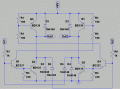
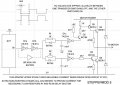
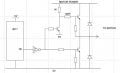
You could try this H-bridge topology. Of course, you could use BD139/BD140.
H_bridge.gif

And your stepper motor current consumption is?
 
Last edited:

sarahMCML

Joined May 11, 2019
697
Right, it took me a while, problems with duff breadboards and dodgy old TTL chips, but i got there in the end.

I've Built a couple of circuits for your amusement, the first one uses some CMOS inverters, which you probably don't have, to make the Anti "Shoot Through" protection, and is the one which I prefer.
The second one uses your 74LS14's, but is much more fussy over the resistors. Too high in value and they won't switch, so the value used means that the companion capacitors have to get correspondingly larger for the same delay value. You'd have to more than double them to get the same delay as that in the first circuit. You also need the additional driver gate at the front of the diode/resistor section to provide enough current to drive the following section low!
I've built 2 pairs of each type, and tested them with a 20 Ohm power resistor between the outputs at 20 V maximum, which is the max for the BD361 transistors.
They barely get warm to the touch.
With nothing connected between their outputs, both circuits take exactly the same idle current of 22 mA when just sitting there being driven with a clock signal and outputting nice square waves. That's mostly the sum of the current through the 1K collector resistors in the upper set input transistor.
I may try modding it back to the NPN/PNP pair inthe upper set again, just to see if it's any better!
Next stop after that, MOSFET's!
I'll attach the circuits in the next post, I've just noticed something!
 
Last edited:

Thread Starter

q12x

Joined Sep 25, 2015
2,227
I've Built a couple of circuits for your amusement, the first one uses some CMOS inverters, which you probably don't have, to make the Anti "Shoot Through" protection, and is the one which I prefer.
Thank you very much for your kind effort. If you prefer it, then I prefer it as well ! Heh.
Yah... they look complicated. Here is the list of inverters I have in my arsenal:
Code:
74HC14      Hex Inverters with Schmitt-Trigger
74LS04      Hex Bipolar Inverters
LC4069  x1  CMOS hex inverter buffer
CD40106 x2  Hex Schmitt-Trigger Inverters
LVC04A      Hex Inverters (6X NOT GATE)                                 14PINS SMD
LVC14A      HEX SCHMITT-TRIGGER INVERTERS (6X NOT GATE)                 14PINS SMD
--------------------------
And your stepper motor current consumption is?
Well, at 5V for the 4wire steppers are consuming a constant 300mA. Well the entire cct. I read it directly from the PSU screen. They barely rotate but they do it and is good enough to tell if they work. You know the story until here.
At 6V the amperage rises to 480mA.
At 10V the amperage rises to 630mA but the speed (and most possibly the torque) is greatly improved and visible.
I didnt test them at 15V or 20V yet. But the google says that a Nema17 like the one I have, can be run at 12-24V.
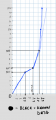
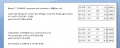
1666462219275.png1666463054613.png
Here are my data observations I did so far, with a blue prediction:
But I think I saw a 800mA at some time in my tests, most probably was at 15V for the 5wire motor. Not for these 4wires that I protected as best as I could. Im not very sure if I should expose them to 15V or 20V, although I know they are current dependent and not voltage.
I also didnt add any kind of current limiting cct, as someone suggested earlier and that I could also see in those commercial stepper controllers, by switching a DIP Switch to choose the right amperage that the motor is rated. I simply dont know how to make a more powerful current limiter. I know a small one how to make it, but not really over 300mA.
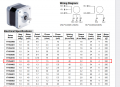
Here is my Nema 17 stepper model number: 17HS4401 data:

1666464920989.png
and also google confirms it:
1666465210869.png
 
Last edited:

MaxHeadRoom

Joined Jul 18, 2013
30,665
Here is my Nema 17 stepper model number: 17HS4401 data:
and also google confirms it:


View attachment 279103


Incidentally there is no such thing as a NEMA current or torque rating for a stepper motor, NEMA is the mounting frame size of the motor, as you can see from the chart, there is 14, NEMA-17 motors and all are different current & torque sizes.
Generally a manuf. will increase the length of the motor body in order to increase the torque value for a given NEMA size.
It is a very typical, common misunderstanding across many forums.
 

Thread Starter

q12x

Joined Sep 25, 2015
2,227
Incidentally there is no such thing as a NEMA current or torque rating for a stepper motor, NEMA is the mounting frame size of the motor,
Well, from my understanding, NEMA is the Brand name and the number that prefix it, like 8, 14, or 17 in my case, I believe is some sort of size identification or a model in their series . If is size , Im not very sure what it is, it might be in -inch- or -mm-. So when I search for Nema 17 I search for the Brand and the model in their series most probably. Thats how I see it and I believe thats how google choose the correct answer to be.
 

MaxHeadRoom

Joined Jul 18, 2013
30,665
It is the Mounting standard In the case of the motors shown it is the front mounting - shaft end.
Not a brand, an industrial standard.

https://www.applied-motion.com/news/2015/10/what-do-nema-sizes-mean

Quote:
Step motors are categorized by frame size, such as "size 11" or "size 23".
Ever wonder how that came to be or what it means? The National Electrical Manufacturers Association (NEMA) sets standards for many electrical products, including step motors. Generally speaking, "size 11" mean the mounting face of the motor is 1.1 inches square. So a Size 23 step motor is, wait for it, 2.3 inches square.
 
Last edited:

sarahMCML

Joined May 11, 2019
697
Thank you very much for your kind effort. If you prefer it, then I prefer it as well ! Heh.
Yah... they look complicated. Here is the list of inverters I have in my arsenal:

74HC14 Hex Inverters with Schmitt-Trigger
74LS04 Hex Bipolar Inverters
LC4069 x1 CMOS hex inverter buffer
CD40106 x2 Hex Schmitt-Trigger Inverters
Etc..
I'd definitely use the CD40106's. You are going to need 2 gates per side, times 4 sides, therefore 8 gates, so that means both packages that you have.
I showed CD4093 gates in the diags as inverters, but in fact they are 2 input NAND Schmitt gates, the only ones I had. I should redo the diagrams!
 

Thread Starter

q12x

Joined Sep 25, 2015
2,227
After my answer for mister @Jony130 in post #127 , after some time and thinking, I realized something and I have a very good question: - How can I supply 1A with those 5V? to the new NEMA17 stepper motor. Or 1.7A as the maximum motor rating is. But at 5V! That's interesting, Right? Because with this cct I built here, after I literally struggle to milk those 300mA from it at 5V, and I believe its the maximum it can give me, I strongly believe this entire cct is limiting the current by itself. I didn't realized it until after I write down those observations. So in other words if I increase the voltage, the current will increase as well so the power. But it will remain dependent one over the other. How do I make it Not dependent? I believe I reach the limit of a BJT H-Bridge. The current is proportional with the voltage pretty much. I don't want that. I want variable voltage and variable amperage for the stepper motor. (up to 25V and 2A)
I will try to make the same move as I did with the 8x BJT NPN's, not including PNP's.
I will use 8x N-ch Mosfet and no P-ch Mosfet. Because I dont have any (power) P-ch, yet. Im curious HOW they will behave, how bad it will be? That's my next move Im thinking. Im not sure about driving them though. I believe they need special and different logic cct to be driven. We'll see. If you have any thoughts, do leave them here in these times of need.
 
Last edited:

sarahMCML

Joined May 11, 2019
697
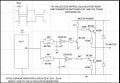
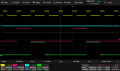
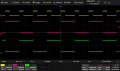
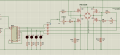
As promised, I built a modified version of the second circuit in post #126 (I've cleaned up that post as well so that it is more readable), which uses the NPN/PNP upper pair. I tested it with a 10 ohm resistor across the outputs of 2 pairs of circuits at 20 Volts (the best I can do with my PSU!) It works exceptionally well, as you can see from the scope pic. The transistors get barely warm to the touch!
Next stop MOSFETS.

StepperMod5b.jpg

The first pic (SM5_4Phase.jpg) is with the drivers connected to 4017 outputs Q0 and Q1, with the reset going to Q4, giving 4 outputs like your setup.

SM5_4Phase.png

The second pic is the same, but with the reset going the Q2, which would be used to drive a normal 2 terminal device like a brushed motor, for example.


SM5_2Phase.png
 

Thread Starter

q12x

Joined Sep 25, 2015
2,227
To miss @sarahMCML , very cool !
But at what amperage? Let's say we drive at 5V. Can you make it draw 1A? And still be cold? Thats what I am after actually.
More power = more speed and more torque for my motors. I believe you mentioned at some point that your circuit is drawing ~50mA, Im sure it was under 100mA. My very experimental circuit using only NPN's in this completely unorthodox configuration, is drawing safely and cold enough, about 300mA @ 5V for any 4wire motors. Which is a win (in my book of death).
Please take a look at my post #127, where I mentioned a couple of important data I collected in my experiments:
Well, at 5V, the 4wire steppers are consuming a constant 300mA. Well the entire cct. I read it directly from the PSU screen. They barely rotate but they do it and is good enough to tell if they work.
At 6V the amperage rises to 480mA. (The speed is a bit better but not very)
At 10V the amperage rises to 630mA but the speed (and most possibly the torque) is greatly improved and visible.

I didnt test them at 15V or 20V yet. But the google says that a Nema17 like the one I have, can be run at 12-24V.
The problem I face is simple. I want to run them at 15V or 20V ! This means at higher amperage as well. Im not sure if 20V with 1.7A will be fine for my new motor or not. But the NPN's are definitely burning if keep them too long to work. For under 1min is ok but risky. Over 1min is not good. The temperature rises too much for my comfort. Over 100dgrC. And the aluminium radiator on each transistor will not really do much difference. Maybe 2or3 dgrC lower. Really, its too high. So we need to attack it with something else. With other weapons of war. Soon the L298 IC will arrive. Probably less than 1 month - I hope. Then after that my P-ch Mosfets.
Until all of them arrive, I will try to make the same circuit here but with the mosfets that I have, only N-ch, IRFZ44N.
Here is my version that I tested already and is NOT working with the current logic cct and the IRFZ44N mosfets.
I believe it should have worked with what I have here already. No?.
1666548056172.png
 
Last edited:

sarahMCML

Joined May 11, 2019
697
To miss @sarahMCML , very cool !
But at what amperage? Let's say we drive at 5V. Can you make it draw 1A? And still be cold? Thats what I am after actually.
More power = more speed and more torque for my motors. I believe you mentioned at some point that your circuit is drawing ~50mA, Im sure it was under 100mA. My very experimental circuit using only NPN's in this completely unorthodox configuration, is drawing safely and cold enough, about 300mA @ 5V for any 4wire motors. Which is a win (in my book of death).
Please take a look at my post #127, where I mentioned a couple of important data I collected in my experiments:

The problem I face is simple. I want to run them at 15V or 20V ! This means at higher amperage as well. Im not sure if 20V with 1.7A will be fine for my new motor or not. But the NPN's are definitely burning if keep them too long to work. For under 1min is ok but risky. Over 1min is not good. The temperature rises too much for my comfort. Over 100dgrC. And the aluminium radiator on each transistor will not really do much difference. Maybe 2or3 dgrC lower. Really, its too high. So we need to attack it with something else. With other weapons of war. Soon the L298 IC will arrive. Probably less than 1 month - I hope. Then after that my P-ch Mosfets.
Until all of them arrive, I will try to make the same circuit here but with the mosfets that I have, only N-ch, IRFZ44N.
Here is my version that I tested already and is NOT working with the current logic cct and the IRFZ44N mosfets.
I believe it should have worked with what I have here already. No?.
View attachment 279166
The only way you can get a 5V supply to drive 1A through anything is if the "anything" has a resistance of equal to or less than 5 Ohms. So if your motor coils are higher than that you will never get 1A through them at 5V.
As for heat in the transistors, they need to be turned hard, so that they have as low a voltage across them as possible. You need bigger heat sinks!
Hence why I used Darlington pairs in the first 2 circuits. As per the diagram, they take about 22mA from the PSU at 20V.
The 3rd circuit, with the Sziklai pair upper transistor set is much more efficient to drive, and without any load connected, takes about 1mA from the PSU at 20V.

Your MOSFET circuit sadly won't work at all.
1) The MOSFET's would barely turn on with 5V on the gates, needing around 10V to be fully on.
2) Their input capacitance means they need high current drive to switch quickly, so as not to stay in their linear region and overheat.
3) The upper N-Channel devices need "boot strapping" to drive the gates above the supply voltage to work properly.
And you still need the anti "shoot through" circuitry!
 

Thread Starter

q12x

Joined Sep 25, 2015
2,227
Ok. I did this and here are my conclusions:
Nema17 17HS4401 measured coil resistance = 2.4R per coil
I know the Resistance, I know the Voltage, I want the Amperage to know
So I =V/R = 5V/2.4R = 2.08A
and P=VI=5V*2.08A=10.4W

In datasheet, 17HS4401 has a maximum of 1.7A.
This means that V=IR=1.7A*2.4R=4.08V
and P=VI=5V*1.7A=6.9W
So nominally is 4.08V @ 1.7A with 6.9W

1666598918970.png
 
Last edited:

sarahMCML

Joined May 11, 2019
697
Ok. I did this and here are my conclusions:
Nema17 17HS4401 measured coil resistance = 2.4R per coil
I know the Resistance, I know the Voltage, I want the Amperage to know
So I =V/R = 5V/2.4R = 2.08A
and P=VI=5V*2.08A=10.4W

In datasheet, 17HS4401 has a maximum of 1.7A.
This means that V=IR=1.7A*2.4R=4.08V
and P=VI=5V*1.7A=6.9W
So nominally is 4.08V @ 1.7A with 6.9W

View attachment 279191
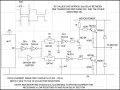
I think I may have been a little confused as to which circuit you are using now. Is it the one in post #115, or similar?
If so, your problem is that you are still driving the bases of the upper transistors wrong. Notice that they can never get more than +5V, because they are being driven by the 4017 at 5V, regardless of how high your motor supply is. So their emitters only go to ~4.3V, and all the rest of the voltage is dropped across the transistor, causing them to heat up.
You can increase the motor voltage as much a you like, it'll only make the transistors hotter!
Give me a few minutes and I'll draw a new circuit.
EDIT: Circuit added:

DriverMod.jpg
 
Last edited:

Thread Starter

q12x

Joined Sep 25, 2015
2,227
I think I may have been a little confused as to which circuit you are using now. Is it the one in post #115, or similar?
All this Heavy math I did here is for (1 coil or motor) that I have brand new.
This is a very important math to be done! Is essential. I am not doing it every day. So thats my excuse not knowing it - not using it. I had to discover it myself from a movie I watched last night on youtube. And I didnt discover it, but I remember it, and I said aaaah, that thing... haha. And I quickly adapt it to my thing here. Coincidentally you come with a similar idea, when you said:
The only way you can get a 5V supply to drive 1A through anything is if the "anything" has a resistance of equal to or less than 5 Ohms. So if your motor coils are higher than that you will never get 1A through them at 5V.
But probably if I wasnt watching that movie last night this little detail was slipping for me.
 

Thread Starter

q12x

Joined Sep 25, 2015
2,227
Notice that they can never get more than +5V, because they are being driven by the 4017 at 5V, regardless of how high your motor supply is. So their emitters only go to ~4.3V, and all the rest of the voltage is dropped across the transistor, causing them to heat up.
This is the theory I dont know at all ! This is the first time Im reading it ! Formidable.
So... a BJT transistor is voltage dependent? I never knew. I was having the impression that is behaving like a mechanical switch, also in the sense of letting whatever current and accepting whatever voltage on its C-E to drive higher voltage components/loads. Also in any Transistor datasheet is specified a maximum voltage over C-E, I was sure I got it right. Very curious !
For example:
1666605124835.png
Or maybe you know this thing in a context I dont know.
Try to understand me here- I really dont know what your logic is and Im trying to get it.
It has sense for the case you described. But also is weird from the datasheet point of view. I cant say I get it.
My friend, you are a fountain of knowledge for me ! Very interesting subject.
 
Last edited:
Top