I will disassemble this multi-transistor cct and make the first or the second cct with N-ch mosfets instead of NPN's.
Maybe that will make a difference.
I will disassemble this multi-transistor cct and make the first or the second cct with N-ch mosfets instead of NPN's.
Maybe that will make a difference.
I built a circuit today to deal with the Shoot Through problem to stop the top and bottom transistors being on at the same time. It worked well, but some still got hot. I think my transistors are too slow for the delay I was using, so I'll have another go tomorrow.
If you try MOSFET's, you'll need to look up " MOSFET drivers", because they have a large input capacitance, which needs a lot of current to drive.
Also check out "High Side Bootstrap Drivers" if using N channels for the top devices. It can be done with just a diode, resistor and capacitor, but the circuit must not be stopped.
Thank you ! I will look into what you recommended.
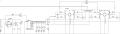
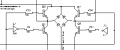
I rebuilt the previous stepper driver cct that was simpler and that worked; this one:
And surprise ! It didn't worked.
I had probably 2-3 days with very slow progress and a ton of attention and I worked almost all day long, with not so long breaks. I took some because they are essential for progress. Is impossible to work and concentrate seriously, non-stop.
It was VERY frustrating. Because I discovered some parts of my Logic driver are destroyed. So I had to come up with a solution to still make it work. And I did. Is not perfect, but it works now. The 4017 decade counter had out2 knocked out(it starts from 0 so its the 3rd output on the wires). Absolutely no signal was coming from that specific pin. So I moved all the wires. Initially I skipped that out2, and put 0,1,3,4. But something else was burned in the circuit and I didnt know what at the time. So I assumed maybe still the logic cct is the problem. I re-moved all the wires : 3,4,5,6. But now I believe it would have worked with 0,1,3,4 as well. So I discovered another problem, !2! from the 8 transistors were burned as well. Thats why motor was trembling all the time. How I figure them out: I switched a new transistor with each one in the cct. And I see a bump in the motor. I assume there was another one burned. So I took 2 new transistors and replace 2by2 in each pair. And the motor finally started to spin as before. Then I replaced the New transistors with the used ones until the motor didnt worked, so I had in my hand the burned one. Then, to be sure, I tested it into my GM328 tester and indeed it was showing me some other values than a NPN transistor. I know, I should had tested all the transistors like that in the first place, and I started with 2 but I give up too early. Is good not to give up and be thorough! Life lesson.
So now it has 2 new replacement transistors but with the older stressed 6. Its working! The scrapped stepper motor I love it. It is so sensitive and responding to any kind of WEAK output, he helped me immensely in debugging the problem. The new motor just dont give any feedback. It needs precise output at 5V or something. Not sensitive at all. But is good for testing as well because is brand new and is telling me how weak the circuit is at the moment. And the new motor is really WEAK. If I touch it's ax, it stops rotating and I have to re-power the circuit for it to start moving. Is extremely weak. Is like a feather.
All this being said, I believe the multi-transistors might have worked. Ill probably have to build it again? Hmmm....
- Its a shame we can not make a strong and reliable circuit from discrete components !
I start to believe that a dedicated stepper driver like that L298 is essential. (is in mail transit right now)
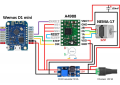
I actually start looking for other steper motor drivers options out there. I find this A4988 SMD board that is not very comforting to look at, at its size:
I start to realize my mistake. I pushed too far the entire cct trying that awful stepper at 15V.
I start to realize there are specific borders of working reliably for every motor, and the cct around it.
I was hoping for a cct that was capable of dealing with more power motors, and these small motors having no problem driving them.
But my question is... how to make a more powerful cct that can drive more powerful steppers? - What's the mysterious component I can't think of ? That is missing from the ingredients here? In my mind, bigger is better ! Meaning, bigger transistors, more powerful, will drive both these smaller steppers and also the more power demanding 15V (or more) 5wire stepper that was the black sheep all the time. Im thinking Not mosfets but IGBT's ! Hahahaha.
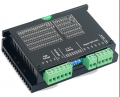
Like these black boxes stepper drivers, and very expensive :
I bet my ass on it, it MUST use some power transistors, and the entire cct inside is around them. Probably with some current and voltage regulators that you have to set on the blue DIP switch in the beginning. It would be nice to have and to look into the circuit diagram of such device.
Im speaking my mind here.
The main concern I have, is to make the New stepper motor work at its maximum efficiency. Maximum torque or maximum speed.
I made a discovery today.
It turns out, that all the H-bridges made from BJT, need a Heat Sink !
I was not very sure about this detail and I was worry about my transistors being cooked to death. Some of them actually were. But the point is that everybody experiences this phenomenon and they deal with it by adding this Heat Sink.
So that is a very important piece of the puzzle to be aware about. And not wonder if it may be good or not.
Even this L298 chip, is having a Heat Sink on it. I was imagining it wont but it does.
So our heat up transistors, it turns out is only normal they heat up. We deal with this heat adding Heat Sinks on them. Problem solved. Very interesting !
I was a bit shocked to 'discover' this Heat Sink in a Large majority of COMMERCIAL H-Bridges !
When I say 'discover' I mean that I didnt put too much thought into this specific detail but it is a very importnat detail to keep in mind and use.
The only H-Bridge boards that dont have Heat Sink on them are the ones with Mosfets on them. But I also find with Mosfets and with Heat Sink as well. most probably they push (like me) to their maximum and didnt accommodate a good heat/power margin.
I already have 100pcs of small Aluminium radiators. Like the one on the VoltReg I am showing in the video.
I have these brand New from a long time ago actually. I told you this is not my first H-Bridge built. But I forget stuff.
Also a lot of BIG Scrapped Heat Sinks as well.
Good News !
I managed to make it work very close as it was in the FIRST circuit. This one with only 4Tr per H-Bridge :
Remember? the one I put 5V on the base of all Tr's and who burned 2x555 and partially 2x4017 and completly scorched 4xTr ?! That one. But this time with the protection layer. So --theoretically-- nothing should burn the logic cct. Im doing a very unorthodox and brutal move here but so far so good. The same proposition that me and my american friend Steve love is "-It works? -It works!". Hahahaha.
Yah ! Hell yah! I actually measured the temperature on each /8 tr's and some of them, the Top ones, are getting as high as 50dgrC (122dgrF). On my finger it feels much hotter than 50, like 90 or so. But I guess, my digital thermometer is not lying so will trust it. The 50dgrC is very stable, I have to mention it. Ill have to check if BD139 is bothered by it. I believe over 70 or 100 is a problem for the tr.
Edited: yep... It's good. That 150 is the maximum and to be avoided, like 1/3 or 1/2 is good for operation, so somewhere at 75-80 I will draw the line as Max working temp.
I only test for 5V. I didnt go up in voltage for the other one with 5wires. Not yet.
I have a wicked idea....
somehow... but this idea is not very well crystalized in my mind... so you will have to help me at this point. Somehow, to add mister Steve favorite IC, the opamp into the scene. Use it as a voltage comparator ! To switch off the entire cct if.... the temperature on one of the tr will rise over 55dgrC and restore it back if is down under this 55 threshold. But Im not so sure here. If to use the temperature? or something else? or even to switch off the cct or to do something else, more smart. Again, is an idea to include a bit more protection, but this time a dynamic one. Im not very sure if is to be temperature dependent... but it sounds as a very good idea for the moment. What do you think ?
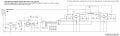
Something like this perhaps:
But I dont have any thermistors, so Ill have to improvise somehow... hmm, challenging.
Ive ordered a couple of NTC and PTC thermistors. They will arrive later in this year.
Im very concerned what is happening on the base of these transistors, with my design as it is right now. I am very concerned not to weaken and then destroy them, giving them a short life. If I can be SURE what is really going on on their base, I will say this project is pretty much done and functional (so far), very close to the maximum efficiency I had in the first unsafe design ! Everything may very well go down to drain if those bases voltage are destroying the Tr's. Its a 50-50 cct in my opinion since I dont know the effects on those bases. Another point is, as long as I stay in the 5V limit, it appears to be safe enough for the Tr's. Not burning them up. Thats why I wanted a way of actively switch off the cct if the temperature is higher than 70dgrC, when I go upper in the voltage/amperage for other kind of steppers. It would be nice if someone can replicate my cct with these parameters I have right now and do some of their measurements to actually see the effects on these bases.
I cant have all the answers in the world, right? So I will start build this cct as it is on my usual cardboard.
I was reading about NEMA 17 stepper motors and google mention 12V-24V optimal voltage for them. And I understand they are current controlled and not voltage controlled, but I was still curious what is the optimal voltage, to be in the safe zone and not to risk burning or overheat the motor. So I dialed up my PSU to 10V and let it run for a few seconds. The speed of the motor did increased a little bit. Not significantly fast but a bit. Also the torque. But at certain frequencies, is stopping and trembling. Its in the middle range so to speak, from my empirical observations. If I increase the fv over that point, is starting running. If I decrease the fv from that point, is also starting running. And is a quite large area of fv that I have to dial the pot. Also I have to restart the entire power of the cct for the motor to start again. If is getting in that zone and stalls it, vibrating, is stopping when Im dialing other fv.
Ive also tested the old scrapped stepper and it also behaves exactly as the new one. With better speed though.
Now, the fun part, the Transistors ! I could literally smell the hot metal in the air. I immediately stopped the power and put my digital thermometer on a couple to find which is baking. And some were at 60dgrC but a special one raised to 140dgrC or so. I bet that one was smelling.
Both the steppers are doing ok, they didnt heat up at all, although the experiment was not that long to properly test them in a longer period of time.
This cct I have here is good to a point ! And the point is not over a certain temperature that will crack the Tr open. Thats a pitty.
So in other words, this circuit is not that good. Is good, but not fully 100% good. Only 50% probably. It can not drive a stepper to it's full potential. Thats the problem. But it can run every stepper ok under a certain power and heat level ! - My question still remains the same:
- How to make this cct more powerful? To drive more power through the coils of the stepper motor? (and not blow up it's Tr's!)
On another hand, Im happy I can run the thing, as limited as it is !!!
NOW- I can make a blog page from it. Haha. Now I have a good amount of data. Before, was too soon.
This cct is working ok but in certain parameters. It is limited to power and heat over the Tr's.
Is working fine in the 5V range for 2 of my stepper motors that I tested with it. But if Im bringing up the voltage, to 10V, I get 140dgrC on one Tr and about 60dgrC on a few others. At 5V, everything stays at a constant 50dgrC which I call it normal and safe.
One of the test motor is a Nema17 17HS4401. The other one is a scrapped stepper. Both work fine at 5V and even at 10V, no one was heating. Over 5V, especially at 10V, only the driver's Tr's were cooked to (almost)death. I stopped the power after smelling hot metal in the air.
I am also receiving a couple of L298N IC's. They are coming in the mail, not arrived yet. But I dont expect much difference from them, compared to what I have here. It would be nice to be better ! I hope so. - My question:
- How to make this cct more powerful? To drive more power through the coils of the stepper motor? (and not blow up it's Tr's!) (click on image to enlarge and then zoom in it)
Thank you !
Is the 4017 counter CD4017, 74HC4017 or...?
The output current from these IC:s is a few mA and is probably too low to drive the transistors.
The 1N4148 diodes leave the bases floating, when corresponding 4017 output is low.
You need extra transistors or a driver IC to drive the BD139.
All of this time and effort and you still won't ever out do one of the inexpensive EBAY stepper drivers modules. They have everything you need built in except for a frequency source for speed. And they work.
All of this time and effort and you still won't ever out do one of the inexpensive EBAY stepper drivers modules. They have everything you need built in except for a frequency source for speed. And they work.
I was reading about NEMA 17 stepper motors and google mention 12V-24V optimal voltage for them. And I understand they are current controlled and not voltage controlled, but I was still curious what is the optimal voltage, to be in the safe zone and not to risk burning or overheat the motor. So I dialed up my PSU to 10V and let it run for a few seconds. The speed of the motor did increased a little bit. Not significantly fast but a bit. Also the torque. But at certain frequencies, is stopping and trembling. Its in the middle range so to speak, from my empirical observations. If I increase the fv over that point, is starting running. If I decrease the fv from that point, is also starting running. And is a quite large area of fv that I have to dial the pot. Also I have to restart the entire power of the cct for the motor to start again. If is getting in that zone and stalls it, vibrating, is stopping when Im dialing other fv.
Ive also tested the old scrapped stepper and it also behaves exactly as the new one. With better speed though.
Now, the fun part, the Transistors ! I could literally smell the hot metal in the air. I immediately stopped the power and put my digital thermometer on a couple to find which is baking. And some were at 60dgrC but a special one View attachment 278982 raised to 140dgrC or so. I bet that one was smelling.
Both the steppers are doing ok, they didnt heat up at all, although the experiment was not that long to properly test them in a longer period of time.
This cct I have here is good to a point ! And the point is not over a certain temperature that will crack the Tr open. Thats a pitty.
So in other words, this circuit is not that good. Is good, but not fully 100% good. Only 50% probably. It can not drive a stepper to it's full potential. Thats the problem. But it can run every stepper ok under a certain power and heat level ! - My question still remains the same:
- How to make this cct more powerful? To drive more power through the coils of the stepper motor? (and not blow up it's Tr's!)
On another hand, Im happy I can run the thing, as limited as it is !!!
NOW- I can make a blog page from it. Haha. Now I have a good amount of data. Before, was too soon.
I've been working on my circuit and now have it working perfectly. I can drive a 20 ohm load at 20 volts supply, giving 1 amp through it, and the transistors hardly feel warm, even without a heatsink!
The circuit is a little more complex though. I'll draw it up and upload it as soon as I can.

 Facebook
 Google
 GitHub
 Linkedin