A Theremin sound problem

Thread Starter

goopygoober

Joined Dec 5, 2023
10
So recently I've found a nice and simple Theremin circuit and decided to replicate it, I used all the components shown in the video, although it took a while for me to find the IC 4093 of B type, but after finally finding it the only one I could order in my country was the BM, a smaller IC which can't really be connected to a breadboard, so I decided to solder all of it's legs to jumper wires in order to be able to connect it to the breadboard.
Now the problem with this Theremin is, although it is kinda working it's not really what I expected, it appears as though the antenna isn't really that influenced by my hand, it's rather the IC itself that is influenced, as will be shown in the video below. To confirm that the antenna was connected to the circuit I touched it a couple times and there was a notable audiable change, thus showing that the antenna is very much so connected.

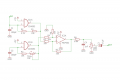
This is the circuit in question I used (as a power source, I used a 9 V battery):
1712412780233.png
This is video showcase of my Theremin:

As you can see, it seems that the pitch of the device depends on how far away my hand is from the IC, rather than the antenna.

This is the original tutorial video from youtube which I followed and from which I got the schematic from:

So yeah, I'm not really sure what's wrong, and I would really like anyone to notice what I did wrong, thanks!
 

MisterBill2

Joined Jan 23, 2018
27,186
What I see from the circuit schematic, which probably was not mentioned anywhere in the presentation, is that this is a capacity sensing system and so the physical arrangement matters very much. Every bit of the wiring around the IC is a part of the frequency determining capacitance. That very much includes the capacitance to your hand. In this circuit component position matters very much.

And aside from that, if the small version of the 4093 has four gates, te inputs to the unused gates must be terminated, either to the common or to the plus V point.
 

Thread Starter

goopygoober

Joined Dec 5, 2023
10
So, where would it be ideally for me to place the IC in that case?
I could cut down the jumper wires connecting it and make it considerably shorter if that would help, but I'm curious as to what you would suggest.
Also the well I did connected all the other gates to the breadboard too so, I don't really see where the problem is in that.
Also thanks very much for a reply, make sure to tell me what you would do in my place.
 

MisterBill2

Joined Jan 23, 2018
27,186
Wow! You got it to work building it on a plug-in breadboard! That in itself is a real achievement! A theremin, especially one using that circuit, is normally assembled on either a closely packed PCB or a piece of Vector board, with the 0.10grid of holes. The sections that are the most critical are the inputs to the gates and the connections between the gate input and output.
The explanation is that the sound you get is the result of the difference in frequency between the two oscillators formed by the two gates. And the frequency of the oscillators is affected by the capacitance to everything else nearby. What happens is that as the capacitance to things other than your hand increases, the effect of changing the capacitance from your hand is reduced.
One thing that might work in your favor is a "ground surface" connected to the power source negative terminal, located beneath everything else. That surface could be a square piece of aluminum foil, as one cheap and easy option.
Shortening the soldered on leads will certainly have quite an effect, if you are able to do it without causing any unwanted connections between the wires.
 

Dodgydave

Joined Jun 22, 2012
11,395
Your video sounds like mains hum, the antenna is picking up mains noise.. Normally a Theremin uses Colpitts oscillators producing sine waves.
 

Audioguru again

Joined Oct 21, 2019
6,826
Your video sounds like mains hum, the antenna is picking up mains noise.. Normally a Theremin uses Colpitts oscillators producing sine waves.
I agree. I measure the sound is exactly 50Hz (the pitch that never changes in the video) which is pickup of mains hum, but it has some distortion produced by the digital comparator. The distance of the hand from the antenna or any of the wires in the circuit changes only the amount of distortion, not the 50Hz pitch.
Of course all the rows of contacts and long wires all over the place on a breadboard are antennas that pickup mains hum. Your body is also an antenna that picks up mains hum.

The video Does not play how the theremin sounds except some mains hum (like your circuit) at 7:13 on the Video.
Then the video IS A FAKE LIKE MANY CARTOONS posted on You Tube.
 

Thread Starter

goopygoober

Joined Dec 5, 2023
10
Could you tell me what would be preferable way to place this piece of aluminium foil or should I better say where?, would the IC and the entire breadboard need to be placed abow the aluminium foil, or just the IC, or the entire circuit?
 

Thread Starter

goopygoober

Joined Dec 5, 2023
10
Wow! You got it to work building it on a plug-in breadboard! That in itself is a real achievement! A theremin, especially one using that circuit, is normally assembled on either a closely packed PCB or a piece of Vector board, with the 0.10grid of holes. The sections that are the most critical are the inputs to the gates and the connections between the gate input and output.
The explanation is that the sound you get is the result of the difference in frequency between the two oscillators formed by the two gates. And the frequency of the oscillators is affected by the capacitance to everything else nearby. What happens is that as the capacitance to things other than your hand increases, the effect of changing the capacitance from your hand is reduced.
One thing that might work in your favor is a "ground surface" connected to the power source negative terminal, located beneath everything else. That surface could be a square piece of aluminum foil, as one cheap and easy option.
Shortening the soldered on leads will certainly have quite an effect, if you are able to do it without causing any unwanted connections between the wires.
Could you tell me what would be preferable way to place this piece of aluminium foil or should I better say where?, would the IC and the entire breadboard need to be placed abow the aluminium foil, or just the IC, or the entire circuit?
 

BobTPH

Joined Jun 5, 2013
11,463
Could you tell me what would be preferable way to place this piece of aluminium foil or should I better say where?, would the IC and the entire breadboard need to be placed abow the aluminium foil, or just the IC, or the entire circuit?
The device in the video clearly is not working. Why not start with a schematic that is known to work?
 

Alec_t

Joined Sep 17, 2013
15,103
With the component values shown, the oscillators should be running at about 750kHz. Even a ~1% variation of one of the RC time constants (e.g. due to thermal drift) could take the beat frequency beyond the audible range, giving the impression that the Theremin is not working.
 

Thread Starter

goopygoober

Joined Dec 5, 2023
10
I agree. I measure the sound is exactly 50Hz (the pitch that never changes in the video) which is pickup of mains hum, but it has some distortion produced by the digital comparator. The distance of the hand from the antenna or any of the wires in the circuit changes only the amount of distortion, not the 50Hz pitch.
Of course all the rows of contacts and long wires all over the place on a breadboard are antennas that pickup mains hum. Your body is also an antenna that picks up mains hum.

The video Does not play how the theremin sounds except some mains hum (like your circuit) at 7:13 on the Video.
Then the video IS A FAKE LIKE MANY CARTOONS posted on You Tube.
So pretty much the circuit more or less doesn't even change the pitch, well dam
Wow! You got it to work building it on a plug-in breadboard! That in itself is a real achievement! A theremin, especially one using that circuit, is normally assembled on either a closely packed PCB or a piece of Vector board, with the 0.10grid of holes. The sections that are the most critical are the inputs to the gates and the connections between the gate input and output.
The explanation is that the sound you get is the result of the difference in frequency between the two oscillators formed by the two gates. And the frequency of the oscillators is affected by the capacitance to everything else nearby. What happens is that as the capacitance to things other than your hand increases, the effect of changing the capacitance from your hand is reduced.
One thing that might work in your favor is a "ground surface" connected to the power source negative terminal, located beneath everything else. That surface could be a square piece of aluminum foil, as one cheap and easy option.
Shortening the soldered on leads will certainly have quite an effect, if you are able to do it without causing any unwanted connections between the wires.
Hey also, would it be a good idea just in case because im notso certain about cutting the wires, if I were to try making some kind of legs which would hold the wires(therefore IC itself) above the breadboard?
 

AnalogKid

Joined Aug 1, 2013
12,045
The sound from a real Theremin sounds like a slide whistle. It is a mostly-pure sine wave, with the frequency varying with antenna loading. The schematic in post #1 is not that. 50 or 60 Hz power line radiation is picked up and combined with the interference product of two high frequency oscillators. The effect is a quasi-squarewave signal that is pulse-width modulated with the result of the oscillators. That is why the sound has two distinct components. One is the 50 Hz, and the other is a narrow pulse whose width changes with antenna loading. As you get closer to the antenna, the apparent pitch of the sound gets higher. This is the pulse width narrowing.

This was one component of the original Doctor Who theme.

ak
 

MisterBill2

Joined Jan 23, 2018
27,186
Wow, lots of discussion. One thing not mentioned a lot is that the generated tone iis the difference between the two oscillator frequencies. So for starters both need to be quite close to each other. , AND both need to be oscillating similar amplitudes and close to the same frequency.
The one in the Post #1 circuit seems reasonable, but only if both oscillators are functioning. So there is quite a bit of diagnostics needed to see what really is happening.
 

bertus

Joined Apr 5, 2008
22,885
Hello,

As @MisterBill2 said, the two oscillators need to be close in frequency.
One of the oscillators has a potmeter to adjust its frequency.
Keep in mind that capacitors can have a large tollerance.

Bertus
 

Thread Starter

goopygoober

Joined Dec 5, 2023
10
Hello,

As @MisterBill2 said, the two oscillators need to be close in frequency.
One of the oscillators has a potmeter to adjust its frequency.
Keep in mind that capacitors can have a large tollerance.

Bertus
So I don't need to move any of the components? It's enough for me to just adjust the frequency with the potentiometer and the problem should be resolved?
 

AnalogKid

Joined Aug 1, 2013
12,045
In the original video, the guy starts with an OR function to combine the two oscillator waveforms, and then shifts to a subtraction function. These two approaches yield very different resulting waveforms and power spectra.

ak
 

BobTPH

Joined Jun 5, 2013
11,463
Perhaps. Try adjusting the pot until you get a clear audible tone without waving your hand around the antenna. Then try waving your hand and see if the frequency changes.
 

AnalogKid

Joined Aug 1, 2013
12,045
The CD4093 Schmitt trigger oscillator is low cost, reliable, and naturally gives an output with exactly 50/50 duty cycle. What it is not is exceptionally stable, repeatable, or precise. Even with theoretically perfect resistors and capacitors, the frequencies of two "identical" circuits will be different enough to matter due to the way the chips are fabricated and function. Thus, you need a way to assure that the *difference* between the two oscillators falls within the range of human hearing. That is why one oscillator has a frequency adjust pot - to get it close-but-not-exactly-equal-to the other one.

ak
 
Top