Help with Arthur Harrison's 1999 Theremin Design

Thread Starter

chloe259

Joined Apr 14, 2026
4
Hi everyone!

I've been working on building Arthur Harrison's 1999 theremin for the past month, and got the design to work last week when it produced a whistling noise that changed pitch as I moved my hand around the antenna. It suddenly stopped working today, and now the speaker only produces a loud, flat buzzing sound that doesn't change tone at all.

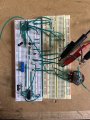
I've attached some reference photos below. I'm using a DC regulated power supply to supply 9 volts to the circuit, and I've connected the headphone jack to an amplier and speaker (the setup is extremely jank, I know).

If you're looking for the schematic I followed, you can find it on the Wayback Machine (the original site was taken down) or here on a google doc: https://docs.google.com/document/d/1m9eecZCp_zEL0PCQKVHNxSN9EEuPZah779fg0FFhKQ8/edit?tab=t.0

Any help, suggestions, or advice would sincerely be appreciated - thanks!
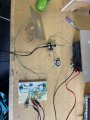
IMG_5300.JPGIMG_5301.JPG
 

MrChips

Joined Oct 2, 2009
34,680
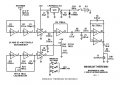
For reference purposes:

Theremin circuit.jpg
Circuit Description

Two identical, commonly-available integrated circuits known as "hex inverters" are used for the theremin's primary functions. These are CMOS (Complimentary Symmetry Metal Oxide Semiconductor) devices, typically used in digital circuits to perform a logic function called "inversion." Each IC contains six identical sections; thus the term "hex inverter."

U1 sections A and B form the theremin's variable oscillator that operates in a frequency range around 73kHz. The antenna forms one-half of a variable capacitor that is part of this oscillator's frequency-determining network, and the player's hand forms the other half. As the distance between the hand and the antenna varies, so does the capacitance and therefore the oscillator's frequency. U1 section C buffers the variable oscillator's output to provide impedance isolation from the rest of the circuit.

U2 sections A and B comprise the theremin's local oscillator that is adjusted with PITCH NULL potentiometer RV2 and PITCH NULL CALIBRATION potentiometer RV1. RV1 is a miniature "trimmer" type, mounted on the circuit board, used to calibrate the local oscillator's frequency range. With RV1 properly adjusted, the local oscillator's frequency will equal the variable oscillator's frequency with the hand furthest away from the antenna. Under these conditions, the phase relationship of the two oscillators will be constant due to their small, but finite capacitive coupling, so no audible tone will be produced.

The inverters' propagation delays and output impedances are supply-dependent. Accordingly, PITCH NULL potentiometer RV2 affects the local oscillator's frequency by varying its supply voltage. This method of adjustment permits RV2 to be located at any convenient distance from the circuit and antenna, since frequency variations resulting from stray capacitance between the potentiometer's slider and ground are decoupled by capacitor C8. In use, RV2 is adjusted by the player so that the theremin is silent with the hand furthest away from the antenna, and produces the lowest tone when the hand is at the maximum playing distance. U2 section C buffers the variable oscillator's output to provide impedance isolation from the rest of the circuit. The three remaining U2 sections are not used, so their inputs are grounded.

U1 section F is the theremin's mixer. The mixer "heterodynes" the two oscillator signals, producing sum and difference terms of their fundamental frequencies and harmonics. Non-linearities inherent in U1-F's transfer function perform this operation, eliminating the diode normally used for the purpose. C4 is a DC blocking capacitor that couples the mixer's output to a low-pass filter consisting of R6 and C5. This filter removes the mixer's inaudible heterodyne sum products, leaving the audible difference, or "beat frequency" product. The beat frequency signal is applied to an amplifier comprised of U1 sections D and E, and gain-determining resistors R7 and R8. Capacitor C6 provides a second low-pass filtering section to further attenuate the inaudible heterodyne products.

Since the theremin's oscillators have some sensitivity to power supply variations, VR1, a low-dropout voltage regulator IC, is used to furnish a steady 5 volts to the circuit. The theremin uses less than 2 milliamperes of current, so a nine-volt alkaline battery will provide many days of operation. Rectifier CR1 protects the circuit from accidental battery reversal, and R14 prevents excessive current from causing CR1 and the battery to heat under such a condition. Since the circuit draws less than 2 milliamperes, the voltage drop across R14 is less than 200 millivolts, causing a relatively insignificant loss in battery life. The instrument will operate with a battery as low as 5.5 volts.

In the prototype, the output at J1 ranges from about 2V peak-to-peak at 80Hz, decreasing to about 120mV peak-to-peak at 1800Hz. These levels can vary appreciably depending on the specific lot characteristics of ICs used for U1 and U2, but the lowest amplitudes observed (with ICs manufactured by Fairchild Semiconductor) still provided an adequate signal for a typical PA amplifier. The theremin's useful pitch range is about 200Hz to 1600Hz, or three octaves, for a corresponding hand distance of about eighteen inches to one inch from the plate antenna. The inherently low "Q" characteristic of the oscillators establish a limit for the lower audible frequency, below which, electromagnetic interference from 60Hz power lines and appliances, combined with stray-capacitive coupling between the oscillators, compromise the output fidelity. These conditions improve if the instrument is far from interfering sources. The values of the oscillators' frequency-determining components may be adjusted empirically to obtain the best compromise of sensing range and fidelity. For example, as C3 is increased, interference effects will diminish at the expense of decreased sensing range.

The Minimum Theremin may be connected to an amplifier via mono OUTPUT jack J1. It also has sufficient output power to drive efficient, high-fidelity headphones at a comfortable level. For use with stereo headphones, the user may wish to replace J1 with a stereo type that has its "tip" and "ring" contacts connected together.

For a theremin to operate properly, sufficient capacitive coupling must exist between the player's body and the instrument. Although not obvious, a player is sufficiently "coupled" to earth via his or her surface area, which presents a large capacitance to earth's ground through "free space." When the theremin is connected to an amplifier, it too, is grounded via an electrical connection and/or capacitance between the amplifier circuitry and earth. This "free space" coupling, along with the amplifier's connection to ground, provide the desired common connection between the player's body and the instrument.

When used with headphones and not connected to external equipment, there may not be sufficient capacitive coupling between the instrument and player. This may be remedied by connecting the circuit's ground (battery negative terminal) to earth or a nearby metal object. A metal microphone stand, when used to mount the theremin, is suitable for this purpose. If this is not practical, grasping a few coils the headphone cord will provide sufficient coupling between the player and the circuit's ground.
Temperature performance is quite excellent for this theremin; warm-up drift is negligible due to the conservative power levels in the oscillator ICs, as well as first-order drift cancellation between the identical oscillator topologies.
 

MrChips

Joined Oct 2, 2009
34,680
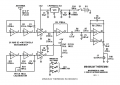
1776189181164.png

In order to trouble shoot this circuit, you need to check that the two oscillators are operating and at the right frequencies, around 75 kHz. To do this, you would need an oscilloscope to examine the signals.

If you don't have access to an oscilloscope, some DMMs are capable of measuring frequency.
Failing that, you can use a divide-by-16 counter to reduce the frequency by a factor of 16 (or 32) into the audible range. CMOS CD4020, CD4040, or CD4060 counters will do that.

You can feed the signal into R6 to hear the tone (after disconnecting from C4).
 

panic mode

Joined Oct 10, 2011
4,902
RV1 is not wired correctly (wiper is not used). also i would not use +ve rail for oscillator feedback. breadboard is notoriously high capacitance (~20pF). and that is for a regular "rib" segments that are just 10mm long and (have five holes and two neighbours). but ... the power rails are much longer (some 150mm) and that length means larger capacitance. (150pF). in a circuit using CMOS chip and 100pF capacitor, that may be a bridge too far
 

panic mode

Joined Oct 10, 2011
4,902
one option to slow down oscillator (for debugging) is to increase capacitance. that can be used to slow it down into audible range.
 

MisterBill2

Joined Jan 23, 2018
27,258
With that large an area for the circuit assembly, and based on the great number of long wires, the two likely cuases would be a single failed connection, or a number of failed connections. The EXCELLENT photographs in post #1 show quite a few points where a poor connection can introduce that mains frequency noise voltage.
 

Thread Starter

chloe259

Joined Apr 14, 2026
4
RV1 is not wired correctly (wiper is not used). also i would not use +ve rail for oscillator feedback. breadboard is notoriously high capacitance (~20pF). and that is for a regular "rib" segments that are just 10mm long and (have five holes and two neighbours). but ... the power rails are much longer (some 150mm) and that length means larger capacitance. (150pF). in a circuit using CMOS chip and 100pF capacitor, that may be a bridge too far
Thanks for pointing that out, I fixed the wire connection. I also connected the oscillator pin directly to the resistor, but unfortunately there wasn't really a difference in the noise output.
 

Thread Starter

chloe259

Joined Apr 14, 2026
4
Hi guys! My bad for the spam — but I just wanted to let yall know, I think I figured out the problem. The audio jack I'm using has 3 wires soldered to it, and I realized that if I connected the third one to the power line the problem was fixed. I genuinely have zero idea why this works, so any insight into that would be appreciated :)
 

MisterBill2

Joined Jan 23, 2018
27,258
I have seen that "third contact" on output connections used asa powerswitch many times. It works , but I don't like it because it can, in some arrangements,send a blast of battery voltage into an amplifier's input. IF the amp is on and the gain turned up that can result in damaged or destroyed speakers.
 
Top