Facebook
 Google
 GitHub
 Linkedin

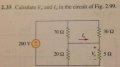
Can a current flow between two points at the same potential or not?
I have so far carefully avoided comment on 'the circuit' that sparked off this thread.I clearly stated "in a load".
That is because I agree with the Electrician - it is ill posed.
Perhaps deliberately by the lecturer to bring out a point.
But what point?
Let me ask a question or two first.
Suppose in the original circuit a second (third...) strap wire was connected. What would be the current in this wire?
Would it change the current in the other wire or the rest of the circuit?
Now let me ask these questions of WBahn's example of a 12v source and a 2 ohm resistor.
Add a second (third...) wire to the connection between the source and the load (Yes RB I will come to your comment about load)
Or better change the original solid wire for stranded.
Now what is the current in each strand?
Well, as I said before ( and I agree that 6 amps flow, make no mistake here), we need extra physics - in this case materials properties and crosssectional areas to answer these questions.
6amps flow but circuit theory regards this wire or assembly of conductors as a single node for circuit analysis purposes.
A single node does not (should not) have a 'voltage' across it, that requires two nodes. All points on the wire are part of the same node.
So back to my original statement.
Connect two nodes of a circuit at the same potential by a conductor of any value and zero current flows.
No inconsistency here. We can return to our circuit theory.
Note that it is this single node characteristic that allows us to stretch, bend, and redraw circuit diagrams to expand or contract individual nodes to put a drawing in its most convenient form.
Or as some lecturers do for effect, to put the circuit in its most confusing form.
If you redraw the original circuit (or WBahn's example) with the strap wire condensed to a single node, the short becomes immediately apparent (or the issue of 6 amps at zero volts goes away).
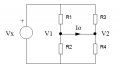
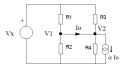
Please note that my example of a wheatstone bridge correctly identifies two separate nodes in a circuit at the same potential and discusses the current in a connection between them.
Similarly, my examples of an unconnected battery and an unpowered vacuum tube identify two nodes in a circuit.
A strap wire is a single node not two and does not constitute a load, according to the definitions of circuit theory.
As an aside, someone compared the original circuit to the mechanical question of an irresisible force and an immovable object.
That is not a good comparison because mechanics has an extra piece of physics to resolve that conundrum, unlike electric circuit theory, which does not. It all hinges on your definition of irrestible force and immovable object.
Last edited: