A question about Capacitors

Thread Starter

KM Photography

Joined Nov 15, 2014
10
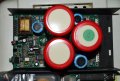
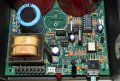
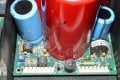
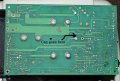
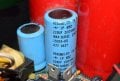
This may have been answered before. I'm currently working on a Photogenic Powerlight 1500SL Studio Strobe Light. I have found a bad capacitor. This is my first time replacing a capacitor, usually it's as simple as replacing a fuse or fixing a solder joint. I would assume this cap is Non-polar since it is 200uf 200VNP 250VDC, However when you look at the tabs that hold the leads in place there is a "-" on one of the tabs and a dot on the other, which to me would suggest it's polarized. Below are some photos of the cap in question, any help would be greatly appreciated!DSC_0212.jpg DSC_0217.jpg
 

wayneh

Joined Sep 9, 2010
18,104
Looks electrolytic (polarized) to me!

Take a look here for instance. I would use a cap rated to a higher temperature (105°C versus 85°C) if I could, with same or higher voltage rating and same or slightly higher capacity.

Finally, be sure the replacement has the right diameter and lead spacing. It looks like you could use one quite a bit taller, but a larger diameter would be a very tough fit.

How did you decide the cap was bad? Just curious. I'd highly consider replacing ALL the electrolytic caps. It will only add a few dollars to your project.
 
Last edited:

Thread Starter

KM Photography

Joined Nov 15, 2014
10
Well I was testing the flash, and after each flash smoke would come out of the unit. Hoping it left a mark I took it apart to see where it was coming from but to no avail, so I hooked the connectors back up and left the unit open, plugged it in (carefully) and flashed it a few times. I saw smoke rolling from underneath this capacitor. If you look at the lead with the "-" on it, that is where it was starting to explode.
 

ISB123

Joined May 21, 2014
1,236
VNP-Vertical Natural Plate
Its just more robust electrolytic capacitor.it has higher voltage breakdown so it can sustain overvoltage.
 

Thread Starter

KM Photography

Joined Nov 15, 2014
10
Okay so this cap is actually polarized and more than likely the lead with the "-" is the negative lead, because there are no other markings indicating positive or negative.
 

GopherT

Joined Nov 23, 2012
8,009
These caps might be used for some type of voltage doubler, common in flash units. The big caps are for the high voltage storage. Since the polarity is reversed as the voltage is doubled (or quadrupled, or...), a non-polar cap is reasonable but not common.
 

ian field

Joined Oct 27, 2012
6,536
But the VNP stands for Volts Non-Polarized, correct?
NP on the label and no obvious "bar" to mark negative strongly points at non-polar, but I'd expect one with those ratings to be a lot bigger.

The arcing at the solder joint could be the whole extent of the problem - I'd make some attempt to test the capacitor, assuming it isn't shorted - I'd be interested whether it had more leakage one way than the other.
 

Thread Starter

KM Photography

Joined Nov 15, 2014
10
I believe it's shot. I didn't see any actually arcing, just smoke coming from underneath the cap. If you look at the lead it's burnt around the body of the cap. If it was just arcing at the solder point, I wouldn't have had to heat the solder to remove it.
 

GopherT

Joined Nov 23, 2012
8,009

Thread Starter

KM Photography

Joined Nov 15, 2014
10
Lol thank you Gopher. I did happen to give some advice for pictures. I'm using a Nikon D3300 to take my photos, however you can still get a decent quality photo with even the most basic point and shoot camera. I put that advice on the forum you linked to me.
 

ian field

Joined Oct 27, 2012
6,536
This may have been answered before. I'm currently working on a Photogenic Powerlight 1500SL Studio Strobe Light. I have found a bad capacitor. This is my first time replacing a capacitor, usually it's as simple as replacing a fuse or fixing a solder joint. I would assume this cap is Non-polar since it is 200uf 200VNP 250VDC, However when you look at the tabs that hold the leads in place there is a "-" on one of the tabs and a dot on the other, which to me would suggest it's polarized. Below are some photos of the cap in question, any help would be greatly appreciated!View attachment 75694 View attachment 75695
Just had a proper look at the posted photo - those burn marks look a lot like rivet failure where the leads come through the seal and attach to the solder lugs.

Obviously not good enough to repair the capacitor to return to service - but you can partially re-form the rivet heads with the point of a screwdriver if you tap the handle with a bit of weight.

That should restore good enough contact so you can do some tests to determine whether leakage is significantly more with one polarity than the other.

The Ohms ranges on an analogue meter such as an AVO 8 should give you some indication - when you apply the prods to the capacitor lugs, the pointer should "kick" to nearly 0 Ohms and slowly sink back to infinity. If it sinks very slowly one way round - that's leakage.
 
Top