Nope, you only "have a single 5V voltage source".Place a potential of +7-8V at the negative terminal.
Maybe I'm using a charge pump or similar mechanism to generate the voltage from the 5V source. You didn't say I couldn't and you didn't specify the LED. Naturally I assumed this wasn't what you intended so I don't know.Nope, you only "have a single 5V voltage source".
You have a standard LED which must be connected "in reverse" to a single external voltage source. Does that help?Maybe I'm using a charge pump or similar mechanism to generate the voltage from the 5V source. You didn't say I couldn't and you didn't specify the LED. Naturally I assumed this wasn't what you intended so I don't know.
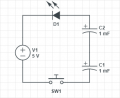
I did it with +5V source, a white LED and two capacitors on the breadboard. The LED doesn't stay lit for long.You have a standard LED which must be connected "in reverse" to a single external voltage source. Does that help?
There is no requirement for how long it stays lit. It just has to conduct "fully" in the forward direction to qualify as a valid solution.How long does it have to stay lit?
Okay, well let's see it.I did it with +5V source, a white LED and two capacitors on the breadboard. The LED doesn't stay lit for long.
Step 1: Charge C1 and C2 to 5VThere is no requirement for how long it stays lit. It just has to conduct "fully" in the forward direction to qualify as a valid solution.
Okay, well let's see it.
I really don't see how that could possibly work. Running it through the simulator doesn't seem to indicate that it would either. Are you sure that you posted the correct circuit?Step 1: Charge C1 and C2 to 5V
Step 2: Close Switch
![]()
Let us say:I really don't see how that could possibly work. Running it through the simulator doesn't seem to indicate that it would either. Are you sure that you posted the correct circuit?
Sorry, your entry cannot be accepted as the charged capacitors qualify as an EXTERNAL voltage source.Let us say:
1) The LED has a forward voltage of 3V and does not conduct in the reverse direction (a diode)
2) Since the LED can only conduct in one direction, it must overcome the forward voltage drop of 3V in addition to the 5V offset (the voltage source) for a total of about 8V
To achieve this, I have charged each capacitor to the available 5V and when placed in series totals 10V. When the switch is closed, the LED will see an instantaneous voltage of 5V declining rapidly. As long as there is a potential difference between two points, current will flow from the greater to the lesser provided there is a conductive path.
It probably did not work in your simulator because the simulation began with the capacitors discharged.
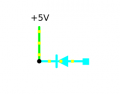
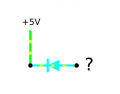
" Imagine you have a single 5V voltage source with an LED attached directly to it. Now all you have to do is complete the circuit such that the LED lights up. The challenge is that the LED must connected to the source, NOT at the anode...but at the CATHODE! "Sorry, your entry cannot be accepted as the charged capacitors qualify as an EXTERNAL voltage source.
There is no LED in your diagram.. Is it a trick question?Imagine you have a single 5V voltage source with an LED attached directly to it. Now all you have to do is complete the circuit such that the LED lights up. The challenge is that the LED must connected to the source, NOT at the anode...but at the CATHODE!
View attachment 261190
Based on your criteria, how is it not a valid solution? Is there a logical error or are you just unable to reproduce it?No I did not. What you have proposed is NOT a valid solution. (That said you might consider going into law school. You do seem to be pretty good at arguing technicalities anyway...)
Care to try again?
5V - L - R - switch - Gnd.
Led parallel with L, cathode to 5V.
When switch opens, led will light.
I guess this is not accepted, because L is "charged" , when switch is closed.
Based on your criteria, how is it not a valid solution? Is there a logical error or are you just unable to reproduce it?
For some reason the simulator displays a regular diode there. Either way, "how to forward bias the thing" is the question.There is no LED in your diagram.. Is it a trick question?
Lamest effort..? Jjw's circuit used the inductor to complete the circuit in a flyback configuration basically ignoring the voltage source as the inductor and LED are in parallel whereas my circuit forced the voltage source to sink current. His incorporated a charging stage as well where my charging stage was invalid. A bit of a rigged puzzle if you ask me.Precisely! 5V develops across the coil with the switch closed. Opening the switch leads to a sudden change in current which then causes the magnetic field to collapse. The rise in voltage at the ground side of the inductor is proportional to the change in current. Once that potential difference rises above the forward voltage of the LED, it briefly conducts until the two voltages equalize.
Well your submission IS technically correct. How about a consolation prize for "Lamest Effort"?
For some reason the simulator displays a regular diode there. Either way, "how to forward bias the thing" is the question.
Your ad hoc solution was indeed very clever. It cannot however be accepted as a valid solution.Lamest effort..? Jjw's circuit used the inductor to complete the circuit in a flyback configuration basically ignoring the voltage source as the inductor and LED are in parallel whereas my circuit forced the voltage source to sink current. His incorporated a charging stage as well where my charging stage was invalid. A bit of a rigged puzzle if you ask me.