A mosfet linearity problem

Thread Starter

q12x

Joined Sep 25, 2015
2,227
I will keep in mind the high resistance on the gate leading to overheating. I will do some future tests specifically about this case. But not right now.

Yes, very interesting what you say, mister @DickCappels , I do have a batch of 100pcs schottky diodes with a minimum of 0.2 Vf, measured with my DMM. Their datasheet mention 0.5 Vf but I had a pleasant surprise when I personally measure them.

1650408274479.png
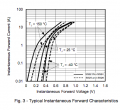
Here is it's datasheet and look for SS24 between their variants.
Can I use safely this 40V fast switching diode for potential over voltages spikes from the motor? I just looked on your 1N5819 and it is also for 40V. Compared with a 1N4007 that resist to 1000V, these 40V diodes will suppress anything? im not very familiar with schottky diodes, I didnt use them seriously in anything yet. I know some theory about them but... nothing practical, especially when it involves voltage spikes.
 

DickCappels

Joined Aug 21, 2008
10,661
The highest reverse voltage the diode will see is that of you 12 volt power supply. The peak forward current will be the maximum peak current your motor draws. If your motor draws less than 2 amps you should have no problem at all with the SS24.

The forward voltage spec you mentioned is specified at 2 amps. Your DVM (in diode test mode) is probably measuring the forward voltage at a very tiny current.
1650409926050.pngAs I mentioned earlier, you should only worry about these picky things if you encounter problems.
 
Last edited:

Thread Starter

q12x

Joined Sep 25, 2015
2,227
Another question... a bit late.
- Is there some GOOD book(s) with lots of circuits for mosfets? (Can be more than 1 one)
Circuits, experiments, prototypes, etc, anything you can think of and you already put your hands on? It will be a great help also to actually make a zip file and share it to me, if you happen to have some interesting pdf's in your PC. Links are good too.
---- Anything that will give me enough diversity in the functionality of a mosfet ! ----
That's what I'm after. And I've already consumed the wikipedia page about mosfet long time ago. It is one of the best resources for true electronic knowledge, in general. I also do understand very well the basics of what the mosfet is best used as: -a switch- , in the vast majority of the cases it is used. But I want some ideas, some out of the box circuits, interesting things and circuits to explore and to discover about mosfets. This is my wish.
Thank you !
 

Papabravo

Joined Feb 24, 2006
22,084
Another question... a bit late.
- Is there some GOOD book(s) with lots of circuits for mosfets? (Can be more than 1 one)
Circuits, experiments, prototypes, etc, anything you can think of and you already put your hands on? It will be a great help also to actually make a zip file and share it to me, if you happen to have some interesting pdf's in your PC. Links are good too.
---- Anything that will give me enough diversity in the functionality of a mosfet ! ----
That's what I'm after. And I've already consumed the wikipedia page about mosfet long time ago. It is one of the best resources for true electronic knowledge, in general. I also do understand very well the basics of what the mosfet is best used as: -a switch- , in the vast majority of the cases it is used. But I want some ideas, some out of the box circuits, interesting things and circuits to explore and to discover about mosfets. This is my wish.
Thank you !
I have an extensive library of LTspice simulations using MOSFETs with explanatory notes and "on schematic" commentary. If that would be of use to you, I'd be happy to attach a zip file in this thread. It may not be textbook quality, but the simulations do work.
 

Thread Starter

q12x

Joined Sep 25, 2015
2,227
I have an extensive library of LTspice simulations using MOSFETs with explanatory notes and "on schematic" commentary. If that would be of use to you, I'd be happy to attach a zip file in this thread. It may not be textbook quality, but the simulations do work.
Yes, like I said, -anything- and I mean it, I'm used to and I love out of the box thinking.
Excellent idea and Thank You !
 

Thread Starter

q12x

Joined Sep 25, 2015
2,227
No rush really, i like a good job better than a fast one.
Also, take time to make order and clean and re-name everything and re-place,move,cut, correct, whatever. I know from my experience, its a forever work when having saved files. They always need some maintenance and re-foldering and re-ordering and re-naming. Because life is complicated. And I totally understand that. So really, take your time.
 

Papabravo

Joined Feb 24, 2006
22,084
No rush really, i like a good job better than a fast one.
Also, take time to make order and clean and re-name everything and re-place,move,cut, correct, whatever. I know from my experience, its a forever work when having saved files. They always need some maintenance and re-foldering and re-ordering and re-naming. Because life is complicated. And I totally understand that. So really, take your time.
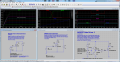
Right. Here are 3 simple examples that I have modified slightly so they "should" run on any LTspice installation and won't depend on my unique library configurations and resources. Try them on your system and tell me if I have understood the requirements for this to work.
 

Thread Starter

q12x

Joined Sep 25, 2015
2,227
I am sincere here, I know little of LTSpice. I learned other electronic simulators unfortunately, and I am more used to them than to LTSpice. I love an interactive live circuit simulator. I know, I'm cheap.
- All I did so far, I opened up your save files in the program, click on the Run button, read the text you put in the saved file, I did changed the values of some Voltage sources in the schematic, I see the changes after I Run each time, but more that this, I really don't know what else to do. These circuits are a bit too abstract for me to be bluntly sincere. Remember, I am a visual artist, not a mathematician. I feel I miss something important and I have no idea what. Haha. I surely need a tutorial into LTspice, although I know something about it, im not at 0 with it but im more a 20 from 100. I didnt put that many hours in it to totally learn it. All I know for sure the program is doing, it is calculating and showing in the graphs its results and YOU and ME should be good enough to understand and interpret those graphs. I am not that good with graphs. I mean, I am good to a point. I am not a 0 with them. Im somewhat at 50 out of 100, perhaps? I dont know, I've seen some weird ass graphs in my life, thats why Im dragging down when Im saying im not good with them.
Maybe some pdf's are better, afterall ? for someone like me? I dont know.
I even compared all of your circuits to prove I do know how to work with the program, to some extent.
...and 2 are pretty similar...
but when I look at those graphs, wwsdfsdsdfsderror31@whats the cat's ass?
1651183848454.png
I mean, I get some idea, but not completely.
For example, in the left most circuit, BS170, sais in the graph that starting at 2V, SOME green line starts to become constant @ 200mA
And for 8.2V SOME gray line starts to become constant @ 1.45A.
But when on the circuit are these green and gray or the red probes? I dont know their settings or if they even exist. At this part im rookie.
 
Last edited:

Papabravo

Joined Feb 24, 2006
22,084
Cool it looks like I was able remove the dependencies on my library so that I can post additional files from my collection.

Well understanding these configurations is essential to understanding the devices. In short

Drain current is a function of​
  1. Vgs, the gate to source voltage. This mut be positive for an N-channel MOS enhancement device
  2. Vds, the drain to source voltage, up to a limit, and then the drain current does not change for increasing Vds.
The third picture can be used to understand why it takes a current source inject charge onto the gate to turn the device on, and a current sink to take charge off of the gate to turn the device off. Use this simulation to identify the "Miller Plateau" when turning the device on and off.
 

Papabravo

Joined Feb 24, 2006
22,084
Yes @Papabravo your files are universal and working ok on my LTSpice version XVII
I'll see what more I can dig up that you might find useful.

One more thing. In the BS170.lib file, if you open it in a text editor you will find three different implementations. The first one uses a "model card". This expression comes from the era when spice programs were submitted to a mainframe computer on IBM punch cards. It is a single line definition of the device parameters. The 2nd and 3rd implementations use subcircuits. You can use these subcircuits by changing the name of the device to match the subcircuit names.

The MOSFET.zip in post 29 has 3 new files in it:
  1. An open loop Buck Converter, which is one of the primary uses cases for a MOSFET switch
  2. A test file from @Bordodynov, for the AO4468 and similar parts. I had to make the text readable by enlarging it to the standard 1.5.
  3. A gate charge demo from @Bordodynov, where I also had to enlarge the text, and modify the drawing with snappy little arrowheads. I hope Alex is not too upset with me for appropriating his work, after all I did give him credit.
 
Last edited:
Top