A circuit that closes twice in small intervals when powered on and then stays open

danadak

Joined Mar 10, 2018
4,057
The initial statement of requirements was rather lacking in quite a few details, such as supply voltage and also the actual output. Was the need for contacts, or a logic level, or mains voltage?
Why do some tout the use of a micro, with it's programming requirements, total lack of repairability, fragile structure, and invisible operation?
In fact one can build into UP redundancy if one so desires. repair ability, most
can be reprogrammed if necessary. Fragile, they are made out of CMOS, like logic.
Invisible, so far none have disappeared in Dr. Whos telephone booth on me.

Space vehicles and landers filled with them. Discrete designs notorious for reliability issues
with interconnect failure. Reliability function -

https://www.renesas.com/us/en/doc/products/others/r51zz0001ej0250.pdf

Dominant failure mechanism is package failure in many applications, thermal
cycling issues, integrity, applies to all ICs.


Regards, Dana.
 

AnalogKid

Joined Aug 1, 2013
12,289
as the thread starter was going to build this himself, it could well be a good project for learning a micro.
Given that the site title is All About Circuits - as opposed to All About Firmware - I think the TS would have requested a uC-based design if that were his intent.
So he would have the code to reveal the "invisible operation". Assuming that is what you are referring to.
I think it is a reference to the graphic-block-program-thingy often posted by danadak. As I recall, he frequently points out that it requires "no programming" so in terms of programming experience you come away with nothing more than a flowchart.
But I would suspect they will be prone to noise and component aging.
Don't see any reason why. All circuits are subject to noise and aging effects, but in this case I think the 1 V hysteresis band at each input is more than enough to handle the noise in a 100 K resistor. And, relative to the electrolytic caps in your example, ceramic caps age way way less. Plus, timing accuracy and stability are explicitly *not* required:
The period can be a few milliseconds even if within half a second should be fine. It need not be very precise.
And, lastly:
I tout the use of a micro as it is often easier and cheaper.
Expanding on my tagline:

"I suppose it is tempting, if the only tool you have is a hammer, to treat everything as if it were a nail."
- Abraham Maslow, The Psychology of Science: A Reconnaissance, 1966

I could not resist ;)

ak
 
Last edited:

danadak

Joined Mar 10, 2018
4,057
I think it is a reference to the graphic-block-program-thingy often posted by danadak. As I recall, he frequently points out that it requires "no programming" so in terms of programming experience you come away with nothing more than a flowchart.
Actually I frequently point out using block programming one can look at C code generated to
start getting a feel for what C looks like.

Anyone that uses a 4 function calculator is doing basic programming.

Whether programming is writing out code with pencil, pen, speech generated coding, ide
written, flowchart, its all programming. Looking for the day we simply give a AI machine
a spoken or graphical system spec and the rest is generated. Telepathy would be good.
I used to code on punched paper tape, teletype, and masses of switches on front panels
of minis, do not want to do that anymore.

Wiring up proto boards with forests of wires also not desired. I like mouse and cursor
wiring of protos, the less of the others the better. Referring to PSOC, FPGA.

Regards, Dana.
 
Last edited:

djsfantasi

Joined Apr 11, 2010
9,237
I was referring primarily to the toy computer type devices so very highly touted in that "Nuts and Volts" publication.
Expanding on my tagline:

"I suppose it is tempting, if the only tool you have is a hammer, to treat everything as if it were a nail."
- Abraham Maslow, The Psychology of Science: A Reconnaissance, 1966

I could not resist ;)
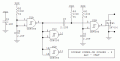
Here is the circuit in post #16, cleaned up for this application. I adjusted some component values per Wally's sim.
I see 7 components that could fail in AnalogKid’s schematic. Including three which are likely to fail. Versus one$3 chip that can be replaced immediately, without having to debug 7 separate components. Whereas there are requirements that are slightly complex, a uP design is called for.

I don’t understand MisterBill2’s reference to “toy computer types”... An 8 pin uP without any other unnecessary circuitry (I.e., Arduino Nano or Uno) is all that's needed. I’m unsure if MisterBill2’s considers that a “toy computer”. Perhaps if he could define “toy computer” I would better understand his position.

Sure, you have to learn programming. And buy a programmer(under $20)... But programming is a valuable skill to have. And can be accomplished in less time than understanding of electronics.

I realize many of you can see the elegance of a solution that doesn’t require a uP, and I respect you. I only ask that that respect is returned.

I could not resist.
 

AnalogKid

Joined Aug 1, 2013
12,289
Whereas there are requirements that are slightly complex, a uP design is called for.
If you are referring to this thread, I don't see any requirements that are anything close to complex. In fact, note that in post #1 the TS ruled out a uC solution.
I see 7 components that could fail in AnalogKid’s schematic.
There are 9 components total, but the output transistor probably is a constant for any design, leaving 8 that are specific to this schematic. And of course, any of them *could* fail.
Including three which are likely to fail.
And those are ... ?

ak
 
Last edited:

djsfantasi

Joined Apr 11, 2010
9,237
Capacitors are more likely to fail than resistors. They fail due to environmental factors more often than resistors. And on a subjective view (I know you don’t like that, but there are objective reasons behind this), how many posts do you see asking “replace all resistors” versus “replace all capacitors”? The takeaway is which is more likely to fail? 7 versus 1 components!
 

KMoffett

Joined Dec 19, 2007
2,918
This sounds like each generation thinking the younger generation's music will be the end of civilization.
Why use logic chips when you can do it with diodes , resistors and transistors?
Why use op amps when you can use transistors and resistors?
Why use uPs when you can use logic chips or 555s or diodes, resistors and transistors.
WHY...why...why? Because!
I started with vacuum tubes. And each new technology seemed like overkill...until I tried them. But at times, I fall back to circuits I designed in the past that worked rather that starting from scratch with the newest technology.
I also work with people who think that vacuum tube audio technology is the Holy Grail.
Go figure. ;)
 

AnalogKid

Joined Aug 1, 2013
12,289
Reliability is a nebulous term, and most people fail to include in it the effects an unfamiliar development process/system can have on the resulting product's short and long term reliability. Separate from that are the true costs of the development cycle, including the learning curve and debugging that pretty much by definition is more difficult that troubleshooting a NAND gate with a voltmeter. Add in the costs of acquiring and learning to use a device programmer, and I think the other initial requirement - cheap - is pretty much gone.

ak
 

AnalogKid

Joined Aug 1, 2013
12,289
Capacitors are more likely to fail than resistors.
True, but all capacitors are not created equal. In my (objective) experience, axial and radial leaded ceramics, properly handled, are functionally equivalent to resistors in reliability.
how many posts do you see asking “replace all resistors” versus “replace all capacitors”?
And how many of those posts are referring to electrolytics in old equipment (statistically, old audio gear)?

ak
 
Last edited:

crutschow

Joined Mar 14, 2008
38,923
Certainly electrolytic capacitors are more likely to fail than most other electronic components.
In this case, ceramic caps could be substituted for electrolytics if long term reliability is a concern.

As far a mirco failures, I had a board problem due to a suspected micro failure.
The board was part of a TV cabinet system that raised and lowered the TV into the cabinet.
It started acting up, often requiring several button pushes to complete the raising or lower process.
Looking up information about the board, I found several instances of a similar failure which was attributed to EEPROM problems with the micro. Apparently the EPROM program bits were being scrambled due to leakage of the stored gate charge that determines each bit state.
So long term micro failure is possible if it uses EEPROM for its program storage (those that use stored charge on the gate capacitor for the bit state).
I believe most micros that have internal memory for the program use such an EEPROM.
Correct me if I'm wrong.
Two components.
C1, C2, C3 (?)..:confused:
 

AnalogKid

Joined Aug 1, 2013
12,289
C1, C2, C3 (?)..:confused:
I was referring to dj's proposed circuit of one uC and nothing else. I was pointing out that his circuit in fact has two components (the other being the decoupling *capacitor* <danger>). If you look at my body count, I got to eight by including decoupling cap C4.

ak
 
Last edited:

AnalogKid

Joined Aug 1, 2013
12,289
This sounds like each generation thinking the younger generation's music will be the end of civilization.
Naw, just two geezers banging on each other.
I started with vacuum tubes. And each new technology seemed like overkill...until I tried them.
I started with tubes, and couldn't wait to get rid of them. Opamps - even the early ones - were a gift.from.god.
I also work with people who think that vacuum tube audio technology is the Holy Grail.


ak
 

danadak

Joined Mar 10, 2018
4,057
Certainly electrolytic capacitors are more likely to fail than most other electronic components.
In this case, ceramic caps could be substituted for electrolytics if long term reliability is a concern.

As far a mirco failures, I had a board problem due to a suspected micro failure.
The board was part of a TV cabinet system that raised and lowered the TV into the cabinet.
It started acting up, often requiring several button pushes to complete the raising or lower process.
Looking up information about the board, I found several instances of a similar failure which was attributed to EEPROM problems with the micro. Apparently the EPROM program bits were being scrambled due to leakage of the stored gate charge that determines each bit state.
So long term micro failure is possible if it uses EEPROM for its program storage (those that use stored charge on the gate capacitor for the bit state).
I believe most micros that have internal memory for the program use such an EEPROM.
Correct me if I'm wrong.
C1, C2, C3 (?)..:confused:
Most micros these days have both FLASH, program and data store, and EEPROM.

But that being said most modern FLASH can now function internally as EEPROM.
They do have different programming time when programmed under code execution -

https://electronics.stackexchange.c...he-difference-between-flash-memory-and-eeprom

Yes, there was a time when ALL memories had issues as design and process evolved.
Thats pretty much behind us now.


Regards, Dana.
 

crutschow

Joined Mar 14, 2008
38,923
You were right a couple of decades ago, but all use flash now.
But don't flash memories store information the same way -- using the floating gate capacitance?
there was a time when ALL memories had issues as design and process evolved.
Thats pretty much behind us now.
Depends how you define "behind us".
My understanding is that flash drives are only good up to about 10 years of reliable storage.
That may be sufficient for most electronics, but not all. :rolleyes:
 
Top