963 Hz Square Wave Generator

BobTPH

Joined Jun 5, 2013
11,521
It works for me does not necessarily mean it could work for everyone.
That was not what the challenge is about. You claimed that a specific frequency was “healing” for you. Since healing is totally subjective here (unless it means we could cut off an arm and it would grow back) your test would not involve healing at all. Based on other similar tests, it would likely involve simply distinguishing the healing frequency from another close frequency by feeling the healing effect in a double blinded test.
 
Generating a 963 Hz square wave with Arduino code is fairly easy. Alternately digitalWrite a pin high and low with delayMicrosecond(519) between steps. Four lines of code.
 

Thread Starter

sab201

Joined Nov 18, 2023
297
That was not what the challenge is about. You claimed that a specific frequency was “healing” for you. Since healing is totally subjective here (unless it means we could cut off an arm and it would grow back) your test would not involve healing at all. Based on other similar tests, it would likely involve simply distinguishing the healing frequency from another close frequency by feeling the healing effect in a double blinded test.
I am not sure what healing is about but I thought it was about relieving some uncomfortable feeling in the body be it pain or any cause that is causing that pain. I don't think cutting off any part could grow it back. For me the 90 percent of pain goes away at 963 Hz while at other solfeggio requencies it didn't. I am not talking about music, I am experimenting pulsed current through electromagnet. Also other low frequencies had other healing effects.

I saw in the US there are this low frequency healing machines made.

https://en.m.wikipedia.org/wiki/Pulsed_electromagnetic_field_therapy

There is a clinic in Ireland offering this service

"PEMF therapy is used to treat a variety of conditions including:

  • Sinus
  • Inflammation
  • Fertility optimisation
  • Pain including acute pain, chronic pain, breakthrough pain, bone pain, soft tissue (nociceptive) pain, and nerve (neuropathic) pain
  • Arthritis
  • Bone healing
  • Anti-aging"

https://thecraneclinic.com/therapies/pulsed-electromagnetic-frequency-pemf-therapy/

Edit: In Wikipedia it says these are banned in the US
 
Last edited:

Thread Starter

sab201

Joined Nov 18, 2023
297
Generating a 963 Hz square wave with Arduino code is fairly easy. Alternately digitalWrite a pin high and low with delayMicrosecond(519) between steps. Four lines of code.
Yes but I like to use the same microcontroller for generating other frequencies from 0.1 Hz to 42 Hz as well. I read on Arduino forums that below certain Hz it needs software PWM. I suppose Pi Pico due to its faster speed and resolution could do that as well.
 

Thread Starter

sab201

Joined Nov 18, 2023
297
That should be a clue.
Excuse for going off topic. I fully respect your beliefs that these claims are untrue and I don't want to argue on that.

I am an Engineer and I wish to build this for myself and not for business or sales. So I wouldn't be bothering anyone or trying to convince anyone it works.

I am learning how electromagnets work and I am getting benefited from this knowledge. I removed medications and if I come out saying something can do that then I could be dead.

Edit: Besides that has its own limitations like after I power it off the healing effects stop.
 
Last edited:

atferrari

Joined Jan 6, 2004
5,012
Since long ago some PIC micros were able to generate less than 50 Hz; specifically those used for power control.

The 18F4431, IIRC, with a huge amount of peripherals not needed for your application but few lines of code for such a simple task.

Simpler, much simpler than that, google for PIC micros with NCO (numeric controlled oscillators). That would be my choice with no doubt.
 

MisterBill2

Joined Jan 23, 2018
27,540
On the western musical scale,
Bb = 932 Hz
B = 987 Hz

Hence 963 Hz is between Bb and B. It is difficult to detect a tonal shift of 5 cents for most people.
Hence we can consider an accuracy of 963 Hz ±5 %.
Hence a range of 915 to 1010 Hz should be considered acceptable unless the Gods disapprove.

Edit:
1 cent is approx. 0.5 Hz at this frequency. Hence 5 cents is about 3 Hz.
The acceptable range is 960 - 966 Hz or ±0.3%
Consider that most crystal oscillators can have their frequency varied a bit by altering the capacitance in the crystal circuit. This is often done in radio equipment to get an exact frequency, because manufacturing tolerances can only get it "quite close".
 

JohnSan

Joined Sep 15, 2018
126
If the fundamental of 963Hz is so important, you really should be producing a sine wave, as noted earlier, not a square wave.

Refer to this for more information:
https://www.allaboutcircuits.com/textbook/alternating-current/chpt-7/square-wave-signals/

A square wave at 963Hz also contains signals at:-

2889Hz at 33% amplitude
4815Hz at 20%
6741Hz at 14%
8667Hz at 11%
etc...

There are a lot of other numerals apart from 3,6 and 9 in those frequencies.

Being as you have also indicated you are interested in the Pi Pico, I would also suggest checking out that and an
AD9833 module. (A couple of $ from ebay / amazon).
Add an audio amplifer to it, size dependent on how loud you need.

It produces sine, square and triangular waveform outputs, from below 1Hz up to 25MHz.
Resolution better than 0.1Hz.
Very simple SPI interface and lots of info on Github for ccts and programs.
Very easy to produce other variants of frequency based on 9,6 and 3.

I made one using an Arduino to use as a general signal generator source.
Although, I never got around to putting it in a box, it is still a useful tool.
It will also do frequency sweeps, if thats of interest.

This is one example.
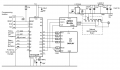
AD9833-waveform-generator-circuit.png
 

Thread Starter

sab201

Joined Nov 18, 2023
297
If the fundamental of 963Hz is so important, you really should be producing a sine wave, as noted earlier, not a square wave.

Refer to this for more information:
https://www.allaboutcircuits.com/textbook/alternating-current/chpt-7/square-wave-signals/
...
There are a lot of other numerals apart from 3,6 and 9 in those frequencies.

Being as you have also indicated you are interested in the Pi Pico, I would also suggest checking out that and an
AD9833 module. (A couple of $ from ebay / amazon).
Add an audio amplifer to it, size dependent on how loud you need.
Thanks, JohnSan I will look into it.

However I only need the waveforms at desired frequencies for powering pulsed current through electromagnets not for musical or audio application. Once I get the waveforms at peak voltage of 3.3 Volts or more I feed it to a mosfet module which switches on and off that sends the pulsing current to the electromagnet.
 

Thread Starter

sab201

Joined Nov 18, 2023
297
Common 32768 Hz clock crystal divided by 34 gives 963.765 Hz.
This can be trimmed downwards with load capacitors.
Yes I can get that 32768 clock crystal in my place but how to divide it by 34... I cannot obtain ICs other than cd 4060.
 

Thread Starter

sab201

Joined Nov 18, 2023
297
The simplest circuit to generate 963 Hz uses a 555-timer IC.
I would suggest that you use a CMOS version such as LMC555, TLC555.
Yes thanks for the idea. I will replace all the 555 timers in my low frequency pwm generator boards with cmos 555 timers to improve the accuracy.
 
Yes but I like to use the same microcontroller for generating other frequencies from 0.1 Hz to 42 Hz as well. I read on Arduino forums that below certain Hz it needs software PWM. I suppose Pi Pico due to its faster speed and resolution could do that as well.
You really don't need PWM which is typically used to mimic an analogue output on a digital pin. If you are happy with a square wave you can toggle a pin high and low at any audio frequency and higher by putting microsecond delays with between each step, the delay being half the period of the square wave.

For 42 Hz you make the delay 11905 microseconds. For lower frequencies you can just make the delay in milliseconds - i.e. for 0.1 Hz use delay(5000). The delay() instruction is in milliseconds, the delayMicroseconds() instruction does what it says on the tin. I believe you can get higher frequencies than delayMicroseconds(1) by inserting a FOR loop between toggling the pin output, modifying the number of loop steps to get the frequency you want by a bit of trial and error - as such loops do a loop in less than a microsecond - I've not done this but it should probably work with a 49 MHz clock.
 
Top