Facebook
 Google
 GitHub
 Linkedin
Good Day,
I want to make a square wave generator with a frequency of 963 Hz, close to 50 percent duty cycle with Voltage greater than or equal to 5 Volts. I already made 555 timer astable multivibrators at lower frequencies from 0.1 Hz to 42 Hz. Now I want to make it at 963 Hz. I have bought a DDS function generator and currently using this to feed it to the load circuit.
But I want to make one circuit separately at this 963 Hz frequency. In other thread I discussed about using MCUs and I was going through the tutorials I found that they can be generated but not below 1 Hz and they use software PWM and hardware PWM for frequency limits with their own limitations. I can use the MCUs to control my analog PWM generators so I am into learning MCUs.
However I like to make this analog 963 Hz PWM square wave generator using the same circuit I used for other lower frequency range using 555 timer, Resistors and Capacitors.
For a 963 Hz 555 Astable multivibrator circuit, I can use the following values.
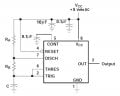

https://circuitdigest.com/calculators/555-timer-astable-circuit-calculator
However the capacitor value I should use is 10 nano Farad and that is available in ceramic disc type not in electrolytic type.
My question is, can I use this 10 nanofarad ceramic capacitor in this 555 circuit and will it produce the desired output or I should go for other type of square wave generators.
Thanks.
Edit: 693 Hz to 963 Hz in picture
I want to make a square wave generator with a frequency of 963 Hz, close to 50 percent duty cycle with Voltage greater than or equal to 5 Volts. I already made 555 timer astable multivibrators at lower frequencies from 0.1 Hz to 42 Hz. Now I want to make it at 963 Hz. I have bought a DDS function generator and currently using this to feed it to the load circuit.
But I want to make one circuit separately at this 963 Hz frequency. In other thread I discussed about using MCUs and I was going through the tutorials I found that they can be generated but not below 1 Hz and they use software PWM and hardware PWM for frequency limits with their own limitations. I can use the MCUs to control my analog PWM generators so I am into learning MCUs.
However I like to make this analog 963 Hz PWM square wave generator using the same circuit I used for other lower frequency range using 555 timer, Resistors and Capacitors.
For a 963 Hz 555 Astable multivibrator circuit, I can use the following values.
https://circuitdigest.com/calculators/555-timer-astable-circuit-calculator
However the capacitor value I should use is 10 nano Farad and that is available in ceramic disc type not in electrolytic type.
My question is, can I use this 10 nanofarad ceramic capacitor in this 555 circuit and will it produce the desired output or I should go for other type of square wave generators.
Thanks.
Edit: 693 Hz to 963 Hz in picture
Last edited: