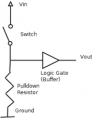
This is the max value. Hence any value from 1k to 20kΩ will be suitable, 3.3kΩ or 4.7kΩ are commonly recommended.
For 7400 series gate,
VIL = 0.4V
IIL = 1.6mA
Rpulldown = VIL/IIL = 0.4V/0.0016A = 250Ω
This is the max value. A resistance from 100Ω to 220Ω is appropriate. Better to use 100Ω for reliability.
For 74LS series gate,
VIL = 0.4V
IIL = 0.4mA
Rpulldown = VIL/IIL = 0.4V/0.4mA = 1kΩ
This is the max value. A resistance from 100Ω to 680Ω is appropriate. Again, 100Ω is recommended.
Now let us compare this with a 74HC00 series CMOS gate.
VIH = 3.15V (min)
IIH = 1μA
Rpullup = (VCC - VIH)/IIH = (5V - 3.15V)/1μA = 1.85MΩ
Hence a resistance lower than 1MΩ works fine for both cases, pull-up or pull-down.
A value from 1kΩ to 100kΩ is suitable, a range of three or more orders of magnitude.
10kΩ pull-up or pull-down is recommended.
What has not been considered in this analysis is what is driving the gate.
If the driver has current drive or sink limitations, these must be taken into consideration.
If the driver is a mechanical switch, minimum and maximum switch contact currents must be considered.
If the the lines feeding the input gate are very long, the impedance of the line and noise pickup must be taken into consideration.
For example, with 100Ω pull-up or pull-down, the driver has to handle 50mA. This could be beneficial for a mechanical switch and provide better noise immunity but too high for a driver IC.
In summary, you cannot just toss in any resistance value without taking all things into consideration.
Just for reference of the power sucking nature of TTL, I have a 1975 Zenith/Heathkit frequency counter that requires 25 Watts. That thing runs hot. I love it because it handles 600 MHz and cost me $10. Maybe I'll look into modernizing it someday.
From that article, note the text above the diagram. It would work with a '4011 though the logic is inverted. Do you think he changed the chip at some point?
---------------------------------------------------------------------------------------------------------------------------------------------------------------------------
Below is the breadboard schematic version of the above circuit so that you can see the exact wiring of the circuit to the 4011 chip.
For 7400 series gate,
VIL = 0.4V
IIL = 1.6mA
Rpulldown = VIL/IIL = 0.4V/0.0016A = 250Ω
This is the max value. A resistance from 100Ω to 220Ω is appropriate. Better to use 100Ω for reliability.
Actually, if you look at the recommended conditions in the datasheet in post #22, the range for a logic low input is 0 V to 0.8 V, not 0.4 V. 0.4 V is just a point within the range that got specified in detail. The current coming out of the input pin is not supplied by a current source, so it almost certainly is less than -1.6 mA at 0.8 V. But the standard assumption that it is 1.6 mA builds a little safety margin into the calculations. Hence, 500 ohms max.
From that article, note the text above the diagram. It would work with a '4011 though the logic is inverted. Do you think he changed the chip at some point?
---------------------------------------------------------------------------------------------------------------------------------------------------------------------------
Below is the breadboard schematic version of the above circuit so that you can see the exact wiring of the circuit to the 4011 chip.
IF you are referring to the circuit in post #7 or #25, then no, it is *not* fine. Not even close. The pinout is wrong and the input stage is dangerous.
If that were a 74HC04, one of the outputs is dead shorted to Vcc by one of the switches. Also, no logic family is worse with unconnected inputs than CMOS. For first gen TTL like the TS circuit it is strongly not recommended, but not dangerous. With CMOS it is.

 Facebook
 Google
 GitHub
 Linkedin