6W (i guess) mini bass guitar amplifier design issues

LowQCab

Joined Nov 6, 2012
5,101
All of this discussion is great as far as learning about Amplifier construction,
but the the brutal truth is that there is no practical solution for a Bass-Practice-Amp
that does not include a Speaker-Cabinet with at least ~2-Cubic-Feet of Internal-Volume,
and twice that Volume is barely adequate for satisfactory reproduction of a Bass-Guitar.
This would include a Speaker with a Cone of at least ~10-inches in diameter.

Then, if using a Transistor-Amplifier, ( rather than Tubes ),
a serious amount of Power needs to be available such that
the Transistor-Amplifier NEVER goes into "Clipping" under any normal circumstances.

~30-Watts is probably the bare minimum Power-Output capability that would be acceptable.

Transistor-Amplifier-Clipping is completely unacceptable in
a Musical-Instrument-Amplifier under any and all circumstances,
and Bass, in particular, requires HUGE AMOUNTS OF POWER, compared to other Instruments.

On the other hand,
a ~5-Watt, Class-A, Tube Amp, would be just fine for a low-Volume "Practice-Amp" for Bass Guitar.
This is because of the completely different character of the Distortion created by
an Over-Driven, Clipping, Class-A Tube-Amp may actually be desirable and welcomed.

Headphones should be given serious consideration for practicing Bass-Guitar with minimum Gear,
and with minimum complaints from your Family and Neighbors.
.
.
.
 

Ian0

Joined Aug 7, 2020
13,226
All of this discussion is great as far as learning about Amplifier construction,
but the the brutal truth is that there is no practical solution for a Bass-Practice-Amp
that does not include a Speaker-Cabinet with at least ~2-Cubic-Feet of Internal-Volume,
and twice that Volume is barely adequate for satisfactory reproduction of a Bass-Guitar.
This would include a Speaker with a Cone of at least ~10-inches in diameter.

Then, if using a Transistor-Amplifier, ( rather than Tubes ),
a serious amount of Power needs to be available such that
the Transistor-Amplifier NEVER goes into "Clipping" under any normal circumstances.

~30-Watts is probably the bare minimum Power-Output capability that would be acceptable.

Transistor-Amplifier-Clipping is completely unacceptable in
a Musical-Instrument-Amplifier under any and all circumstances,
and Bass, in particular, requires HUGE AMOUNTS OF POWER, compared to other Instruments.

On the other hand,
a ~5-Watt, Class-A, Tube Amp, would be just fine for a low-Volume "Practice-Amp" for Bass Guitar.
This is because of the completely different character of the Distortion created by
an Over-Driven, Clipping, Class-A Tube-Amp may actually be desirable and welcomed.

Headphones should be given serious consideration for practicing Bass-Guitar with minimum Gear,
and with minimum complaints from your Family and Neighbors.
.
.
.
I just about managed it with my design in Post #11 using an 8" speaker. But it was a 250W 8" speaker on a 50W amplifier, with some 6th order EQ.
I have a 6.5" Celestion to try, but I might just be pushing my luck. . .
 
Last edited:

MisterBill2

Joined Jan 23, 2018
27,977
I have seen a ONE WATT amplifier circuit presented as being suitable for a practice headphone application. I am not prepared to comment on the suitability for bass guitar as far as volume goes, but certainly that will provide enough wattage headroom for practice.
 

MrChips

Joined Oct 2, 2009
35,017
There are IC solutions for simple low to medium wattage amplifiers, for example, LM1875 and TDA2040.

If you want to learn to design with transistors and op amps, building your own audio amplifier is always a good exercise.
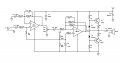
I think this is my final offering. For bass practice it is adequate. At least it will not disturb the neighbours.

Q1 and Q2 power transistors run cool and do not require heat sinks.
D1 and D2 are 1N914 diodes.

AAC audio amplfier1.jpg
 

Ian0

Joined Aug 7, 2020
13,226
There are IC solutions for simple low to medium wattage amplifiers, for example, LM1875 and TDA2040.

If you want to learn to design with transistors and op amps, building your own audio amplifier is always a good exercise.
I think is my final offering. For a practice bass practice it is adequate. At least it will not disturb the neighbours.

Q1 and Q2 power transistors run cool and do not require heat sinks.
D1 and D2 are 1N914 diodes.

View attachment 310923
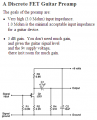
11k input impedance isn't suitable for a guitar pickup. Optimum is about 220k
 

Ian0

Joined Aug 7, 2020
13,226
Thanks for the input. I will change that in the next update.
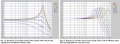
Everyone like to use 1M, but if you plot it in SPICE, including a sensible value for cable capacitance, you get a whopping big peak in the response in the 1kHz-5kHz region, the frequency of which varies with the length* of the cable.
Then you get guitarists wondering why it sounds different when they are on stage using a longer cable.
100k or 220k damps it, without removing too much treble.
(Use 6kΩ in series with 6H for a reasonable model of a guitar pickup)

*Actually it's the square root of the length of the cable, but most guitarists don't know what a square root is. Brian May might, because he's got a Ph.D in Physics.
 

MrChips

Joined Oct 2, 2009
35,017
Everyone like to use 1M, but if you plot it in SPICE, including a sensible value for cable capacitance, you get a whopping big peak in the response in the 1kHz-5kHz region, the frequency of which varies with the length* of the cable.
Then you get guitarists wondering why it sounds different when they are on stage using a longer cable.
100k or 220k damps it, without removing too much treble.
(Use 6kΩ in series with 6H for a reasonable model of a guitar pickup)

*Actually it's the square root of the length of the cable, but most guitarists don't know what a square root is. Brian May might, because he's got a Ph.D in Physics.
My Fender Jazz bass has an active output option. I have to check what is the output impedance.
 

Audioguru again

Joined Oct 21, 2019
6,826
The big peak in the high midrange frequencies of an electric guitar helps produce the awful distortion sounds of its overdrive fuzz.
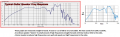
Most of the old tooob (valve) amplifiers had a 1M input resistance and the resulting frequency peak was between 2.2kHz to 8kHz depending on cable capacitance (length). The more than two octaves above the average of 4kHz was not produced because the guitar speakers were woofers with a poor high frequency response.
 

Attachments

Audioguru again

Joined Oct 21, 2019
6,826
We're beginning to loose the plot again.
A bass guitar range is around 40 to 400Hz.
Anybody who has normal human hearing hears harmonics and distortion up to 20kHz. Then a bass guitar sounds different to any other low frequency instrument.
Very Old people with normal-for-their-age high frequency hearing loss, hear only fundamental frequencies like spoken vowels.
 

LowQCab

Joined Nov 6, 2012
5,101
Virtually all purpose built Bass-Guitar Speaker-Cabinets have a built-in Horn-Loaded-Tweeter.
This is because there are very important Harmonics and "String/Fret-Noises" that
seriously enhance the overall "Tone" created by the Bass-Guitar.
This can make the Bass-Line of the song "stand-out" in a big way,
otherwise the Bass would just fade into the background, and when played-back on small Speakers,
You wouldn't be able to hear the Bass-Line at all.

Drums are treated similarly, many hours are devoted to getting
the High-Frequency "Attack" of the Drums just right, as well as the "Room-Reverberations"
.
.
.
 

MisterBill2

Joined Jan 23, 2018
27,977
Would all of that effort really be needed for practicing playing the required material by one's self?? My long-ago experience with solo musical practice is getting the playing right, certainly not in performance or group rehearsal. First one must get their own part right.
 
Top