5W audio amplifier, how to drive a small load

Thread Starter

rtzs287

Joined Jun 10, 2025
12
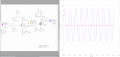
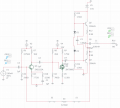
Hello. I'm trying to design a little audio amplifier to drive an 8ohm 5W max rated mini speaker. I am struggling a bit and getting muddled a lot.
It's for a project, which is why I'm mix and matching a BJT with a MOSFET

I can't really find many circuit examples that go into the design of an amplifier circuit that drives 8 ohm loads, perhaps I'm not looking hard enough.

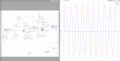
I'm a bit stuck because as soon as my load goes low, my voltage goes to mV. I thought MOSFET's had a low output impedence. I am looking for advice
on where to start looking for answers. I thought it was relativly straight forward, set the collector/drain resistor to 1/2 Vsupply, bias the base/gate to operative in the active region for linear amplification.

If my speaker was 1k ohm I think I could get away with not understanding. My only thought it I don't have enough gate current to drive such a small load. Unsure what to do with that thought. If my speaker was 50-200k ohm, then I feel like I have options. But with an 8 ohm load, I don't know which way to turn.

Thanks
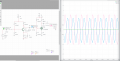
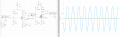
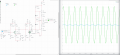
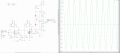
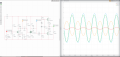
Amp voltage 460ohm.pngAmp current 460 ohm.pngAmp voltage 8ohm.pngAmp current 8ohm.png
 

Ian0

Joined Aug 7, 2020
13,097
The output impedance of a MOSFET is actually very high, it is a voltage-controlled current source, so the output impedance approaches infinity. The output impedance of the STAGE is R9.
So, designing it with a single transistor simply isn't going to work unless R9 is very low and a lot of heat gets dissipated.
You need to drive the output in both directions - so what you need is a complementary emitter follower.
https://www.nutsvolts.com/magazine/article/bipolar_transistor_cookbook_part_2
see Fig. 19.
 

MrChips

Joined Oct 2, 2009
34,628
Your output impedance needs to be lower than that of the load. Hence it has to be lower than 8 Ω.
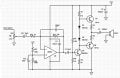
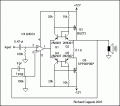
What you need is a Class AB push-pull output stage, something like this for starters.


AAC audio amplifier.jpg
 

crutschow

Joined Mar 14, 2008
38,316
I can't really find many circuit examples that go into the design of an amplifier circuit that drives 8 ohm loads
You need to look for audio amps.

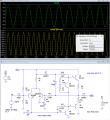
Below is the LTspice sim of a fairly simple such circuit with a differential input, to give both AC feedback to reduce distortion and determine the gain, and DC feedback to set the output DC quiescent point at 1/2 the supply voltage, with a Class AB push-pull output:

It uses a transistor (Q3) instead of two diodes to set the output bias current, so that current can be set to the desired value by varying R6.

C6 and D2 provide a bootstrap voltage from the output to generate a higher plus peak output voltage before Q5 saturates

It outputs a maximum of about 12.7Vpp into an 8 ohm load before clipping with a 15V supply, for a maximum power of 2.55W.
Its simulated total harmonic distortion is <0.3% at 1kHz with that power.
Without the feedback the distortion would be over 3%.

If you want 5W, then you need either a higher voltage supply, or an amp with a bridge output, which would generate 4 times the maximum power.

Edit: Modified DC bias to slightly increase maximum power output.

1749693532516.png
 
Last edited:

Thread Starter

rtzs287

Joined Jun 10, 2025
12
I have slightly altered my design, it work's much better than it did, to the point where it may actually be feasible.
Amp improved voltage.pngAmp imrpoved current.png


@Ian0 - Well I'm unsure how I got to the notion that MOSFET's have low output impedance, I probably read google's AI answer and ran with it. I was a bit confused in the biasing design as R9 was being called the load resistor, but my load is a speaker. Lowering R9 did not improve things, if I went down to 10 ohm the whole thing would fall apart. Thankyou.

@MrChips - That was my first design, but one of my tutors really pushed for me to include a MOSFET output stage. Have a VAS common emitter stage that feeds an output stage of MOSFET's, neither him nor me really know what I'm doing. The point of the MOSFET is so I have more to talk about and therefore more marks.

Could you explain why having a push-pull AB output stage is able to drive a small load wheras a single common emitter cannot? If I link it back to Ian0's reply, is it because in the push-pull AB transistor configuration, there are no collector resistors and thus the output impedance is the combined emitter resistors?

@crutschow - Could you elaborate on the bridge output? My initial thought is a bridge rectifier. A quick google appears to use op-amps in a push pull configuration. I'm not allowed to use the op-amp for amplification, it's got to be a discreet design. I am hoping to use a couple of op-amp's for bass and treble control, active filter hopefully.

Can I ask, DC quiescent point, as in the DC voltage at the base of the transistor? I thought 1/2 Vcc was at the collector to allow for maximum voltage swing, positive and negative. I had been setting my DC base voltages at 0.7v-0.8v. I think the circuit you have provided is a bit beyond me at this point. I don't understand what the purpose of the differential input is. I would say R11 and C3 look like a bootstrap to me, not that I really understand boot strapping. Did you mean C6 and D1, I can't see a D2?

I think the feedback is a bit beyond me. I understand it's to improve stability and distortion, but I don't really understand how. Does it work in tandum with the differential input amplifier circuit to try and pull the signals back to the input, It works to correct the output waveform when it departs from the input waveform? Is the input signal traveling through R12 to be amplified and then a feedback loop through R5 to imrpove stability/distortion?
 

Ian0

Joined Aug 7, 2020
13,097
To Understand why you can’t get enough power out of a single transistor stage, just look at what would drive the speaker positive. The MOSFET can only drive it negative. Only R9 can drive it positive. For that to work R9 would have to be lower than 4Ω.
It can be made to work like that, but it will get mighty warm. . .

The output impedance of a complementary emitter follower is approximately equal to the driving impedance divided by Hfe, plus any emitter resistors.
If you really want a MOSFET output stage, then you can use a complementary source follower in just the same way as you have used a complementary emitter follower. The DC biassing would be more difficult as Vgs is not well defined, so your bias would need to be adjustable.
Not worth the trouble, as it is just making things unnecessarily complicated.

If you were thinking of an op-amp based tone control, then you really do need to understand feedback.

Building a power amplifier is effective building a power op-amp out of transistors, so applying feedback is no different.
 

Thread Starter

rtzs287

Joined Jun 10, 2025
12
@Ian0 - Maybe someone could get it to work like that, but I couldn't. The value of R9 in my first post is 470 ohm, I believe I got to that number from wanting 10mA at the collector for reasons unknown to me to be honest. I see these Falstad shorts on youtube of AB circuits pushing and pulling around the load between the two output transistors, I assume it's wrong but now I'm imagining a common emitter amplifier pushing and pulling around the load between the transistors emitter leg and the collector resistor.

The driving impedance being the load or the resistance of the transistor itself? I really don't want to use MOSFET's at all so that's music to my ears, I get confused enough with only BJT's.

I feel like I am comfortable using op-amps with feedback, perhaps that is misplaced. But I am not comfortable with feedback loops within a discreet amp. So a differential input amp, with negative feedback, one tranistor see's the error signal, the complementary transistor inverts it and then responds in kind, effectively cancelling out the distortion? I am hoping I can avoid differential inputs, bootstrapping, long tailed pairs, negative feedback loops and current mirrors. As I need to mathematically explain and justify each component.
 

Ian0

Joined Aug 7, 2020
13,097
@Ian0 - Maybe someone could get it to work like that, but I couldn't. The value of R9 in my first post is 470 ohm, I believe I got to that number from wanting 10mA at the collector for reasons unknown to me to be honest. I see these Falstad shorts on youtube of AB circuits pushing and pulling around the load between the two output transistors, I assume it's wrong but now I'm imagining a common emitter amplifier pushing and pulling around the load between the transistors emitter leg and the collector resistor.

The driving impedance being the load or the resistance of the transistor itself? I really don't want to use MOSFET's at all so that's music to my ears, I get confused enough with only BJT's.

I feel like I am comfortable using op-amps with feedback, perhaps that is misplaced. But I am not comfortable with feedback loops within a discreet amp. So a differential input amp, with negative feedback, one tranistor see's the error signal, the complementary transistor inverts it and then responds in kind, effectively cancelling out the distortion? I am hoping I can avoid differential inputs, bootstrapping, long tailed pairs, negative feedback loops and current mirrors. As I need to mathematically explain and justify each component.
The driving impedance is the output impedance of the previous stage.

Now look at @crutschow ‘s circuit in post #4. That’s an op-amp. Do you recognise it?
It has two power supply connections, an output, an inverting input and a non-inverting input.
The non-inverting input is the base of Q1 and the inverting input is the base of Q2.
if you follow the circuit R4, R5 and C2 you will see an op-amp circuit with a gain of (1+R5/R4)
 

Thread Starter

rtzs287

Joined Jun 10, 2025
12
@Ian0 - Gotcha with the impedence.

Ah, I'm familiar with triangle op-amps, not what's inside them. I see Vcc and I think it feed's Q1 via R28. Q1 and Q2, differential amplifier, Q2 is the 'feedback' transistor that see's the distortion on it's inverting input. Q1 compensates for it outputting through R2? I'm unsure of the power supply to Q2. My gut say's the power to both transistors it through R2, but I think that's the output.

Q1, Q2, C2, R4 and R5 make a non-inverting op amp circuit to me.

I've added a feedback loop with R1, it appeared to slightly improve the waveform, I thought the output was ever so slightly slanted, adding R1 appears to straighten the output slightly. But as it's not feeding into the inverting input of a differential amplifier, is this just feedback, rather than negative feedback?

Feedback resistor R1.png
 

Ian0

Joined Aug 7, 2020
13,097
@Ian0 - Gotcha with the impedence.

Ah, I'm familiar with triangle op-amps, not what's inside them. I see Vcc and I think it feed's Q1 via R28. Q1 and Q2, differential amplifier, Q2 is the 'feedback' transistor that see's the distortion on it's inverting input. Q1 compensates for it outputting through R2? I'm unsure of the power supply to Q2. My gut say's the power to both transistors it through R2, but I think that's the output.

Q1, Q2, C2, R4 and R5 make a non-inverting op amp circuit to me.

I've added a feedback loop with R1, it appeared to slightly improve the waveform, I thought the output was ever so slightly slanted, adding R1 appears to straighten the output slightly. But as it's not feeding into the inverting input of a differential amplifier, is this just feedback, rather than negative feedback?

View attachment 350860
Don’t think of the transistors as being an input and a feedback transistor, otherwise you come unstuck with an inverting amplifier, where one is just connected to ground.
It is a differential amplifier, it amplifies the difference between two signals. One signal is your input, the other signal is a fixed fraction of the output (the fraction being set by the feedback resistors), and it should amplify the difference by an absolutely huge amount, so much so that any difference between the two signals will send the output to either of its maxima. If it is balance, then there will be no difference between the two signals, which means that your input signal will exactly match the fixed fraction of the output. So the output must be the input multiplied by the ratio of the two resistors.

Back to your circuit, you have connected feedback around two inverting stages, so that the output will add to the input not subtract from it. The feedback connects to what is an inverting input, but your circuit doesn’t look like an op-amp inverting amplifier, because there is no input resistor. If you had an input resistor, you would have created positive feedback, and perhaps made an oscillator, or perhaps a Schmitt trigger.

I suggest you go with @crutschow ’s circuit because it works, and if you ever do any audio work, audio amplifiers will generally be based on his circuit.

And have a look in data sheets for LM833, NE5534, LM358, because they have internal circuit diagrams. You should know what is happening inside the triangle!

On the NE5534, do you see the diodes across the inputs? Did you know that they were there? That’s something you need to know if you use that op-amp, because they can affect your circuit.
 

crutschow

Joined Mar 14, 2008
38,316
look at @crutschow ‘s circuit in post #4. That’s an op-amp.
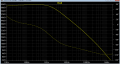
For your interest, the simulated open-loop, low-frequency voltage gain of that power "op amp" is about 64dB (15k) with a gain-bandwidth product of 1.1MHz (below) .

1749657753394.png
 
Last edited:

Ian0

Joined Aug 7, 2020
13,097
For your interest, the simulated open-loop, low-frequency voltage gain of that power "op amp" is about 64dB (15k) with a gain-bandwidth product of 1.1MHz (below) .

View attachment 350878
64dB: That’s close enough to “an absolutely huge amount” to illustrate the point!
There‘s a chapter in one of Linsley-Hood’s books that shows how the gain goes up as you add current mirrors, constant current sources, cascodes etc.
 

crutschow

Joined Mar 14, 2008
38,316
There‘s a chapter in one of Linsley-Hood’s books that shows how the gain goes up as you add current mirrors, constant current sources, cascodes etc.
Yes, I've seen more complex and higher-power versions of that basic circuit that includes some of those added structures.

I hadn't realized that, until you mentioned it, the circuit is indeed basically a power op amp.
It can even be DC coupled If plus and minus power supplies are used.

I like that circuit for having both AC and DC feedback from the output.
Don't think you can make a simpler circuit that has similar stability, output power, and low distortion.
 
Last edited:

Ian0

Joined Aug 7, 2020
13,097
I hadn't realized that, until you mentioned it, the circuit is indeed basically a power op amp.
It was my eureka moment many years ago when I was learning power amplifiers. I realised "this is nothing more than a big op-amp", not only does it have output, inverting and non-inverting input, it has connections for a compensation network (C3 R11 in your circuit).
Don't think you can make a simpler circuit that has similar stability, output power, and low distortion.
The only thing that is not entirely necessary is the bootstrap.
 

crutschow

Joined Mar 14, 2008
38,316
The only thing that is not entirely necessary is the bootstrap.
True, but that reduces the maximum power, since clipping of the positive excursion occurs at a lower voltage.
The 2.55W max of my posted circuit drops to 1.5W (10Vpp) without the bootstrap.
 
Last edited:

Thread Starter

rtzs287

Joined Jun 10, 2025
12
I had a look at LM833, NE5534, LM358 block diagrams. The LM358 looks the most simple, casdaded differential input, supplied by a current mirror?, which feeds into a Darlington pair of common emitters, then I'm unsure, it looks like a casdaded/darlington pair push pull output stage. I couldn't dream of mathmatically understanding what's going on inside an LM358. The same reason why I can't just use crutshow's circuit, I've got to tell a story with a report, logbook and mathmatically explained methodology, it doesn't necessarily need to work. I now need to reverse engineer what I've done and explain it with math and tell a story.

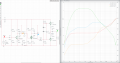
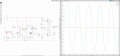
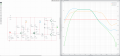
My previous circuits had no frequency response, well, a good response at 1kHz, but no where else. Whilst the output is much worse, it is much better over a reasonable frequency. I expect that whilst it works in the simulator, in the real world it will just burn up. It's been suggested that I build a heat sensor that turns on a fan to cool the active devices...I think they will blow up for other reasons but I digress. I think I'm settled on the design thus far, I don't want it to get any more complicated. Any advice to improve? Or where I've made blunders? I'm seeing that the MOSFET a bit pointless, but it doesn't tank the signal so I can talk about what I'd hoped it would achieve and demonstrate that it doesn't, but still functions.
current AC sweep.pngcurrent.pngvoltage AC sweep.pngvoltage.png
 

BobTPH

Joined Jun 5, 2013
11,463
@MrChips circuit in post #3 is the simplest practical audio power amp as you can get. Hopefully you can understand it.

Try using a CE gain stage in place of the opamp if you think the opamp is cheating.
 

Ian0

Joined Aug 7, 2020
13,097
@MrChips circuit in post #3 is the simplest practical audio power amp as you can get. Hopefully you can understand it.

Try using a CE gain stage in place of the opamp if you think the opamp is cheating.
.. . And @crutschow ‘s circuit (plus a few elaborations) is representative of about 90% of linear power amplifiers (before Class D came along)
 

Thread Starter

rtzs287

Joined Jun 10, 2025
12
I would say I do not understand the circuit in post 3. I cannot find anything that explains it step by step. Everything is piecemeal explanations. I'm currently trying to improve the MOSFET part, but I see that previously I just assumed K=50mA/V^2, K is quite crucial to the guide I'm following to bias it, but I can't figure out what K is, I don't think it's constant.

I would more than happily use either circuit. But I need to be able to explain the maths behind it, and create a story as to how I ended up with the circuit. I can't really say, a fourm post said to use this, so I did, and it worked. It would be better to create a terrible circuit that burns up and talk about why it burned up, what the goal was, how I iterated and built it up. If I want to play music, I use my old bronze monitors with a TDA amp. The goal is not to play music. All to say, I find I do not have the confidence, ability or resources to understand the circuits provided to a reasonable degree. I have a reasonable understanding of what I have so far.

In post 3. Q3 is a current source? Q1 and Q2 are setup in a push pull configuration, biased to avoid crossover distortion using the 2 diodes to create volt drop of 1.4V. Feedback through C5? R5 and R6 form a voltage divider to bias Q3 to be on. R2 provides temperature stability? R1 and R2, I'm not sure, voltage divider to provide the diodes with voltage to forward bias them? R22 is feedback gain?
 
Top