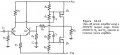
@Bordodynov
Thats a funky mix of analogue and digital. Thankyou, it looks amazing. But....how do I even, start....You don't happen to have 10 pages of text to accompany the circuit?
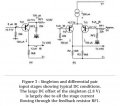
The earlier version (1970s) with a single transistor input stage is a current feedback op-amp. (Not a particularly good current feedback op-amp, because of the DC offset between non-inverting and inverting inputs)
The earlier version (1970s) with a single transistor input stage is a current feedback op-amp. (Not a particularly good current feedback op-amp, because of the DC offset between non-inverting and inverting inputs)View attachment 350912
Can I ask what book this is from. It looks like it goes into the math which I desire. I have 2 books by Doug Self, but they massively go over my head and don't dive deep into the math. Practical electronics for inventors I'm finding more useful. But it just gives a single MOSFET circuit with no derivation. It has guided me in biasing the CE part.
I would say I do not understand the circuit in post 3. I cannot find anything that explains it step by step. Everything is piecemeal explanations. I'm currently trying to improve the MOSFET part, but I see that previously I just assumed K=50mA/V^2, K is quite crucial to the guide I'm following to bias it, but I can't figure out what K is, I don't think it's constant.
I would more than happily use either circuit. But I need to be able to explain the maths behind it, and create a story as to how I ended up with the circuit. I can't really say, a fourm post said to use this, so I did, and it worked. It would be better to create a terrible circuit that burns up and talk about why it burned up, what the goal was, how I iterated and built it up. If I want to play music, I use my old bronze monitors with a TDA amp. The goal is not to play music. All to say, I find I do not have the confidence, ability or resources to understand the circuits provided to a reasonable degree. I have a reasonable understanding of what I have so far.
In post 3. Q3 is a current source? Q1 and Q2 are setup in a push pull configuration, biased to avoid crossover distortion using the 2 diodes to create volt drop of 1.4V. Feedback through C5? R5 and R6 form a voltage divider to bias Q3 to be on. R2 provides temperature stability? R1 and R2, I'm not sure, voltage divider to provide the diodes with voltage to forward bias them? R22 is feedback gain?
It’s easy to break it down.
First you have the op-amp stage.That just boosts the input signal and is entirely separate from the res of it.
Then you have a what is simply a common emitter amplifier with R1 as the collector load, and some bias on the base to set the DC operating conditions. Ignore the diodes and output transistors For now.
It has a gain which approaches R1/R2.
The you have a pair of common collector amplifiers, which have (almost) unity voltage gain, but boost the available current.
Can I ask what book this is from. It looks like it goes into the math which I desire. I have 2 books by Doug Self, but they massively go over my head and don't dive deep into the math. Practical electronics for inventors I'm finding more useful. But it just gives a single MOSFET circuit with no derivation. It has guided me in biasing the CE part.
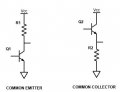
Learn basic transistor configurations and their properties.
Common emitter configuration provides both current and voltage gain, 180° phase shift.
Common collector configuration provides current gain and less than unity voltage gain, and low impedance output.
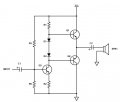
This is the basic push-pull complimentary output common collector amplifier.
Q1 and Q2 are complementary paired NPN/PNP transistors in common collector configuration. They provide low impedance output.
Q3 is a common emitter amplifier. It is biased to provide approximately Vcc/2 at the bases of Q1 and Q2.
As noted, D1 and D2 supply approximately 1.3 V difference between the bases of Q1 and Q2.
Input signal is AC-coupled via C1.
Output to the loudspeaker is AC-coupled via C2.
I have omitted any negative feedback to keep the discussion simple, except for R2.
R2 provides negative feedback to Q3 alone.
Common emitter configuration provides both current and voltage gain, 180° phase shift.
Common collector configuration provides current gain and less than unity voltage gain, and low impedance output.
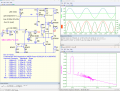
Thankyou. In my first post, because Q1 is Common Emitter configuration the blue output voltage waveform is out of phase with the green input waveform. It does not exhibit good current gain in my circuit as the input impedence of the next stage is too large I believe, I could be wrong.
Then Ian0 shared a link to the transistor cookbook which showed a common collector push push output stage which as you say, exhibits low output impedence which was able to drive an 8 ohm load which allowed me to get a bit further.
@crutschow - The MOSFET'S, erroneously...I think of them as switches for digital circuits, probably erroneously again
@Bordodynov
Thats a funky mix of analogue and digital. Thankyou, it looks amazing. But....how do I even, start....You don't happen to have 10 pages of text to accompany the circuit?
It’s @crutschow‘s circuit, but with the long tailed pair resistor replaced by a constant current source, the load resistors of the long tailed pair replaced by a current mirror, the load of the common emitter stage replaced by a constant current source, and the two bias diodes replaced by a Vbe multiplier.
That circuit has a problem. If it goes into clipping on the positive side with M1 fully off the load for Q7 disappears and R4 collapses the D1/D6 reference. That turns off the current source to the long-tailed pair and the entire amplifier locks up, because nothing can turn M1 back on. Always use two separate constant current sources.
This is the basic push-pull complimentary output common collector amplifier.
Q1 and Q2 are complementary paired NPN/PNP transistors in common collector configuration. They provide low impedance output.
Q3 is a common emitter amplifier. It is biased to provide approximately Vcc/2 at the bases of Q1 and Q2.
As noted, D1 and D2 supply approximately 1.3 V difference between the bases of Q1 and Q2.
Input signal is AC-coupled via C1.
Output to the loudspeaker is AC-coupled via C2.
I have omitted any negative feedback to keep the discussion simple, except for R2.
R2 provides negative feedback to Q3 alone.
@MrChipsCheers. That push pull circuit is about the level of understanding I'm at. I now clearly see that Q3 in post #3 is not a current source, and is indeed a common emitter. But now I'm thinking about it. Why bias the bases of Q1 and Q2 at 1/2 Vcc and not just 0.7V? How does Q3 provide 1/2 Vcc at the base of Q1, I could see how it provides voltage to the base of Q2.
Yes, the basic rule so you are actually amplifying rather than attenuating I suppose.
@Ian0Don't really know what to say to that. Why replace the load of a common emitter with a constant current source?
@Ian0Don't really know what to say to that. Why replace the load of a common emitter with a constant current source?
[/QUOTE]
Because it eliminates the common-mode gain of the long-tailed pair, making it a true differential amplifier.
@MrChipsCheers. That push pull circuit is about the level of understanding I'm at. I now clearly see that Q3 in post #3 is not a current source, and is indeed a common emitter. But now I'm thinking about it. Why bias the bases of Q1 and Q2 at 1/2 Vcc and not just 0.7V? How does Q3 provide 1/2 Vcc at the base of Q1, I could see how it provides voltage to the base of Q2.
Regardless of whether you are using a single supply voltage or a dual supply voltage, you want to maintain the DC signal voltages to be about halfway between the power supply rails. In this manner, the signal can maintain a maximum amplitude range with balanced clipping when at saturation.
With the emitters of both Q1 and Q2 at Vcc/2, you want the DC bias on Q1 to be Vcc/2 + 0.7 V and the DC bias on Q2 to be at Vcc/2 - 0.7 V.
The voltage at the base of Q1 will follow at 1.4 V higher than that at Q2. This is because diodes D1 and D2 create a 1.4 V clamp.
You adjust the bias on Q3 via R5 and R6 to give the desired DC voltage on the collector of Q3.
That circuit has a problem. If it goes into clipping on the positive side with M1 fully off the load for Q7 disappears and R4 collapses the D1/D6 reference. That turns off the current source to the long-tailed pair and the entire amplifier locks up, because nothing can turn M1 back on. Always use two separate constant current sources.
I disagree with you here. The current source of the differential stage will never turn off completely. The current will decrease, but not to zero. I was in a hurry and set a low current. I wanted to put 150 ohms, but I left a 1.5 kOhm resistor from the previous circuit. I hope to get even less distortion. Tomorrow I will simulate your case when transistor M1 closes completely.
Ideally maybe, but not for a circuit with real components.
In practice, the required quiescent bias current to prevent crossover-distortion for that circuit is greatly affected by the normally large variation in the Vgs(th) of the MOSFETs.
It will work but with a complementary common source output stage, biassing is going to be very tricky.
I don't know what devices it recommends for Q3/Q4 but as soon as it gets warm and the Vgs threshold falls, it's going to blow up.

 Facebook
 Google
 GitHub
 Linkedin