555 Timer Help

Thread Starter

BZech

Joined May 2, 2022
21
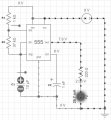
Can someone explain why according to this circuit app (EveryCircuit.com) the LED does NOT flash. However, when I breadboard it, it works great.

Also, recommendations on a site with a good 'tutorial' on 555 timers. I am having difficulty understanding the resistor between pin 4 (reset) and 7 (discharge). (how high/low can this resistor be? what does it do?)
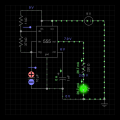
1654263014575.png
 

eetech00

Joined Jun 8, 2013
4,705
I am having difficulty understanding the resistor between pin 4 (reset) and 7 (discharge). (how high/low can this resistor be? what does it do?)
If you look closely at the circuit, the resistor is between 9v and the discharge pin. Likewise, the reset pin is directly connected to the 9V supply. The timer is "enabled" when the reset pin is higher than 1v.
 

crutschow

Joined Mar 14, 2008
38,505
the LED does NOT flash
Perhaps the frequency is too high for the flash to show in the simulation.
I am having difficulty understanding the resistor between pin 4 (reset) and 7 (discharge). (how high/low can this resistor be? what does it do?)
555 Basic Operation---
(Vcc is the plus supply voltage)
The 555 is a level-triggered latch (flip-flop) with an added DIScharge output to reset the timing capacitor.
When the TRIG voltage goes below 1/3 Vcc, the latch is set (OUT high and DIS open).
If the TRIG voltage is back above 1/3 Vcc, then when the THRS voltage goes above 2/3 Vcc, the latch is reset (OUT low, and DIS connected to ground to discharge the timing capacitor).
It stays low until a low on the TRIG input again sets the latch (if the THRS voltage is below 2/3 Vcc).


From that you can see that the resistor between pin 4 and pin7 (part labels on the schematic would help when discussing the circuit) determine the discharge time of the capacitor (and thus the output OFF time).
Thus the value of the bottom resistor times the capacitor value is proportional to the output OFF time and the value of the two capacitors in series times the capacitor value is proportional to the ON time.

The upper limit on the resistor values is determined by the leakage current of the capacitor, and the input bias currents of the 555.
The lower limit for the upper capacitor is about 2kΩ, while the lower resistor can be zero.
 

AnalogKid

Joined Aug 1, 2013
12,129
This site has a large 555 page somewhere. I think Wendy runs it.

Functionally, the resistor is between 7 (Discharge) and 8 (Vcc). Reset also is tied to Vcc, but that has nothing to do with the Discharge function. When several signals are tied together on a schematic, the order in which they appear from left to right or top to bottom is not significant. It is simply a matter of connecting them together in whatever order has the fewest crossed lines and best clarity.

The minimum value for that resistor (usually called Ra in 555 datasheets) is determined by the maximum allowed current into the Discharge pin (stated on the datasheet) and the value for Vcc. You calculate this using Ohm's Law. When the Discharge output is active, it tries to short whatever is connected to it to GND. This discharges the timing capacitor through the 37 K resistor in your schematic, usually referred to as Rb.

Note: Using letters for a reference designator enumerator is a very bad idea because of history, tradition, industry standards, and they do not translate well across languages. For your own schematics, use numbers for the enumerators, such as R1 and R2.

ak
 

MrSalts

Joined Apr 2, 2020
2,767
Maybe the simulation slices are too small (too short of time) and it may take minutes to hours to simulate 0.5 seconds to see a full on/off cycle.
Monitor the discharge pin voltage to see if it changes over time. Or, change the 37k resistor to 3k to see if you can see any animation.
 

dl324

Joined Mar 30, 2015
18,326
I am having difficulty understanding the resistor between pin 4 (reset) and 7 (discharge). (how high/low can this resistor be? what does it do?)
Some might find this image easier to read:
timer-reversedCropped.jpg
R1 and R2 determine the charging time for the capacitor and, therefore, the ON time for the LED. R2 determines the discharge time for the capacitor and, therefore, the OFF time. By choosing R1 to be much smaller than R2, the output duty cycle is almost 50%.

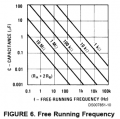
You can use this graph to get approximate frequencies:
1654268246422.png
R1 == Ra and R2 == Rb. With the values you've used, frequency would be about 3Hz. Using the formula gives just under 2 seconds, but the tolerance on the electrolytic cap is likely to be 20%.

To get the same frequency with lower value resistors, you'd need a larger timing cap.
 

Ian0

Joined Aug 7, 2020
13,131
This discharges the timing capacitor through the 37 K resistor in your schematic, usually referred to as Rb.
Don't forget that it also grounds the lower end of R1 (normally called Ra) so that adds another 9V/1k=9mA to the current flowing into the discharge pin.
Although 9mA is not a problem for most 555s, an extra 9mA on the operating current doesn't do wonders for the battery life!
 

Thread Starter

BZech

Joined May 2, 2022
21
Maybe the simulation slices are too small (too short of time) and it may take minutes to hours to simulate 0.5 seconds to see a full on/off cycle.
Monitor the discharge pin voltage to see if it changes over time. Or, change the 37k resistor to 3k to see if you can see any animation.
YES! that was it!!!! I simply changed the time to 1s/s. Now it it flashes on the simulator and I can "see" what is happening!!! Thank you for this.
 

Thread Starter

BZech

Joined May 2, 2022
21
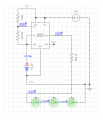
This is my first circuit. I feel like I am missing something basic. When I create this on a breadboard, it works perfectly.

I prototyped JUST the three LED's on a PCB board, when I connect them, to the breadboarded circuit they light, but do not blink??? Am I missing something with the ground? I have searched for images but can not find anything.
1654528887755.png
 

Alec_t

Joined Sep 17, 2013
15,119
Post a sharply focussed picture of your actual circuit, in which we can see all the connections, and perhaps we can spot the source of the problem.
 

dl324

Joined Mar 30, 2015
18,326
When I create this on a breadboard, it works perfectly.
Do you really mean that it works in a simulator?
I prototyped JUST the three LED's on a PCB board, when I connect them, to the breadboarded circuit they light, but do not blink???
You have a working simulation. Use it to determine what isn't working, or connected, properly in your breadboard.

If you take the time to understand how the 555 timer works, you wouldn't need a simulator to help you troubleshoot your circuit.
 

Audioguru again

Joined Oct 21, 2019
6,826
The formula for the flashing frequency in the 555 datasheet shows 1.44/R1+2 x R2)C which you have as 1.44/(1k + 2 x 37) x 0.00001= almost 2 times per second.
 
Top