555 monostable self triggering ..#2

djsfantasi

Joined Apr 11, 2010
9,237
I hope you realize that none of the solutions in this thread actually disconnect the timer from power.
There is always a conductive path thru the timer. So...a glitch can always false trigger the timer and cause the output to bounce. Maybe change your target solution to address the surge problem instead.
or instead of focusing on disabling the timer by cutting power to its power pins, focus on disabling or ignoring any timer output under given conditions.
 

Thread Starter

Costyco

Joined Dec 14, 2020
19
So If my understanding is correct, you don't need a one-shot, just a latch.
The push-button sets the latch to start the motor and the cam resets the latch to stop the motor.
This brings up questions:
1. The reset switch is pressed by a motorized cam, that holds the switch pressed until the next run. The latch won't be able to be set again, will it?
2. The IC will be powered-on all time. How can we address the possibility of a false start due to a surge?
 

Thread Starter

Costyco

Joined Dec 14, 2020
19
I hope you realize that none of the solutions in this thread actually disconnect the timer from power.
There is always a conductive path thru the timer. So...a glitch can always false trigger the timer and cause the output to bounce. Maybe change your target solution to address the surge problem instead.
Hopefully, a closed transistor won't open due to a glitch. Otherwise, it will be disappointing.
 

Thread Starter

Costyco

Joined Dec 14, 2020
19
or instead of focusing on disabling the timer by cutting power to its power pins, focus on disabling or ignoring any timer output under given conditions.
Most of the time (for hours or days) the thing will await a button press and so will the timer (if it's powered). Ignoring the timer output will bring logic (and parts) into the schematics. And as I said, I want to keep it simple.
 

eetech00

Joined Jun 8, 2013
4,705
Hopefully, a closed transistor won't open due to a glitch. Otherwise, it will be disappointing.
It can open or close depending on the conditions (conditions that widely vary and usually random).

If you want to keep things simple, why not devise a passive "press and hold" circuit.
Manually press a button long enough for the motor to start running...
 

eetech00

Joined Jun 8, 2013
4,705
You missed post #7. :)
Hi

Actually...I didn't.
:D

Your circuit will work fine.
But it doesn't meet the TS requirement to disconnect power in order to prevent a "a glitch", or "surge", or whatever anomaly, from possibly energizing the output (this was stated in the first post). Since the supply is permanently connected to the timer, a "glitch" induced from somewhere (or a shorted transistor) can still feed energy thu to the output.

I think the TS should use a standard timer circuit designed for the desired functionality (like your circuit), but add components to address protection from external transient sources, instead of trying to figure out how to disconnect power from the timer...

Just my opinion....
 

eetech00

Joined Jun 8, 2013
4,705
So you are saying the only way to disconnect the timer is through a relay?
I don't know of any other way except by using some kind of isolation device, like a relay.:)
The TS is concerned about a random surge starting the motor. The TS is saying that the timer has to be disconnected from power so that a random surge doesn't cause the motor to start and run until someone stops it. But in reality, any kind of conductive path from power to the motor can pass a surge/transient. Thats why I suggested to focus on transient/surge suppression and, instead, use a standard "always powered up" timer circuit.

So I was thinking, as an alternative, just using a simple manual press and hold circuit (basically just a button that is pressed long enough to establish startup power to the motor), that, when released, cuts off "startup" power to the motor. The TS says once its provided with startup power, the motor runs on its own. It won't be automatic but would isolate startup power from the motor.

I hope this makes sense....
 

Thread Starter

Costyco

Joined Dec 14, 2020
19
So I was thinking, as an alternative, just using a simple manual press and hold circuit (basically just a button that is pressed long enough to establish startup power to the motor), that, when released, cuts off "startup" power to the motor. The TS says once its provided with startup power, the motor runs on its own. It won't be automatic but would isolate startup power from the motor.
This is how it is right now. I wanted to add a timer to eliminate that long press.
 

crutschow

Joined Mar 14, 2008
38,526
I agree with eetech00.
Transient suppression (filtering) and adding a short delay before a signal can start the motor should be sufficient to prevent spurious starts from any likely transient.
 

Thread Starter

Costyco

Joined Dec 14, 2020
19
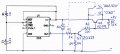
This is what I have in the end. The entire circuit has absolute zero consumption in stand-by. When one presses the S1 push-button, the timer is powered on and produces a positive impulse on its output that opens the Q2 transistor which locks the timer powered on. After a second, when the timer runs out and impulse finishes, the transistor closes and disconnects the IC from power. The circuit then waits for the next button press.

NE555 Power-on One-shot_off.jpg
As for surge safety of this schematic, I have to agree with eetech00 that there is a conductive path through the timer, so a glitch can possibly false trigger the timer and cause the output to bounce. As an example, I experienced false triggering when finger touched the base of the Q1 transistor without a pull-down resistor R4. The addition of R4 has eliminated the issue. Using a relay appears to be the way to make this schematic surge-safe. Anyway, this schematic works, will see how surge-safe it is under working conditions.

Thanks to everyone on this thread who helped with advice.
 
Top