555 and flyback not the same frequency?

Thread Starter

magnet18

Joined Dec 22, 2010
1,227
Now that your 555 driver is working better, what does the wave look like at the drain of the mosfet? Start with a relatively high voltage setting for your scope, say 100 V, then decrease until you see the waveform.

John
I'm actually scared to do that if it's that high of a voltage, my maximum setting for my scope is 10V, the absolute maximum it can handle is 20V, according to the warnings everywhere. It's intended for educational purposes, and not really meant to be used in place of a professional scope, which is what I'm doing for lack of funding.

I ended up powering the primary with a modified PSU from a computer, so as to ensure that the voltage stayed constant, and I'm still powering the 555 off the marine battery, which seems to be a dandy combination. I've started collecting data, and a relationship is beginning to appear :)

(I also learned that a little plasma arc can catch a piece of paper on fire faster than you can say MOSFET, and that it can punch small holes straight through a plastic bag :D)

[EDIT]
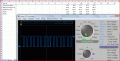
I attached a screenshot, pin 3 wave form looks good enough to me
 

Attachments

Last edited:

jpanhalt

Joined Jan 18, 2008
11,087
Good, I am glad you are concerned. You have 12V feeding the Drain through a few coils. I suggested that you use a high voltage setting in case there was some inductive kick, even though you have bypassed the mosfet. If your scope is limited to 10V , is that 10V full scale or 10V per division (I suspect it's the latter). It is probably safe, but maybe you should try something else first.

Do you have any small resistance, high-wattage resistors? Like 1 or 2 Ω, 25W? How about a 25W to 50W, 12V light bulb? The idea here is to be sure the mosfet is switching as you intend it to switch with a heavy load. That load will be relatively non-inductive, compared to your transformer, but it is just for testing one more step.

Have you tried the separate supplies with the flyback? What happens?

John
 

Thread Starter

magnet18

Joined Dec 22, 2010
1,227
Good, I am glad you are concerned. You have 12V feeding the Drain through a few coils. I suggested that you use a high voltage setting in case there was some inductive kick, even though you have bypassed the mosfet. If your scope is limited to 10V , is that 10V full scale or 10V per division (I suspect it's the latter). It is probably safe, but maybe you should try something else first.

Do you have any small resistance, high-wattage resistors? Like 1 or 2 Ω, 25W? How about a 25W to 50W, 12V light bulb? The idea here is to be sure the mosfet is switching as you intend it to switch with a heavy load. That load will be relatively non-inductive, compared to your transformer, but it is just for testing one more step.

Have you tried the separate supplies with the flyback? What happens?

John
I also assumed it was for any potential spikes

10V per division, but it can't take more that 20V total

Yes, I have some resistors (2Ω 50W), no lightbulbs though

and that attached waveform was taken while it was powering the flyback making a lovely 1/4 inch, purplish/orange, silent arc :D:D
 

Thread Starter

magnet18

Joined Dec 22, 2010
1,227
Now I can attest that there are voltages spikes on the MOSFET, one of them shocked me when I touched the icewater it's in.
felt like about 100 volts or so, but I was holding an icecube that was touching the heatsink (brilliant idea :rolleyes:), so my fingers were wet, so I really don't know what voltage it was.
 

jpanhalt

Joined Jan 18, 2008
11,087
Well it seems you have a working circuit. All you need to do is tweak it. First, I don't know anything about flybacks, except what they are. I don't know how they are driven or whether they might actually saturate if driven too hard.

You don't want to saturate them, because at that point the magnetic field does't increase, but the current increases effectively unimpeded. That is, it takes off and would probably destroy your mosfet in short order like a short circuit. One way around that is to shorten the width of the on pulse -- decrease duty cycle -- or increase the number of turns on the primary. The latter may seem counter-intuitive, but its true. I am sure others can contribute a lot more than I can about that.

I suspect one problem you had was the current through the mosfet was so high, it was affecting the 555, even with the de-coupling caps you had on it. I would keep the supplies separate for the time being. Then when everything is working, you can try a single supply.

Mosfets can be paralleled to increase current capacity, but that will introduce some other variables. I would suggest not doing that until the present system is working or you know for sure that you need more current.


At this point and without more data (like what the actual current profile across the mosfet looks like), I think it is a toss up as to what to do first. Do you have a very low value resistor that could be used as a current sense resistor? Commercial ones will be 0.1 to 0.001 Ω and are kind of expensive compared to regular passive devices. With a high current, you would use a very small resistor.

Let me toss up this plan for debate. Double the turns and see what happens. Keep increasing until you no longer get a stable arc. Then back off. If the mosfet still gets hot, shorten the duty cycle. If mosfet is not hot, then I would take off some more turns, and so forth until you have a balance of arc stability and mosfet warming.

John
 
Last edited:

debe

Joined Sep 21, 2010
1,419
Hi Magnet, Just love your sensitivity to voltage, It felt like 100V. Iguess abit like weting your finger to test wind direction.
 

Thread Starter

magnet18

Joined Dec 22, 2010
1,227
Hi Magnet, Just love your sensitivity to voltage, It felt like 100V. Iguess abit like weting your finger to test wind direction.
Well, It didn't feel as bad as my 180V nixie transformer did, so I guessed about a hundred-ish.

@john, I don't think saturation is an issue, I was driving it at 50kHz, 70% duty cycle, got a one inch arc. As for the other stuff, I'll have to do some fine-tuning before I mount the thing permanantly, but I think I'm going to keep what I have for a few days.
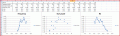
It works good enough for my purposes, and data collection is going as smoothly as could be expected (I'll attach it)

Eventually (no idea when) I want to test some ideas for half bridling it with a 555, a 556, and 2 MOSFETs, but thats another project in and of itself.
 

Attachments

Last edited:

jpanhalt

Joined Jan 18, 2008
11,087
You table makes sense. Some of your graphs do not. Check the Y axis of the frequency graph. For the duty cycle graph, duty cycle should is the dependent variable, which is usually plotted on the Y axis. It is not clear what it is that you have currently plotted on the Y axis.

John
 

Thread Starter

magnet18

Joined Dec 22, 2010
1,227
Sorry, The Y axis is the gap distance in mm for all of the graphs, the X axis is the same as the graph title.
 

Thread Starter

magnet18

Joined Dec 22, 2010
1,227
Re: core saturation.

Why do you not think that can be a factor?

Here are some resources:
http://focus.ti.com/lit/ml/slup127/slup127.pdf
http://focus.ti.com/lit/ml/slup124/slup124.pdf

John
I didn't say it couldn't be a factor, I said I didn't think it was a problem, which it doesn't seem to be, although it would explain the drop in distance at the higher frequencies... dang it, I know I already have enough data to get an A, but now I just NEED to collect more because I'm curious...

also, in regards to your question on my other thread, I usually would try it with my original values, I didn't because
1) I was (kinda am) too stressed and mentally exhausted to care
2) a value less than 3K can harm the chip, I don't wanna do that as I only have one other that I know for a fact is good, all my others got blown trying to get things to work
3) It wasn't really my design, I just grabbed the first values that would work with the cap I currently had in there, I didn't have any time invested in it or anything
 

RRITESH KAKKAR

Joined Jun 29, 2010
2,829
Alright, I've attached some pics of my setup and some scope captures, the first one is pin 8, the second is pin 5 (that appears to be a problem), the third and fourth are pics of my physical setup. (the LARGE electrolytic you see isn't connected)

I'm about to switch from 20 to 18 ga wire on the primary and use 5 turns (same as these were taken with)

Wookie, you mentioned a cap to the primary high side, would that just be from the primary high to ground?

Hi, what is the name of this stimulation software??
 
Top