4047 power supply

Thread Starter

MGPERF

Joined Jun 8, 2021
77
Hello,

Building a 12v dc to 300v dc power supply using 4047 as IC. I have seen several different ways of laying out the mosfets in similar circuits with and without the freewheel diodes. Do you think they are necessary? Voltage is not super critical so long as I get around 300v dc. I am rewinding a transformer and using an EE25 core to get the 300 volts. I do not see anyone running high frequencies (I calculated 16.5 KHZ) with a 4047 as the IC just curious as to why it's rarely done and if it poses a problem. Any help/feedback is always appreciated!
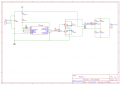

4047 Power Supply.PNG
 

michael8

Joined Jan 11, 2015
472
CD4047 CMOS Low-Power Monostable/Astable Multivibrator
https://pdf1.alldatasheet.com/datasheet-pdf/view/26874/TI/CD4047.html

IRF540 33A, 100V, 0.040 Ohm, N-Channel, Power MOSFET
https://media.digikey.com/pdf/Data Sheets/Fairchild PDFs/IRF540N.pdf

Looking at the data sheet the 4047 can only output about 1 mA. The input capacitance
of the IRF540 is 1220pF.

Reading the IRF540 "switching specifications" they are quoted with a 10 volt gate signal
but with a source of only 9.1 ohms. This implies more than 1A of gate current during
turn on (to meet the switching speed). Lower available gate current is going increase
the turn on time as well as the losses in the FETs while they are partially on.

16.5 KHZ is about 60 uS (microseconds) per cycle. If each FET is to use 1/2 that time
that leaves 30 uS for each to turn on, be on, and turn off. How long does turning
on and off take with 1 mA gate current?

Other questions? Why C4? How well will 1n4007 diodes work at 16 KHz?

An output voltage of 300 volts was specified but no power (or current). Those FETs
are capable of switching lots of power -- what power level do you need at 300 volts?

I haven't looked at specifically what the 4047 does or how it's connected, but
I'd want to be very sure that both FETs would not be on at the same time.
 

Ian0

Joined Aug 7, 2020
13,126
A 4047 has no dead time between the two outputs. That means that one MOSFET will start to turn on before the other is turned off, and that’s like a short circuit.
The SG3525 was designed for this application, and consequently does the job a lot better (and will reach 500kHz).

Flyback diodes? Do you mean from the MOSFET drain to +12V? If so, then the look like a dead short on the output, as the drain of the MOSFET that is switched off must go to 24V due to the action of the transformer?
Or do you mean a diode in parallel with the MOSFET? There is already a diode connected like that inside theMOSFET and it’s probably rather quicker than a 1N4007.
 

Thread Starter

MGPERF

Joined Jun 8, 2021
77
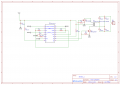
After considering feedback provided I decided to go with the TL494. The diodes will also be STTH3R04RL as the 1N4007 would not have fast enough recovery. Let me know if you think this is a good option. Unfortunately I rarely have luck breadboarding something like this and usually go straight to a PCB so any feedback regarding the layout/parts would be helpful as well.


TL494 Power Source_2021-11-01.png
 

michael8

Joined Jan 11, 2015
472
tl494 datasheet
https://www.ti.com/lit/gpn/tl494

Pin numbers? Pin 8 is ?not C1?... (check them all..)

I notice there isn't any feedback from the 300 volt output to control the PWM, just fixed
resistors on the feedback pins. Does the power level needed change over time?

How is this going to stop at 300 volts (or get to 300 volts if the set PWM amount isn't eoungh?).

What power level do you need at 300 volts?

From looking at your other posts I'm guessing this is a (very small) part of some sort of capacitance
discharge ignition system. The old SCR types were from before power fets existed. I wonder if the
300 volts could be directly switched today by a fet which would allow turn off control.
 

Ian0

Joined Aug 7, 2020
13,126
SG3525 is much better because it is designed to drive MOSFETs and the TL494 isn't.
10k pull down to switch off the MOSFET may be too high.
 

Thread Starter

MGPERF

Joined Jun 8, 2021
77
Thanks, I will look into the SG3525 I considered not having feedback because I am shorting the output briefly when the SCR fires there is really no other way. I thought it would do something weird with the feedback. I am really not sure what you mean regarding using an IGBT to switch off 300 volts, can you explain a bit more?
 

Thread Starter

MGPERF

Joined Jun 8, 2021
77
Also I need max 150 watts normal power consumption would be 40-60 watts. I am using a center tapped transformer 3 turns primary 12, 75 turns secondary.
 

michael8

Joined Jan 11, 2015
472
This article might be interesting to you:

A high-energy Capacitor Discharge Ignition systemBased on an article by ‘Silicon Chip’ (Septermber 1997)This completely new capacitor discharge ignition system has been designed from the groundup to provide a high energy "multiple spark discharge" to cope with engines which have veryhigh RPM rates. It is intended particularly for use with two stroke engines, high performancefour strokes and older vehicles.

http://www.molla.org/DIY-CDI/SC-DIY-CDI-article-hires.pdf
 

Thread Starter

MGPERF

Joined Jun 8, 2021
77
This article might be interesting to you:

A high-energy Capacitor Discharge Ignition systemBased on an article by ‘Silicon Chip’ (Septermber 1997)This completely new capacitor discharge ignition system has been designed from the groundup to provide a high energy "multiple spark discharge" to cope with engines which have veryhigh RPM rates. It is intended particularly for use with two stroke engines, high performancefour strokes and older vehicles.

http://www.molla.org/DIY-CDI/SC-DIY-CDI-article-hires.pdf
Michael, very cool I can definitely incorporate some of the ideas from this into my design. I cannot get the IR2155 anywhere but I imagine there is an equivalent that wouldn't be too hard to find.
 

michael8

Joined Jan 11, 2015
472
I wouldn't take it as an exact design, I'd "borrow" the ideas and concepts (and warnings on what to watch out for).

That was the result of one quick web search, there are likely many many more relevant hits out there.

As a believer in "conservation of energy" I'd figure out how much energy each spark needed, and use that
plus the number of cylinders and RPM to calculate an approximate total power level.

This would be a lower limit on the power needed as it would ignore losses, but it would be a start.

Some research should provide the voltage and timing needed at the spark plug (or coil?).

That's where I would start a design -- with a good idea of the output needed.
 

Ian0

Joined Aug 7, 2020
13,126
Michael, very cool I can definitely incorporate some of the ideas from this into my design. I cannot get the IR2155 anywhere but I imagine there is an equivalent that wouldn't be too hard to find.
IR2153 is much the same thing.
Other manufacturers make much the same thing, but not all of them like being configured as two low-side drivers.
The voltage regulation technique would be a bit crude for my liking!
Though the multi-spark is interesting.
 

MisterBill2

Joined Jan 23, 2018
27,394
The CD4047 is a much older IC design, available as early as 1972, I recall. A lot of advances in the past 50 years. But I see newer ICs included so good choice there.
 
Top