4013 overheats without apparent cause

Thread Starter

OpafiX

Joined Jan 8, 2015
5
Circuit.png
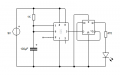
I have breadboarded the above circuit, and the 4013 IC gets very hot very rapidly.

It works using a 555 acting as a monostable activated when you touch a metal plate attached to pin 2. The monostable part works, emitting a pulse of 0.1 seconds, but the 4013 which is designed as a toggle on the clock input overheats. I have powered it using a PP3 9V battery as well as a lab power pack set to 9V, with the same result.

Any help would be much appreciated, thanks in advance
 

urb-nurd

Joined Jul 9, 2014
269
i cant say i have much of an idea.
But are you limiting the input current?
also what current can the d-latch output ? Maybe the LED is asking too much.
 
Last edited:

jjw

Joined Dec 24, 2013
823
I don't know if this is the reason, but you can get only a few mA from the output of 4013.
Try with a bigger resistor or with a transistor to drive the led.
 

Thread Starter

OpafiX

Joined Jan 8, 2015
5
What are doing with the other half of the 4013?
The other half of the 4013 is n/c

I don't know if this is the reason, but you can get only a few mA from the output of 4013.
Try with a bigger resistor or with a transistor to drive the led.
I am using the LED as an indicator of whether or not the 4013 is outputting anything, it stays on very dimly no matter what I do to the 555. I know the 555 works from using my multimeter
 

MikeML

Joined Oct 2, 2009
5,444
The other half of the 4013 is n/c


I am using the LED as an indicator of whether or not the 4013 is outputting anything, it stays on very dimly no matter what I do to the 555. I know the 555 works from using my multimeter
Try bypassing Vcc to Vss with several uF.

Ground all of the unused inputs on the other FF and the S &R inputs on the FF you are using.
 

MikeML

Joined Oct 2, 2009
5,444
Do you mean Vdd instead of Vcc? i.e. pin 14 to pin 7?

I will try grounding the unused inputs, should I do the same for the unused outputs?
Actually, it is more import that the bypass is across the supply pins for the 555. The 555 modulation input (pin5) should be bypassed to ground with a 0.01uF to 0.1uF. Download and read the 555 data sheet. All of the required bypassing is discussed there.

All unused inputs on CMOS must be tied somewhere, either Vdd or Vss, depending on if they are active low, or active high, respectively. Leave unused outputs alone.
 

GopherT

Joined Nov 23, 2012
8,009
Change the Output resistor to 4.7k ohm or more. It will be dim but you can connect a NPN transistor if you need a brighter LEh.

The 4013 is not intended to deliver more than 2.25 mA at 9 volts!

Of course it will get hot if you drive that poor old technology at 20 mA (10 times the designed current with a 470 ohm resistor)!
 

WBahn

Joined Mar 31, 2012
32,823
View attachment 78435
I have breadboarded the above circuit, and the 4013 IC gets very hot very rapidly.

It works using a 555 acting as a monostable activated when you touch a metal plate attached to pin 2. The monostable part works, emitting a pulse of 0.1 seconds, but the 4013 which is designed as a toggle on the clock input overheats. I have powered it using a PP3 9V battery as well as a lab power pack set to 9V, with the same result.

Any help would be much appreciated, thanks in advance
Be sure to read the data sheet for the parts you are using:

https://www.fairchildsemi.com/datasheets/CD/CD4013BC.pdf

You'll note that the maximum output current at Vdd=10V and an output HI is 2.25mA. On a lot of parts they can sink considerably more current than they can source, so you might have been able to tie the LED/R to the positive rail and turn it on by having the output go LO. But if you look at the data sheet you will see that the current drive limits are the same whether sourcing or sinking. So if you want anything more than a couple milliamps, you will need to use a transistor switch. You can either connect it as a switch, in which case you need to be sure to use a current limiting resistor in the base leg (assuming you use a BJT), or you can configure it as an emitter-follower in which no resistor is needed. You can also use a FET transistor.

Although you are abusing the outputs on this thing, my guess is that that is not why it is heating up. If you leave CMOS inputs unconnected they can float to an intermediate level in which there is a path from Vdd to Vss through circuits that normally always have one or the other transistors in the series chain cutoff. This is called "shoot through" and can rapidly destroy a device. So you need to tie all unused inputs on the entire chip to an appropriate logic level. Do NOT tie unused outputs to anything.
 
Top