4 layer pcb and decoupling capacitor connection

Thread Starter

janbert

Joined Aug 6, 2025
18
Hi everyone. I hope thats the right forum for this question.

I would have a question about a 4 layer pcb with 1 layer ground and 1 layer power.

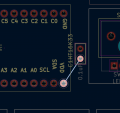
I was under the impression that when using an entire layer for power and ground, I wouldn’t need any additional traces to connect power to my components. But how does that work for a decoupling capacitor? If it’s not placed directly between the power source and the component’s power pin, how does it actually help? Also, if I have multiple decoupling capacitors, don’t they just add up across the whole power plane?

Or in this case I would need to route the power from capacitor to the component?
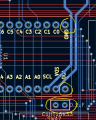

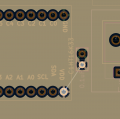
1756224291797.pngAlso if that is okay I would another question. When using a whole layer for power, i have drawn a power zone through the whole pcb, but would it be more wise just drawing the zone just as big so it just covers the power connections i need?
So basiscally the yellow rectangle would be all i need for my power layer zone?
1756224947969.png
 
Last edited:

drjohsmith

Joined Dec 13, 2021
1,549
power planes,
its easier to cover the complete board with a plane ,
purely cause if you don't put plane in areas ,what do you do,
if you take off large areas of copper , this leads to imbalance in the board , and the board is liable to warp, esspecialy a worry with smd parts, where just about any warp can pop the parts.

if yoh leave an area of copper not connected, it will radiate, if you ground the copper , its a split plane, why not leave it connected to power.
if you try to route tracks there, a problem as planes and tracks are often done inverse etching , so you end up defining the layer as tracking, and putting in a large blob of track,

decoupling
different capacitors for different jobs,
100nf ceramics, used for high frequency decoupling,
bigger , 10uf or 100 uf around board for bulk decoupling .

the traditional rule for the high frequency decoupling , place next to each power pin, wire from capacitor to the pin, then via at the capacitor to the plane.
the aim is to direct the current flow and ensure it comes from the capacitor ,

but , to be honest , dont get to hung up on it ..

earth's, direct to power plane.

ensure you use thermal relief on all vias to planes , else your going to have great assembly problems.,

Just fyi.
for real high frequency stuff , one has to do things like cut out under pads , put bias inside pads, etc .
dont get hung up on it

I've seen very big boards , with 12 layers, with no high frequency decoupling pass all emissions test and work great .
don't try it , but dont worty to much for simple designs of digital electronics.

analog and rf , now they are different

https://resources.pcb.cadence.com/blog/2020-decoupling-capacitor-placement-in-pcb-layout
 
Last edited:

MrChips

Joined Oct 2, 2009
34,628
All connections have inherent resistance and inductance. When it comes to power supply decoupling capacitors, it is essential to keep all leads and traces as short as possible. This is where SMD capacitors have an advantage over thru-hole components.

Capacitors across the board do not add because they are too far away from each other.
In critical applications you may find two or more capacitors in parallel, e.g. 1 nf, 10 nF, 100 nF, 1 μF, 10 μF.
They do not add. Each capacitor has a different frequency response. Capacitors in parallel are there to cover a wider frequency range.

On a multi-layer board, you still need to keep traces to the decoupling capacitor as short as possible between the power and ground pins of each IC, not with the power and ground planes. Presumably, the IC power and ground pins already connect directly to the power and ground planes.
 

Thread Starter

janbert

Joined Aug 6, 2025
18
Thank you very much for your help on this. :)

So basically I would still need to route from the capacitor power to the component power? Like this? Even I have a whole layer of power and ground? I removed the other routes for now, just to visualize it better.

Also I am sorry if that are super newbee questions but I am pretty new to all this. What do you mean by thermal relief. Is that what it automatically does in KiCad? Or what would I need to do exactly to get thermal relief on all vias?

1756227286498.png

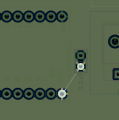
this is how my power layer looks like.
1756227319133.png

and this is ground:
1756227337645.png
 

drjohsmith

Joined Dec 13, 2021
1,549
Thank you very much for your help on this. :)

So basically I would still need to route from the capacitor power to the component power? Like this? Even I have a whole layer of power and ground? I removed the other routes for now, just to visualize it better.

Also I am sorry if that are super newbee questions but I am pretty new to all this. What do you mean by thermal relief. Is that what it automatically does in KiCad? Or what would I need to do exactly to get thermal relief on all vias?

View attachment 354855

this is how my power layer looks like.
View attachment 354856

and this is ground:
View attachment 354857
First. Move the capacitor next to the power pin. .
Why is it floating so far away ?
Track on top or on top and plane or just plane is arbitrary. .
I've seem all sorts of variants on that. Each company is fitment that their way is right. .
Just get it close unless you can't .
 

drjohsmith

Joined Dec 13, 2021
1,549
Is that an Arduino your soldering down by any chance ?
If it is a board , it's unlikely you will need high frequency decoupling , but a bulk cap .it be best practise
 

drjohsmith

Joined Dec 13, 2021
1,549
Why are you using a thru-hole capacitor when an SMD capacitor would give a shorter path?
Do we know what sort of frequencies the op is interested in ?
If the rest of the board is through hole, personally I can't see why the need to move to smd would be a real advantage
 

MrChips

Joined Oct 2, 2009
34,628
Note: A power supply decoupling capacitor at the digital IC is not there to attenuate noise from getting into the IC. It is the opposite. The decoupling capacitor is there to remove noise originating from the IC.

Every time a logic gate switches, it draws current from the supply and ground rails. This causes the rails to bounce, what we call ground and supply bounce.
 

MrChips

Joined Oct 2, 2009
34,628
Do we know what sort of frequencies the op is interested in ?
If the rest of the board is through hole, personally I can't see why the need to move to smd would be a real advantage
If you are laying out a new PCB, consider moving to SMT. The advantages must not be ignored.
 

Thread Starter

janbert

Joined Aug 6, 2025
18
@drjohsmith: Its an adafruit ht16k33 breakout board. But I am also using 3 adafruit mcp23017 breakout boards, which I am daisy-chaining. You think I won't need the decoupling capacitors at all in this case?

I had the capacitor closer to the powerpin before, but I thought it would need to stay between power and ground. I will move it closer to the power, shouldn't be an issue I hope.
But my main question is still, do I have to trace or route between the power of the capacitor and the ht16k33 power or is that not necessary because I have a whole layer dedicated to power. I still don't understand this part unfortunately.

@MrChips: Because I didn't know about it. I thought when I dedicate the a whole layer for power I would need through hole to get connected to the actual layer.

Thanks again for your help on this. It's really much appreciated :)
 

MrChips

Joined Oct 2, 2009
34,628
Now that we know the purpose of the board, you don't need a 4-layer board, power and ground plane, and decoupling capacitors. The board is what we call a patch board. The decoupling capacitors are already on the Arduino board.
 

Thread Starter

janbert

Joined Aug 6, 2025
18
Yea the complete board is much bigger though, I have lots of other things connected to it and everyone recommended changing to a 4 layer pcb in this case. Its lots of buttons and RGB lights, encoders, digital and analog.
I just thought with a 4 layer pcb I would be more on the safer side and not worrying much about noise or other things.

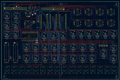
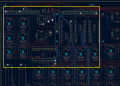
The whole board looks more like this, the highlighted Part is the power connections I have, and almost all items need a ground connection, and thats where I run into issues with the 2 layer pcb.
I am very happy if you could give me general feedback about my whole routing. As I mentioned I am pretty new to it and there might be lots of issues I am not even aware of.

The wider traces are mainly SDA and SCL. For power and ground I have no traces at all because I thought I wouldn`t need them if I have a whole layer dedicated to ground and power.
The pinheader on the left will be connected to all Raspberry pi 4 pins

1756233097176.png
 
Last edited:

drjohsmith

Joined Dec 13, 2021
1,549
@drjohsmith: Its an adafruit ht16k33 breakout board. But I am also using 3 adafruit mcp23017 breakout boards, which I am daisy-chaining. You think I won't need the decoupling capacitors at all in this case?

I had the capacitor closer to the powerpin before, but I thought it would need to stay between power and ground. I will move it closer to the power, shouldn't be an issue I hope.
But my main question is still, do I have to trace or route between the power of the capacitor and the ht16k33 power or is that not necessary because I have a whole layer dedicated to power. I still don't understand this part unfortunately.

@MrChips: Because I didn't know about it. I thought when I dedicate the a whole layer for power I would need through hole to get connected to the actual layer.

Thanks again for your help on this. It's really much appreciated :)
as you are seeing , there are many views on this subject.
rather like if you ask a software writer what the best editor is , many answeres , few wrong ( that would be vi as wrong :-> ..)

as @MrChips said ,in general, the important thing is the capacitor is a reserve for power for the chip. so it needs to be as close to the power pins as possible . the capacitor needs to be grounded to the power ground.

there is no nedd to decouple the chip ground pin.
yep when I started with 14 pin dil chips , it was common to put decoupling in between the ground and power pins in opposite corners of the chip. looking back I wonder how they ever worked, but they did, I bumped into one of my boards from 30 years back , amazing what "rules" we broke.

as to you thought about do you.
a, only track from capacitor to V+ pin
b. only conect V+ to capacitor on the plane
c. conect by track and plane

easy answer is none are wrong , I've seen all employed with great arguments by companies as golden rules , but dont sweat it . just keep the decoupling next to the power pin .

last.
you say they are using modules.
these often have their own on board high frequency decoupling, so reducing the likelihood that adding your own on your board will have a benefit.

but.
no one got sacked for having a few extra high frequency decoupling capacitors, and debugging a problem caused by lack of decoupling is a real stress place to be.
till its critical you save every penny, dont scrounge on high frequency decoupling .

last plus 1 !
bulk decoupling , some of these boards nedd a fair kick rpfrom the power, id suggest a few 10 uf bulk decouplers on the power pins parallel to any high frequency decouplers.

if you use decent 10uf ceramic capacitors, you won't need the high frequency decoupling in this case.

last plus 2 !

Great your using a 4 layer board, again unless your counting every penny, then the simplicity of the 4 layers IMHO more than compensate for the small real cost increase .

I.e. assume your cost is usd 500 per day , going two or one layer costs you two days on layout, but costs usd 10 more per board you have to make 100 boards till the reduction in layers is a cost advantage .

my bet is your not making that many of these boards,

edit . Just noticed whilst I've been typing other overlapping posts have come in.
 

Thread Starter

janbert

Joined Aug 6, 2025
18
@drjohsmith: thank you so much for your help on this. That all sounds great, as long as I am not doing an essential mistake its probably all fine :)
Maybe just one last question for the bulk capacitor. I have that already in my layout. The two power pins you see is basically the main powersource for the whole board, which comes from the raspberry Pi. I have placed the bulk capacitor fairly close to one of them. But its probably also recommended to just trace it from one power pin straight to the bulk capacitor? For the ground I guess its fine as it is?

1756234640133.png
 

drjohsmith

Joined Dec 13, 2021
1,549
Bi
@drjohsmith: thank you so much for your help on this. That all sounds great, as long as I am not doing an essential mistake its probably all fine :)
Maybe just one last question for the bulk capacitor. I have that already in my layout. The two power pins you see is basically the main powersource for the whole board, which comes from the raspberry Pi. I have placed the bulk capacitor fairly close to one of them. But its probably also recommended to just trace it from one power pin straight to the bulk capacitor? For the ground I guess its fine as it is?

View attachment 354862
Bulk capacitor , just connect to the planes somewhere near the connector to the pi..
And id put 10uf next to each of the modules powers .
Easy to not fit if you don't need .

No way I can comment on tracking , on phone so small screen , maybe someone else can check the general tracking of the signals for you

I'm concerned, you mentioned analog , these are get different to wiring for LEDs , switches etc. and I'm not in position to comment on that fir you .
 

MrChips

Joined Oct 2, 2009
34,628
It would help if you had told us the function of the board. It looks like some kind of mixer control panel.

The purpose of a ground plane is to reduce cross-talk between signals. If you have SDA and SCL signals, you want to keep the connections short. If you have analog signals on the board then you now have a mixed signal application which can be a nightmare.

I don't see a real need for a power plane but keep the ground plane. I would run power with very wide traces instead of a power plane. Skip the 0.1 μF but put 10 -100 μF electrolytic capacitors where needed (more details later).
 

drjohsmith

Joined Dec 13, 2021
1,549
It would help if you had told us the function of the board. It looks like some kind of mixer control panel.

The purpose of a ground plane is to reduce cross-talk between signals. If you have SDA and SCL signals, you want to keep the connections short. If you have analog signals on the board then you now have a mixed signal application which can be a nightmare.

I don't see a real need for a power plane but keep the ground plane. I would run power with very wide traces instead of a power plane. Skip the 0.1 μF but put 10 -100 μF electrolytic capacitors where needed (more details later).
I'd suggest ceramic not electrolytic and @MrChips and I are always going to be at opposite ends of risk v cost .
 
Top