3W LED array Forward Voltages

Thread Starter

Ross Mortimer

Joined Nov 10, 2017
27
The CC and CV module is running the Xl4016E1, this is the datasheets i could find
http://www.xlsemi.com/datasheet/xl4016 datasheet.pdf

And according to this site under applications it says Because of CC and CV adjustments module can be used as battery charger or CC led psu
https://artofcircuits.com/product/x...own-converter-5-40v-to-1-25-35v-max-8a-output.

So i presume the voltages vary to keep the current limited. SO if thats the case how do i go about finding the resistor values for each string given the max and min forward voltages?
 

spinnaker

Joined Oct 29, 2009
7,830
Yes, Thanks i saw after wards that it was wrong, i meant that when i adjust the voltage up on the trim pot, the led strings start to get brighter when the current has been set.

Would adding fuses before each string be an option?

A fuse will might not be fast enough. But if they survived the initial shock then at least they would at least not be exposed top the higher current over the long term. Your issue would be to find a fuse small enough.


You might be able to roll your own if you have the components. Here is one from Roman's site for a motor.

http://www.romanblack.com/current.htm


There might be others out there.
 

Audioguru

Joined Dec 20, 2007
11,248
If you use a single constant current supply, then each LED string will have different currents and different brightnesses, maybe one string will have so much current that it burns out, then the remaining strings get too much current and also burn out in order of their total forward voltages.
The current limiting resistor in each string will need a value much higher than only 1 ohm so that it helps match the forward voltages.

Then it is best to have a current regulator for each string.
 
The drop is usually a maximum, so sorting by color and then by voltage drop is what you need for uniformity. Then adjust the current slightly for each string composed of similar LEDS with the same voltage drop. Just make sure you have enough voltage to cover n*Vmax_ (some series resistor).
 

Thread Starter

Ross Mortimer

Joined Nov 10, 2017
27
Im getting different responses now, one saying best to use resistor per string, another saying current regulator.
How are so many many people running high powered cobs in parallel or arrays with no resistors and no problems? IS this just theoretical ? that hardly happens in practice.

Can you please explain to me if using a resistor is the best method, how do i determine that resistor?
and if using a current regulator which regulator or how do i determine what i need.

I'm getting to that point where im just going to set it at a set current, max volts it lets me and let it run. its been running like it is 12 hours a day for past 4 days and nothing has even flickered or burned out or brighter than other led..
i''m starting to think this is just all being over thought.
On another forum a user says unless you getting near max current ad junction tempreture you shouldn't see current hogging.
 

ebeowulf17

Joined Aug 12, 2014
3,307
Im getting different responses now, one saying best to use resistor per string, another saying current regulator.
How are so many many people running high powered cobs in parallel or arrays with no resistors and no problems? IS this just theoretical ? that hardly happens in practice.

Can you please explain to me if using a resistor is the best method, how do i determine that resistor?
and if using a current regulator which regulator or how do i determine what i need.

I'm getting to that point where im just going to set it at a set current, max volts it lets me and let it run. its been running like it is 12 hours a day for past 4 days and nothing has even flickered or burned out or brighter than other led..
i''m starting to think this is just all being over thought.
On another forum a user says unless you getting near max current ad junction tempreture you shouldn't see current hogging.
Debates over how to drive LEDs are never-ending and surprisingly contentious. I don't think you'll ever find consensus.

There are lots of different methods that can all work fine, but some are more failsafe than others, and some rely on deep, complex theoretical understandings of circuit-specific situations, while others are more generally applicable.

From what I've learned, an individual constant-current source per string is the best way to drive LEDs, both in terms of consistency (independent of temperature changes, forward voltage variations, etc) and in terms of handling failure modes gracefully. Unfortunately it's also among the bulkiest and most expensive.

Using a constant voltage source along with a series resistor per string makes the circuit more temperature dependent, but will work acceptably well in most situations. It handles the loss of an entire string perfectly well, but if a single LED fails as a short, that will increase current in that whole string and could potentially lead to eventual failure of the whole string (but it shouldn't effect other strings.)

Using a constant current source along with a series resistor per string is probably about the same in terms of consistency of performance when everything is working, but has an extra failure mode pitfall: if one whole string is lost (disconnected, open circuit failure, etc.) then the source increases voltage/current to the remaining strings, potentially damaging all of the remaining strings.

Other methods, relying on internal resistance of a voltage source or working out performance of the LED in an ohmic region beyond its normal Vf rating, require much more application specific knowledge and very careful component selection. I wouldn't recommend them to beginners.

In general, the less "ideal" circuits are chosen as a good compromise based on other requirements like cost, size, etc. If the extra precision or highest level reliability isn't required for a given project, why pay for it, right?

I apologize in advance - probably got some details wrong in there. I wasn't trying to provide an authoritative answer on what's right or wrong, more of a general overview of why there's such a spectrum of opinion. Several of the people who have responded to this thread have expertise beyond my wildest dreams, so I'll defer to them when they correct my mistakes!
 

Audioguru

Joined Dec 20, 2007
11,248
Some people are lucky to get LEDs with the same forward voltage or have strings with random forward voltage averaged to be the same. Other people (Chinese flashlight manufacturers) have somebody test and sort the forward voltages of thousands of LEDs.
 

Thread Starter

Ross Mortimer

Joined Nov 10, 2017
27
Thank you EW17, The scenarios do makes sense and i do understand how the different setup affect the strings and how they can burn out.
I apologize as well, its just very frustrating as i cant seem to wrap my head around it. and you see its simple as 1-2-3 sites showing how to build led arrays but they dont go into the depth of restricting current on the strings.

im probably just going to have to compare a higher voltage meanwell driver to run in the array in series or more cc cv buck converters for each string and see whats cheapest.

atleast until i can find a way to regulate the current in each string.
Also Thank you to everyone for the time you have taken to explain things and try help me out.
 

spinnaker

Joined Oct 29, 2009
7,830
If you use a single constant current supply, then each LED string will have different currents and different brightnesses, maybe one string will have so much current that it burns out, then the remaining strings get too much current and also burn out in order of their total forward voltages.
The current limiting resistor in each string will need a value much higher than only 1 ohm so that it helps match the forward voltages.

Then it is best to have a current regulator for each string.

A good point. This is where buying lots of LEDs and doing lots of testing to find matching LEDs can help. But you are correct. One current source for each LED leg is always the best way to go.

Our communityt had an LED garden light with an array of LEDs . The light was purchased from a company that sells such lights. It used one current source for the whole array even though there were a number of LEDs in parallel. I suppose a large company can buy millions of LEDs and pay someone to sort them but I wouldn't put any money on it. :)
 

Thread Starter

Ross Mortimer

Joined Nov 10, 2017
27
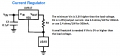
You need only one buck voltage reducer then a simple and cheap current regulator for each string.
Here is a simple and cheap current regulator:
Thank you, that seems like it may be the best option. I'm guessing i would need the 1.5A lm317. Would using the lm317 as a current regulator have a difference in input and output voltage?
 

spinnaker

Joined Oct 29, 2009
7,830
Thank you, that seems like it may be the best option. I'm guessing i would need the 1.5A lm317. Would using the lm317 as a current regulator have a difference in input and output voltage?

Is this a battery project or a project that plugs into the wall? If it is a battery project your battery is not going to last for very long with a linear regulator. If it is a plug in project then why not simply use resistors.

Why do you need a voltage regulator at all? What is your input voltage?
 

MisterBill2

Joined Jan 23, 2018
27,508
Using a resistor to set the current for each string is the simplest way to run the LED strings safely. It is also by far the least expensive, and usually resistors are easier to get than current regulators. In addition, if the supply voltage is a few volts more than the voltage across the string of LEDs, so that there are a few volts dropped across the series resistor, the change in current as the LEDs warm up will be less. The power that is wasted in the resistor will probably not be much, so not much of a problem. The second benefit will be that the current for each string of LEDs can be set to the value that you choose, so that the brightness can be just what you want for each string. And it will be easier as well.
 

Thread Starter

Ross Mortimer

Joined Nov 10, 2017
27
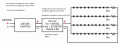
This might help with what im trying to acheive and the power from wall to led's4x10 1ohm led string.png
if i wanted to limit each string to 30.8V 600mA
would i need a 51.33ohm 18.48W resistor on each string?
 

BobTPH

Joined Jun 5, 2013
11,515
I don’t think you understand how your buck converters with voltage and current controls work.

You cannot control both the current and voltage at the same time. If one is held constant, the other is determined by the load.

The two controls set the maximum current and maximum voltage that it will output.

If you want a constant voltage, you set the max current higher than the load will take at that voltage, then set the voltage to the desired valie.

If you want constant current, as you do when driving strings of LEDs, you set the current to the desired value and the set the voltage higher than the load requires to draw that much current.

Bob
 

ebeowulf17

Joined Aug 12, 2014
3,307
This might help with what im trying to acheive and the power from wall to led'sView attachment 162649
if i wanted to limit each string to 30.8V 600mA
would i need a 51.33ohm 18.48W resistor on each string?
If you've got a 36VDC supply, I'd eliminate the constant current supply completely. It's only confusing things. If your minimum Vf is 28.9, then that leaves at most 7.1V to drop across each resistor. For 600mA, that would mean roughly 12ohms. The resistor will dissipate 4.26W, so it'll need to be big, but not 18W.
 

Thread Starter

Ross Mortimer

Joined Nov 10, 2017
27
If you've got a 36VDC supply, I'd eliminate the constant current supply completely. It's only confusing things. If your minimum Vf is 28.9, then that leaves at most 7.1V to drop across each resistor. For 600mA, that would mean roughly 12ohms. The resistor will dissipate 4.26W, so it'll need to be big, but not 18W.
Would i not have better efficiency running the resistors with the buck controller though, if i can set the current and get the max set voltage as close to max forward voltage as possible?

so something like like if i set the current on buck to 2.4A (600mA per string) and max current allowed to 31V where min forward voltage is 28.9 and max 30.8.
31V-28.9V = 2.1V
2.1V/0.6A = 3.5ohm
2.1V*0.6A = 1.26W dissapated

Or would the buck converter varying its voltage make it difficult for a set value resistor to keep a stable current to each string?
 
Last edited:

Tonyr1084

Joined Sep 24, 2015
9,744
The proper way to figure a resistor for an LED string is to take the starting voltage - your example - 36 volts. Next you figure the total voltage drop across the LED's. Your case, 31 volts. Subtract the Vf from the supply voltage. 36 - 31 leaves you 5 volts to drop across a resistor. Since voltage is equal to resistance times current, and resistance is equal to voltage divided by the current (not a complete explanation of ohms law) then 5 volts divided by 600 mA (0.6 amps) means you'd need a resistor value of 5 ÷ 0.6 = 8.3 ohms. The calculated wattage of the required resistor would be the voltage times the current. This case, 5 x 0.6 = 3. You'd need at least a 3 watt resistor. Best practice is to always over rate your resistor. Most will say two times, I commonly say 1 and 1/2 times. By my practice, you'd need a 4.5 watt resistor. They don't make them. So a 5 watt resistor would likely do just fine. For each string.
 

Tonyr1084

Joined Sep 24, 2015
9,744
Bob's right. If you don't mind the cost and the time it takes to get materials shipped to Africa - - - . The thing is you probably want to keep it simple. Resistors are simple enough. And for what you want them to do - well, my personal approach would be to go with a resistor on each string. Now, if you were designing something that was mission critical then I'd go for the more complex approach simply because of the reliability and adjustability. But even with a CC source, you're still going to need some sort of resistance to protect the circuit. (my opinion)
 
Top