3W LED array Forward Voltages

Audioguru

Joined Dec 20, 2007
11,248
A white, blue or bright green LED could have a forward voltage from about 3.0V to about 3.8V. Why do you think yours are 3.6V?
If you bought hundreds of an LED then you could test them all and group their forward voltages. You might find some that are 3.6V.
Please post the LED datasheet so that we can show you its range of forward voltage.
 

Thread Starter

Ross Mortimer

Joined Nov 10, 2017
27
A white, blue or bright green LED could have a forward voltage from about 3.0V to about 3.8V. Why do you think yours are 3.6V?
If you bought hundreds of an LED then you could test them all and group their forward voltages. You might find some that are 3.6V.
Please post the LED datasheet so that we can show you its range of forward voltage.
The site i got them off only has max drive current and forward voltage in the description and doesnt have links to any datasheets for the led's.. the were around the corner from so was easier to just to buy from them.

The description says they excotic bridgelux 3w led's.and they have max current as 700mA for all the colours ive used (recomended (350-500mA).
Forward voltage they just give the following for each colour

Deep Red - Forward voltage: 3.6v https://improvedlivingpe.eshop.co.za/Excotic-3W-Bridgelux-Deep-RED-LED-chip-660nm-p61712946
Royal Blue - Forward voltage: 3.6v https://improvedlivingpe.eshop.co.za/Excotic-3W-Bridgelux-Royal-Blue-LED-chip-445nm-p61712880
Deep Green - Forward voltage: 3.6v https://improvedlivingpe.eshop.co.za/Excotic-3W-Bridgelux-Deep-Green-LED-chip-520nm-p61712928
UV - Forward Voltage 3.2-3.4V https://improvedlivingpe.eshop.co.za/3W-UV-LED-chip-395-410nm-p27060092

Anyone perhaps know more about these leds or where to find the datasheets. i do understand that the led's have a minimum and max forward voltage. just i have not been able to find them and presume they giving me max forward voltage.

I know in normal circumstances the totals of the max and min forward voltage will be between the min and max output volts of the driver. but as im using CC and CV which i normally set it to the stable voltage and current i would like between the min and max forward voltages or even at max voltage and drop current slightly. have not had any led's burn out on me yet, but all those were either in series or single leds and with no resistors ever needed.
This is the first time im adding series to parallel though
 

Thread Starter

Ross Mortimer

Joined Nov 10, 2017
27
Thanks Bertus. I Have emailed the shop owner asking to please get the datasheets from the supplier. I will go on this though if she they dont get back to me..
Ive had a look at testing each led for forward voltage. but seems they use a bench power supply to set there current they running at and then turn up the voltage untill it stops. and then do some measuring. but as i dont have a bench power supply im a bit worried supstituting the cc & cv buck controller and turning the voltage up and seeing if it stops, lol
 

Thread Starter

Ross Mortimer

Joined Nov 10, 2017
27
This is the reply i got from the shop, lol have asked for the colours i have and will see what i get back

Bridgelux do come in 1W and 3W

We buy directly from the factory

I will have to request the datasheet for you.
 

panic mode

Joined Oct 10, 2011
4,978
remove two LEDs from each strip so that max 8 LEDs are per strip. this will give you five strips.
connect resistor in series with each strip. if LEDs are 3W, 10Ohm 15W resistor may be a good start.
 

Audioguru

Joined Dec 20, 2007
11,248
Digikey lists 81 pages of LEDs made by the Bridgelux company. Most of them are white and are obsolete.
They look different to the ones you show from the fishtank store.
 

Thread Starter

Ross Mortimer

Joined Nov 10, 2017
27
This is reply i got from the shop, very different figures to what they have on the the site for each colour.

Red:2.5-2.6V 650mA (But we always run them on lower mA 350mA = Red is more sensitive)

Blue 3.8-4.2V 650mA (We run them on lower voltage 3.2V)

Green 3.8-4.2V 650mA (We run them on lower voltage 3.2V)

UV 3.8-4.2V 650mA (We run them on lower voltage 3.2V)
 

Audioguru

Joined Dec 20, 2007
11,248
The new voltage ranges look to be correct.
The shop knows nothing about LEDs. You NEVER feed a voltage to an LED, instead you feed it a certain current like they show for the red LED. Then the LED sets its own voltage.
The current listed is probably the absolute maximum allowed current if you cool the LED somehow. Then at almost half the max allowed current the LED does not get too hot and survives.
 

Thread Starter

Ross Mortimer

Joined Nov 10, 2017
27
ok, I was thinkin that is what this buck converter is doing, I hooked up the lights with a 1ohm 1 watt resistor on each string and set the current to 500ma i then adjusted the voltage up and got to about 27 odd volts max, i then changed the current up to 600ma and could now turn up the voltage to around 28.9 volts. but the voltage would not go higher than those peaks, if i kept turning pots.

So at the moment i seem to be under running the leds, which im fine with,working no problem. but ill look at removing 2 leds out of each srting ant going 8 leds x 5 strings
 

Audioguru

Joined Dec 20, 2007
11,248
If you have 10 LEDs that have their minimum voltage then the total voltage is low.
If you have 10 LEDs that have their maximum voltage then the total voltage is high.

If you connect a string that has minimum voltage parallel with another string that has maximum voltage then the 1 ohm resistor value is much to low to match them so the string with the lower voltage will hog all the current and burn out, and the other string with thwe high voltage will not light until the other string has burnt out then it too will burn out.

Even if The voltage of each string is the same then if an LED burns out on one or more strings then the remaining LEDs will get too much current and burn out. You must increase the value of the resistors so that the resistors limit the current in each string if one or two parallel strings do not pass any current.
 

MisterBill2

Joined Jan 23, 2018
27,513
It is ALWAYS useful to have a resistance in series with LEDs because, exactly as stated, they are CURRENT driven devices and the current ghange with the voltage drop is VERY NON-LINEAR!!! so just a small increase in voltage can produce a very large increase in current and it is all over for the LED. Also, the forward voltage drop changes with temperature quite a bit, and so what works initia;;y can be far to great as they get warmer. So seeking to avoid disaster and destruction by having a series resistor is a cheap way to go.
 

Thread Starter

Ross Mortimer

Joined Nov 10, 2017
27
Ok, so I think im getting confused here again.

So If its running under Constant Current do i still need resistors on each string? If so this is where im having trouble calculating what size.

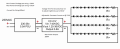
With the new Forward voltages i will be changing my array slightly, so the voltages match on each string. Here is a drawing ive done hopefully it helps making it clearer.
Each string has the same min and max voltage drop with the new figures i got.4x10 1ohm led string.png
 

bertus

Joined Apr 5, 2008
22,923
Hello,

Never run leds near the maximum allowed current.
I would use 4 CC drivers of 350 mA or 450 mA, one for each string.
You can find a lot of them on ebay and co.
This way you will have not the chance that if one of the strings fails, that the other strings will follow soon.

Bertus
 

Thread Starter

Ross Mortimer

Joined Nov 10, 2017
27
Unfortunately importing goods from ebay, digikey and co takes about 3 months to reach me. Our Postal service is shocking and the parcel ends up sitting at customs for 6-8 weeks.. TIA - This is Africa.

I'll have to have a look at getting a few more of these cc buck converters, but at about $10 a pop here it will be adding up.
 

spinnaker

Joined Oct 29, 2009
7,830
To answer your question. No you do not need to add current limiting resistors . If you have current limiting circuitry. Also your trimpot statement is incorrect. You do not control brightness of an LED by controlling its brightness. You do so by limiting the current to it. You can also do it with PWM, which is the right way to do it when you are trying to conserve power.

Your constant current source might have such an adjustment.

As Bertus mentioned putting LEDs in parallel (without them each having their own constant current is not advised but it is not always feasible. Just be aware you are risking losing all of the LEDs.

The problem I have seen is it can be difficult even finding a constant "off the shelf" current source in the lower current sizes. You might need to design your own.
 

Thread Starter

Ross Mortimer

Joined Nov 10, 2017
27
Yes, Thanks i saw after wards that it was wrong, i meant that when i adjust the voltage up on the trim pot, the led strings start to get brighter when the current has been set.

Would adding fuses before each string be an option?
 

Tonyr1084

Joined Sep 24, 2015
9,744
Peanut gallery here: A lot of assumptions are being made about the forward voltage of an LED. I've purchased large quantities in the past - without data sheets. Taking a group of 100 LED's I've charted the forward voltage of a sample of 10 from each different color and found a fairly significant difference in forward voltages. I'm running on memory here so my numbers are not going to be accurate, but I purchased a bunch of super-bright LED's. Just using the Blue LED as an example, I found an average forward voltage of 3.1 volts. Remember, I don't have a data sheet for them, so I had to set up a test rig and take the measurements myself. Using a set voltage and set resistance (again, this is from memory) I tested each LED and wrote down the values. As I recall, I saw Vf ranging from 2.85 Vf to 3.4 Vf. One of the two points I want to make is that depending on where you get them from - you can have a sock full of stink for parts. Knowledge is important. Test each LED alone on a limited supply and current.

The second thing I want to make that I'm not sure has been fully conveyed is that whether using a constant voltage (CV) or constant current (CC) is that in order to maintain a CV, the supply must vary the current in order to keep up with the demand. The same is true when using a CC supply, the VOLTAGE must change.

It goes back to ohms law. Voltage is equal to current times the resistance. Since the resistance of the circuit isn't going to be changing then the voltage or the current must. Example: 10 volt supply with a 20 ohm resistor means you're running half an amp (0.5 amps). If you change the voltage to 15 volts with the same resistance the current changes to 3/4 amp (0.75 amps). If you are shooting for 0.75 amps (750 mA) and your circuitry presents 20 ohms then you need a supply that can vary the voltage to keep that current at its setting. Same thing would be true if you were to use a CV supply, then the current needs to change accordingly.

Using a single resistor per string is the way to go. Each string is limited by the resistor, so that no matter what another string does, the current - assuming the voltage is stable - will not increase in the other strings.
 
Top