Facebook
 Google
 GitHub
 Linkedin

Good tubing is exceedingly hard to kink or distort. Is the length correct? If the tube is too long, at the left side of the tool head travel (X = 0), there will be a fair amount of force on it in compression against the connector. If it is too short, on the right side (X ≈ 250) there will be excess force in tension.The problem I've been having is the compress the tube causing drag on the filament. when that happens I replace the tube and/or the PC4-M10 connector.
I feel lucky if it locks on the tubing, gennerally I can't get the tube out if they are mated, I just throw the connector away.
Still, it should be very hard to distort even mediocre tubing because it has a very high wall thickness and is quite stiff. I would expect it would take a lot of force to manage it. Is the tubing particularly inexpensive?
There is a trick to removing a tube that seems stuck. The locking is accomplished using a spring steel collet. It is shaped like a truncated cone, pointing towards the outlet side of the connector. It’s diameter is a few hundredths of a millimeter smaller than the tubes and so it flexes to permit the insertion.
This causes the edge of the relatively thin collet to dig into the tubing. Attempts to remove the tube without releasing it causes it to dig in further and the tubing will not come out. It’s quite strong. When the lock release collar is depressed, it deforms the collet making the opening larger. The tube can then (in theory) be withdrawn.
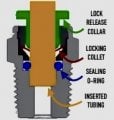
a cross section view of the connector and its parts
(please excuse the small size, I made an error while creating it)
While in the Bowden tube application, where no pressure must be maintained, the question of how the locking collet can do this is moot. But, for the sake of completeness: note the sealing o-ring (blue)—when the tube is inserted into the connector, it passes the o-ring before it bottoms out in the cavity sized to contain it. The o-ring makes the actual seal against the tube’s exterior while the locking collet prevents pressure from pushing the tube out. It works very well.
In practice the lock release color may not be able to deform the collet sufficiently to get the edge of the collet out of the groove it has cut in the tube. This makes the tube feel stuck, but with few exceptions a very simple trick will release it.Depress the collar as far down as you can manage, then, instead of trying to pull the tube out push it in firmly, then pull it out. This should release the collet from the tube. You can see the distortion of the tube made by the collet, it is a shallow groove cut around where the collet dug in.
Note: attempting to pull the tube out without depressing the lock release collar will cause the locking collet to dig much deeper into the tube making removal that much harder.
Sometimes it is hard to push the collar down because of the small space to work in and the narrow rim of the collar. Not being able to use two hands would make it much harder to do while also pushing in on the tube to get it to release.
Here is a tool you can print that reaches down to the collar and provides easier access. You can use one hand to do both by grabbing around the tube and pushing. Your hand will slide enough to release the lock but also continue to put pressure on the tube to free it from the collet.
When you have the lock released and tubing driven home, you can pull back on the tube while maintaining pressure on the lock by sliding the fingers of your closed fist away from the connector while maintaining pressure on the lock release with your thumb.
If this doesn’t work well for you, you can modify the design to the tool so it has a larger top flange, or even so it has lock similar to the collet in the connector.
One more thing, you can modify a connector by drilling the <4mm hole from the threaded side sp the tubing can pass straight through. This connector can be installed on the tube near to the printer’s connector so that their lock releases face each other.
Install a safety lock (print file in the post above) on the modified connector to prevent the depression of its lock release. Now, to remove a stubborn tube is a matter of two steps:
1. Push the modified connector down the tube until it depresses the lock release collar on the printer’s connector. Because of its own locking collet, the connector will maintain the pressure depressing the collar on the printer’s connector.
2. Push in the tubing, then pull it out. It will come out with difficulty ranging from none to moderate but it will come out.
After you’ve got the tube off, you can slide the free connector of the end and use it on the new tube.
Attachments
-
1.3 MB Views: 4