316 ss spring wire for a solenoid

Thread Starter

cmartinez

Joined Jan 17, 2007
8,783
Thanks for the info, Bertus. I knew that beryllium is a dangerous material, and your links are quite valuable as cautionary info. But seems beryllium's pretty safe when it's present in copper alloys:

http://www.lfa-wire.com/application-benefits-of-beryllium-copper.htm

The benefits of this alloy are numerous, and again, this is why you can find the alloy in most places. Whether aware of it or not, chances are a person encounters this alloy multiple times throughout any given day.
 

bertus

Joined Apr 5, 2008
22,938
Hello,

In our company the beryllium bronze tools have been replaced by titanium tools.
We need to have anti-magnetic tools as we will have to work on magnets upto 21 Tesla.

Bertus
 

Thread Starter

cmartinez

Joined Jan 17, 2007
8,783
I've already made up my mind. I'll be using 0.0079" 316L hardened wire for the solenoid's spring, and 0.020" titanium wire for the solenoid's plunger limiting rib. Regarding its safety, the 316 ss alloy is a no-brainer, and the titanium I chose claims to be "surgical grade"
Hello,

In our company the beryllium bronze tools have been replaced by titanium tools.
We need to have anti-magnetic tools as we will have to work on magnets upto 21 Tesla.

Bertus
Interesting. But isn't beryllium bronze also non-magnetic? I'm guessing there was more than one reason for the change? Perhaps due to the fact that it has traces of lead (Pb 0.05%, according to this datasheet)
 

bertus

Joined Apr 5, 2008
22,938
Hello,

Our company wanted to be freed of the toxic of the beryllium.
You might also want to know that beryllium is used as heat conductor in RF transistors.
Never try to open a RF transistor.

Bertus
 

shortbus

Joined Sep 30, 2009
10,049
@shortbus, I've gotta feeling this is right up your alley. Any thoughts?
Sorry for being late to the party just now back after a 3 day forum ban.

Don't know if you've ever tried making your own springs or not, but it's not as simple as a spring looks. If needed to fit a particular area size wise it usually means many prototypes to get things correct.

How many of these do you need? Do you have or plan on buying the machines to make the springs? Reason for the question is there are other alternatives to DIY when it comes to springs.

The one the places I worked for used was Lee Spring - https://www.leespring.com/ That is where I would start for something like this.

They can either make or do make stock springs in many materials, more that may work better than the 316 stainless. I'm thinking like the nickle alloys. https://www.leespring.com/materials-finishes-and-plating
 

Thread Starter

cmartinez

Joined Jan 17, 2007
8,783
Sorry for being late to the party just now back after a 3 day forum ban.

Don't know if you've ever tried making your own springs or not, but it's not as simple as a spring looks. If needed to fit a particular area size wise it usually means many prototypes to get things correct.

How many of these do you need? Do you have or plan on buying the machines to make the springs? Reason for the question is there are other alternatives to DIY when it comes to springs.

The one the places I worked for used was Lee Spring - https://www.leespring.com/ That is where I would start for something like this.

They can either make or do make stock springs in many materials, more that may work better than the 316 stainless. I'm thinking like the nickle alloys. https://www.leespring.com/materials-finishes-and-plating
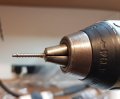
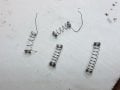
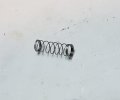
Thanks, shortbus. I knew I could count on your help. I plan on launching this product commercially, and I've already arrived at the conclusion that I'm gonna have to make my own springs. The reason is that all of the spring manufacturers I've consulted down here and overseas are simply INSANE in their pricing. Lee Spring (there are two manufacturing plants in Mexico) is one of many that I contacted, and the price per spring (3 mm x 15 mm x 0.008") that I was given was more than $5 dlls each. Volume discounts brought that price down to about half of that, which is still almost 10 times as much as I think the thing's really worth. So I bought a small spool of 316L hardened SS wire and I'm already performing some tests on it. That material cost me $85.00 dlls (taxes, S&H included) for a little more than 500 yards. And my estimate is that I can produce at least 10 springs per yard of said wire... a little math shows that the cost of material is less than 2¢ per spring.

I've been designing and building machines for 30 years now, and I know that making a spring manufacturing machine is not a walk in the park. But I also know practically everything one needs to know to be able to design and build one in less than 30 days. You've seen what I can do... :cool:
 

Tonyr1084

Joined Sep 24, 2015
9,744
Spring making - - - I've made a few in my time. Had a telescope with an adjustable tracker. The spring inside it went weak after many years. So I re-hardened it then annealed it. Didn't anneal it enough. It was still brittle and it shattered like glass. Next was to take some plain old steel wire and coil it up and manufacture another spring. After hardening and annealing, it was too soft. Over annealed it. Getting it just right took several tries and careful measuring of heats and times as well as quench rates. But in the end I gave the telescope to a neighbor with a child who was wanting to look at the stars. I don't know how that last spring is holding up.

When you take a hardened wire and force it to bend it softens. And since I'm not the spring expert, bending it can make it softer than you want it to be. With an 008 wire, I'd imagine bending it - the sharper the bend the more softening - will result in some dissatisfaction. You may be best suited to make a certain size spring using a certain wire and then testing it for strength and pressure. I don't know how springs are rated, whether they're rated in grams per inch or ounces per millimeter (deliberately mixed those terms). I'm sure you can find some information on the internet.

Then it will be a matter of trial and error heating your springs to cherry red, then quenching them in water or in oil. Track the fluid temperature as well because the amount of energy put into the spring (heat wise) will drain out quicker if the fluid is colder. So moderating the fluid temperature is a part of it. Once you have a hardened spring you'll want to anneal it. Put it in an oven at 400˚F (204.4•••˚C) for a set period of time, then let it cool to room temperature in a consistent manor, whether you open the oven door and let it cool or if you put it in a shoe box. Temperature and time are going to make the differences between a workable spring and a failed attempt. Like I said it took me several attempts at getting something close to what I wanted for the telescope.

One lesson I learned that I'm willing to pass on - - - when cooling the heated spring, don't use a plastic container for either oil or water. Plastic can still melt and you can still get a hole in the bottom and leak oil all over your work bench. "(
 

Wolframore

Joined Jan 21, 2019
2,619
316 is higher in Ni content than 304. It is more tolerant to corrosion and chlorine due to the Mo content. It is food safe and used all over for medical and food containment... Ni alloys cannot be heat treated to create springs. But they can be cold rolled for this purpose. I have seen 316L fail from salt and chlorine over time. Heat treated spring will be more corrosive due to the carbides that are formed from the heat treating. I would try the 316L spring, sounds expensive.

be careful the hardened 316L is very brittle.
 

shortbus

Joined Sep 30, 2009
10,049
When you take a hardened wire and force it to bend it softens. And since I'm not the spring expert, bending it can make it softer than you want it to be.
that's a new one for me. Can you give some examples or other evidence of that? In all of my years of experience it's just the opposite, bending work hardens and causes fracturin
 

shortbus

Joined Sep 30, 2009
10,049
They used 304 sheet almost exclusively at work for fabrication that need to be welded. The welds would rust if left outdoors or under water. The welds wouldn't rust though if sand blasted after welding. A simple chemical less form of passivating to bring the surface of the stainless back to exposed nickle/chrome and not iron.
 

Wolframore

Joined Jan 21, 2019
2,619
I’ve seen more stainless railings ruined by contamination from using girders that gets used on carbon steel that anything else. Duh
 

Tonyr1084

Joined Sep 24, 2015
9,744
I've worked with hardened SS, though I can't tell you exactly what grade. Welding ribbon and you couldn't easily bend it. If you DID bend it the darn stuff would get soft. That's about all the experience I have with bending SS.

What @Wolframore said about heat treating - I forgot that it does introduce carbon into the steel. And I have seen people grind on steel then on SS with the same wheel. What a mess. The SS has to be pickled - a process I can say nothing about because that's as much as I know about pickling steel.
 

Wolframore

Joined Jan 21, 2019
2,619
316 is an austenitic steel that can’t be hardened through heat treatment. But the Ni content allows you to work harden. If your SS grade was heat treated it was either ferritin martensitic like 410, 420 or 440 or similar or a precipitation hardening grade. I’m not sure what you experienced with softening. It may be you had material that was only hardened on the surface due to friction from tooling or the like. Then by bending you got to the elastic layer below.
 

shortbus

Joined Sep 30, 2009
10,049
The SS has to be pickled - a process I can say nothing about because that's as much as I know about pickling steel.
Standard steel/iron is pickled to remove scale formed when it is "hot rolled " into shape. SS is passivated to bring the chrome and nickle back to the surface, it does that because the acid eats the iron but not the chrome and nickle in the SS. https://www.besttechnologyinc.com/passivation-systems/what-is-passivation/ But sand blasting or bead blasting will also do it without chemicals.
 

Wolframore

Joined Jan 21, 2019
2,619
You can pickle stainless... it's the same basic process as passivation except it's localized. I've seen electrolytic processes that does a nice clean job. Issue with pickling is it can cause stains... looks darker than the rest. You can sand off the HAZ (heat affected zone). It's best to use L grade and keep welding time to a minimum. I've seen TIG welding come out amazing due to the use of Argon for shielding. You can't always shield it especially when you're welding out in the open.
 

Tonyr1084

Joined Sep 24, 2015
9,744
I may be mistaken but the ribbon I have is hardened. To make it bendable I have to heat it. Yeah, that's it - I heated it to soften it. For a while I attempted to make an HHO system. As you all probably know - it failed. Truth is - for anyone not sure why it failed - you can't get more energy out of something than you put into it. Unless it's energy rich, like gasoline - kerosene or diesel - or other flammable materials. Water isn't flammable.
 
Top