30Kw EV Motor Controller

strantor

Joined Oct 3, 2010
6,875
Much is true, though there are perfectly good designs out there that do use parallel MOSFETs in the sub-10kW space. Most EV-scale controllers now use IGBT rather than MOSFETs in the large matchbox sized pack I showed in post #13 (rather than cigar-box size). And they are 3-phase half-bridges.
One Idea I was toying with for the many-small-transistor concept was a radial arrangement instead of linear (picture a tuna can shaped heat sink), and/or using star-connected equal length wires instead of busbar for transistor leads connecting to input/output lugs. I decided against it as I wasn't confident it would work and it was tedious, a large investment in time. So I bought the giant MOSFET and giant diode. Then life got in the way, I didn't have time to finish, it's the death sentence of at least half my projects. Still have those components around the shop somewhere, haven't seen them in a while.
 

Irving

Joined Jan 30, 2016
5,119
One Idea I was toying with for the many-small-transistor concept was a radial arrangement instead of linear (picture a tuna can shaped heat sink), and/or using star-connected equal length wires instead of busbar for transistor leads connecting to input/output lugs. I decided against it as I wasn't confident it would work and it was tedious, a large investment in time. So I bought the giant MOSFET and giant diode. Then life got in the way, I didn't have time to finish, it's the death sentence of at least half my projects. Still have those components around the shop somewhere, haven't seen them in a while.
The thing with the many small MOSFETs is that it is very doable but you have to choose your MOSFETs carefully - not all power MOSFETs are created equal. And each MOSFET must have a small series (source) resistor (typically 2 - 10mOhm). I built a 10kW one that delivered 200A max @ 48V (full bridge DC motor) that had 3 MOSFETs per leg - I had to use an existing motor, if I'd had the choice I'd have increased the volts and used 2 or maybe even 1 per leg as the MOSFETs were 200v devices and were 20GBP each ( IXFX300N20 from memory). I could probably have got away with 2 per leg even at 48v.
 

Thread Starter

Dragonoid

Joined Nov 27, 2017
64
I have not built a high amp/low volt multi-kW motor drive myself but I once had plans to do so, and I researched it to utter exhaustion. I studied a great many build threads and paid special attention to the ones that failed (which were most of them). I also read accounts of failed commercially available drives (ex: Kelly controller) and got an idea for what works and what explodes.

Drives like the one you've designed (many parallel small FETs) explode. That's how Kelly makes their controllers, and they explode. That's how most hobbyists go about their designs, and they explode. It doesn't matter how well you match your MOSFETs, you can even pay premium for matched sets. The problem is that the voltage drop across the busbar, which can be several volts (and it seemingly doesn't matter how big you make the busbar, same result, and 10x10mm is absolutely insufficient BTW) means each FET sees a different voltage and therefore passes a different amount of current, and one poor little bastard ends up eating most of the lunch and pukes his guts. Now the next one has to pick up the slack and pass even more current than before, so he lets the smoke out too, and so on down the line. In a fraction of a second all the transistors explode.

If you want guaranteed success, you're going to need to pay a premium for a single switching transistor rated for the whole current. And don't just look at the bold font rated current on the first page of the datasheet, that's a bold faced lie. You have to look at the current rating of the package that it's in. I've seen MOSFETs rated "150 amps" in a through-hole package with toothpick legs that would instantly fuse open if 150A was pass through them.

The MOSFET you need is about the size of a cigar box.
Wow @strantor this is really very practical and to the point knowledge that you have provided, I was considering using
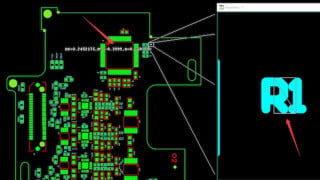
IPB100N12S3 TO-220 or AUIRFSL4010 TO-247 AC Device in parallel since I wanted to keep the voltages on the lower side and wanted to keep the parts cost lower.Screenshot (230).png

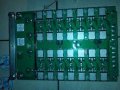
I have seen something like this in Tesla Car Inverter.

download.jpg
 

Attachments

Thread Starter

Dragonoid

Joined Nov 27, 2017
64
One Idea I was toying with for the many-small-transistor concept was a radial arrangement instead of linear (picture a tuna can shaped heat sink), and/or using star-connected equal length wires instead of busbar for transistor leads connecting to input/output lugs. I decided against it as I wasn't confident it would work and it was tedious, a large investment in time. So I bought the giant MOSFET and giant diode. Then life got in the way, I didn't have time to finish, it's the death sentence of at least half my projects. Still have those components around the shop somewhere, haven't seen them in a while.
Star Topology would definitively be a great idea. Let me try to trace the power stage on the board with new calculations and thicker busbar.
 

Ian0

Joined Aug 7, 2020
13,131
Once the gate voltage is high enough for the transistor to be fully "on", it just looks like RdsON, so for a row of MOSFETs, if the Drain busbar is fed from the left and the source busbar from the right, the current flow should be equal through each device. RdsON also increases with temperature, which will tend to even it out.
If the transistor is not fully on, then Vgs(th) decreases with temperature, the warmer ones will hog the current, and blow up.
 

Irving

Joined Jan 30, 2016
5,119
Once the gate voltage is high enough for the transistor to be fully "on", it just looks like RdsON, so for a row of MOSFETs, if the Drain busbar is fed from the left and the source busbar from the right, the current flow should be equal through each device. RdsON also increases with temperature, which will tend to even it out.
If the transistor is not fully on, then Vgs(th) decreases with temperature, the warmer ones will hog the current, and blow up.
Here's a selection of app notes on paralleling MOSFETs. Its more than just current, its about gate drive characteristics, parasitic oscillation (a known killer), layout, etc.
 

Attachments

Irving

Joined Jan 30, 2016
5,119
Wow @strantor this is really very practical and to the point knowledge that you have provided, I was considering using
IPB100N12S3 TO-220 or AUIRFSL4010 TO-247 AC Device in parallel since I wanted to keep the voltages on the lower side and wanted to keep the parts cost lower.View attachment 238343
So how many of each were you thinking of?

Also, in addition to the App notes I posted, watch this video (and others on this channel):
 

strantor

Joined Oct 3, 2010
6,875
I have seen something like this in Tesla Car Inverter.

View attachment 238346
Keep in mind Tesla cars run at hundreds of volts
Once the gate voltage is high enough for the transistor to be fully "on", it just looks like RdsON, so for a row of MOSFETs, if the Drain busbar is fed from the left and the source busbar from the right, the current flow should be equal through each device.
Very interesting. I've never heard that or considered it, but it makes sense...

Looking at pictures of failed controllers (ex), all of the ones I've seen had all busbars coming out the same end of the controller, so not compliant with your guidance, and also maybe failed as a result.
 

Ian0

Joined Aug 7, 2020
13,131
Keep in mind Tesla cars run at hundreds of volts

Very interesting. I've never heard that or considered it, but it makes sense...

Looking at pictures of failed controllers (ex), all of the ones I've seen had all busbars coming out the same end of the controller, so not compliant with your guidance, and also maybe failed as a result.
It's not from MOSFET guidance, it's from guidance about paralleling batteries, but it makes sense for MOSFETs too.
 

Ian0

Joined Aug 7, 2020
13,131
Here's a selection of app notes on paralleling MOSFETs. Its more than just current, its about gate drive characteristics, parasitic oscillation (a known killer), layout, etc.
Agreed - there are two separate areas of bad design that can blow up your MOSFET! One at the switching transient, and one whilst turned on. Which one is prevalent depends on the switching frequency.
Come to think of it there might even be three areas - I suppose you could blow them up whilst they are switched off as well.
 

schmitt trigger

Joined Jul 12, 2010
2,088
I wish I could show you what my company is doing, but that would violate the NDA policy I signed.
But suffice to say that is not only the power silicon devices which require careful attention: the capacitors (snubber, filter, bypass) are critical. The ripple currents much self heating and failures.
My company actually invested money in a film capacitor company to ensure the capacitors were designed, built and tested to very specific requirements.
Of course for a given power rating, the currents decrease with increasing voltage.
That is the reason that my 2005 Honda Civic Hybrid had a 10kW electrical motor sourced from 144 volts.
Attempting to get 30kW from only 60 volts? For your very first design? Plainly difficult.
 

BobaMosfet

Joined Jul 1, 2009
2,211
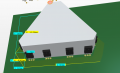
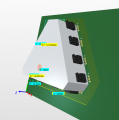
I have just Placed the components to get a feel of room available for the Components. The PCB Traces used are exposed copper with 10mmX 10mm Bus Bar soldered upon it to carry the current.
I am working in the heatsink and space constraints as well, Actually, I will be using a T Type Heating that will be connected with the chassis on the Controller it self ( Aluminium block with CNC cut fins)
I recommend TRAN-TEC for heatsinks:
Code:
+-----------+------------------------------------+
| oem_name_ | oem_weburi_                        |
+-----------+------------------------------------+
| TRAN-TEC  | https://www.tran-tec.com/index.php |
+-----------+------------------------------------+
Your board placement is going to depend largely on heat-sink and fans because you MUST manage derating if you hope to get anywhere near what you're expecting from those IC packages based on their thermal-junction limits.
 

Thread Starter

Dragonoid

Joined Nov 27, 2017
64
So how many of each were you thinking of?

Also, in addition to the App notes I posted, watch this video (and others on this channel):
Thanks for the video, I will watch the video after some time and I was thinking of using 4 MOSFETs in 1 phase so a total of 12 Mosfet for 3 Phase would be incorporated.
 
Last edited:

Irving

Joined Jan 30, 2016
5,119
Thanks for the video, I will watch the video after some time and I was thinking of using 4 MOSFETs in 1 phase so a total of 12 Mosfet for 3 Phase would be incorporated.
Working with 30kW from 60v & assuming thats 30kW input to the motor, the phase current is going to be 30000/(sqr(3)*60) = 290A approx. Allowing a safety margin of 20% thats 350A so for TO220 you need a minimum of 5, preferably 6 devices based purely on TO220 pin current limits. The TO247 is the better option, 4 will be acceptable.

350A over 4 devices is 87.5A/device. A very rough calculation, assuming 50KHz switching frequency, gives approx 60W switching and conduction losses per device. 12 devices on a single heat-sink at 30C ambient requires a heat-sink with a thermal resistance better than 0.14K/W @ 720W so thats likely to be a fairly chunky fan cooled job. I'd suggest the high-power pin fan sinks from coolinnovations.com, much more effective than an extruded fin.

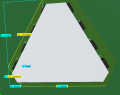
Your idea of putting the 4 devices in a row on one side of a triangular heatsink is pretty but is a poor layout... look at the ideas in the app note AN11599 above.
 

Thread Starter

Dragonoid

Joined Nov 27, 2017
64
Working with 30kW from 60v & assuming that's 30kW input to the motor, the phase current is going to be 30000/(sqr(3)*60) = 290A approx. Allowing a safety margin of 20% that's 350A so for TO220 you need a minimum of 5, preferably 6 devices based purely on TO220 pin current limits. The TO247 is the better option, 4 will be acceptable.

350A over 4 devices is 87.5A/device. A very rough calculation, assuming 50KHz switching frequency, gives approx 60W switching and conduction losses per device. 12 devices on a single heat-sink at 30C ambient requires a heat-sink with a thermal resistance better than 0.14K/W @ 720W so that's likely to be a fairly chunky fan-cooled job. I'd suggest the high-power pin fan sinks from coolinnovations.com, much more effective than an extruded fin.

Your idea of putting the 4 devices in a row on one side of a triangular heatsink is pretty but is a poor layout... look at the ideas in the app note AN11599 above.
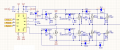
So that means I have to use top side with 4 Mosfet and Lower with 4 as shown in Schematic
ID of mosfet @ 100 =121A So for 350 Amp it is 3 /4 mosfet for 350 Amp or
2 Mosfet high side and 2 Mosfet low side, I am a bit confused.
Screenshot (239).png
 

Irving

Joined Jan 30, 2016
5,119
Ah my bad, its 4 devices for the phase current, so 8 per half bridge, 4 top, 4 bottom x 3 phases = 24 devices @ 60W per device = 1.5kW switching losses approx (5% isn't bad) so you'll need a heat-sink of better than 0.07K/W @ 1440W if all devices are on one sink. You'd be better off using 3 sinks, one per phase, which only need to be 0.21K/W @ 480W, a much easier call.
 
Top